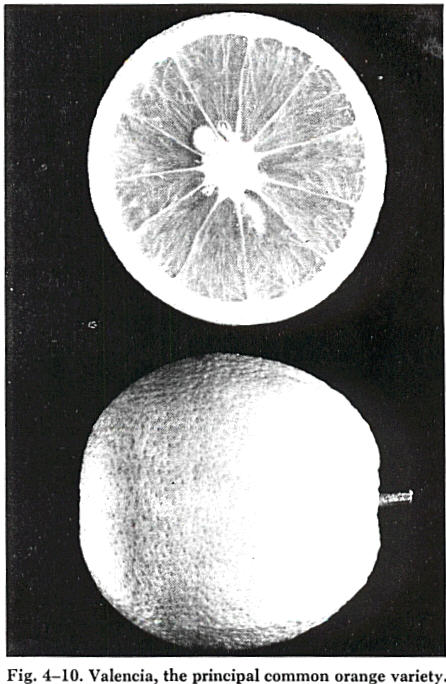
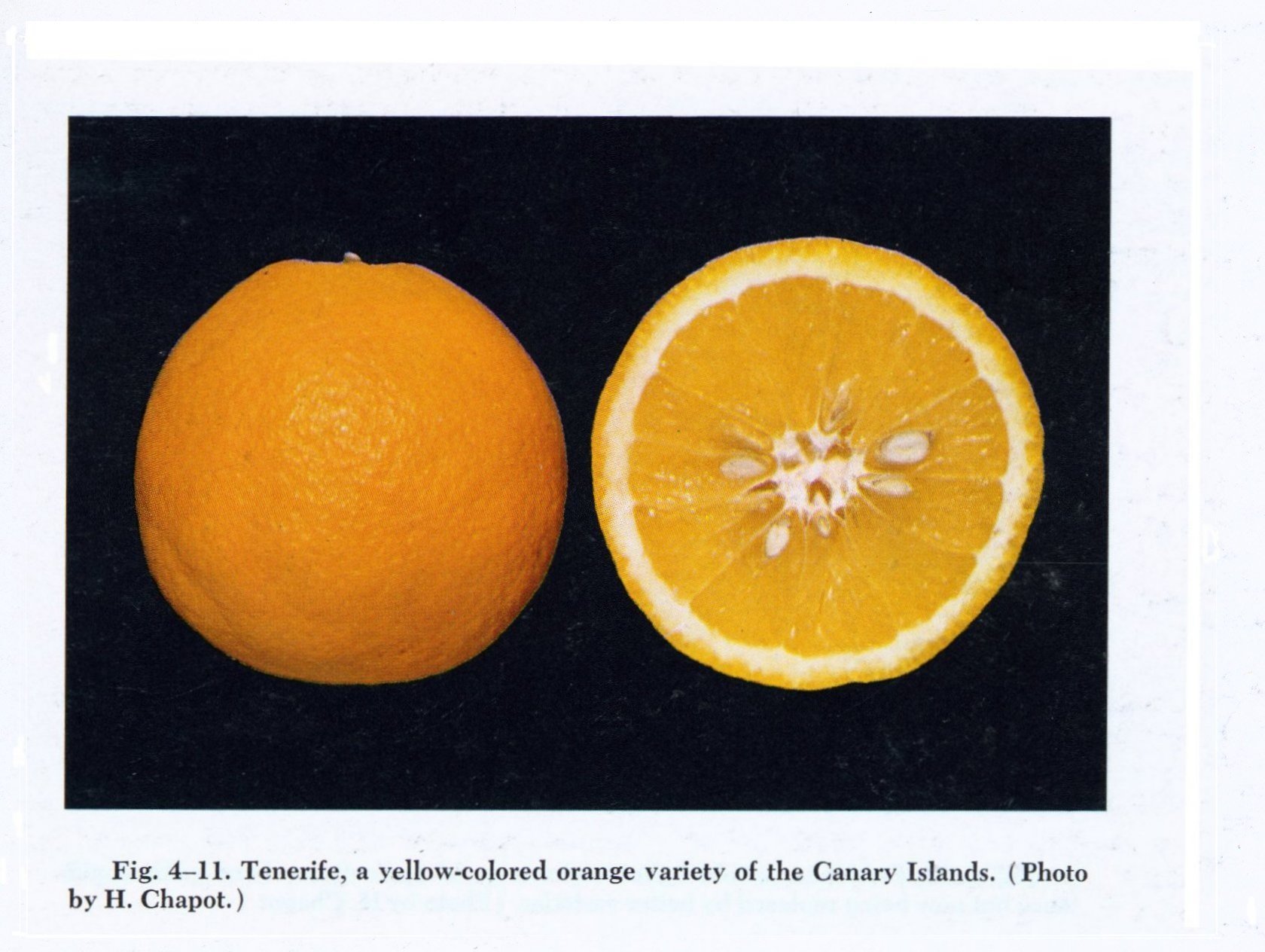
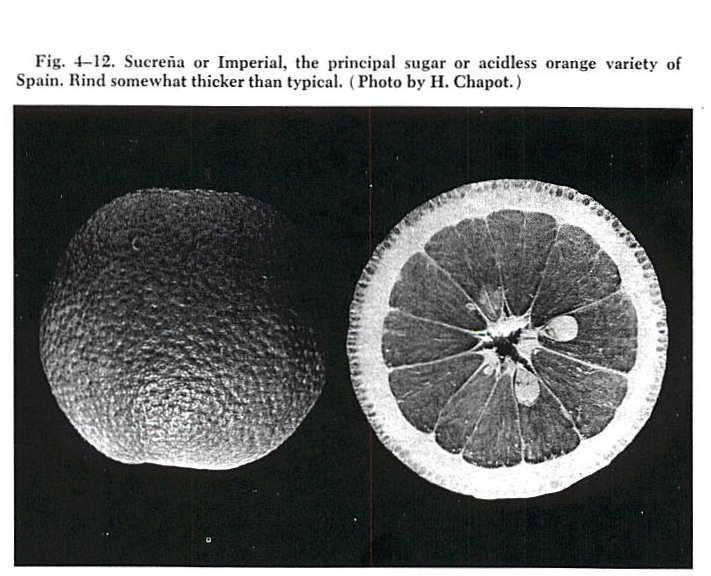
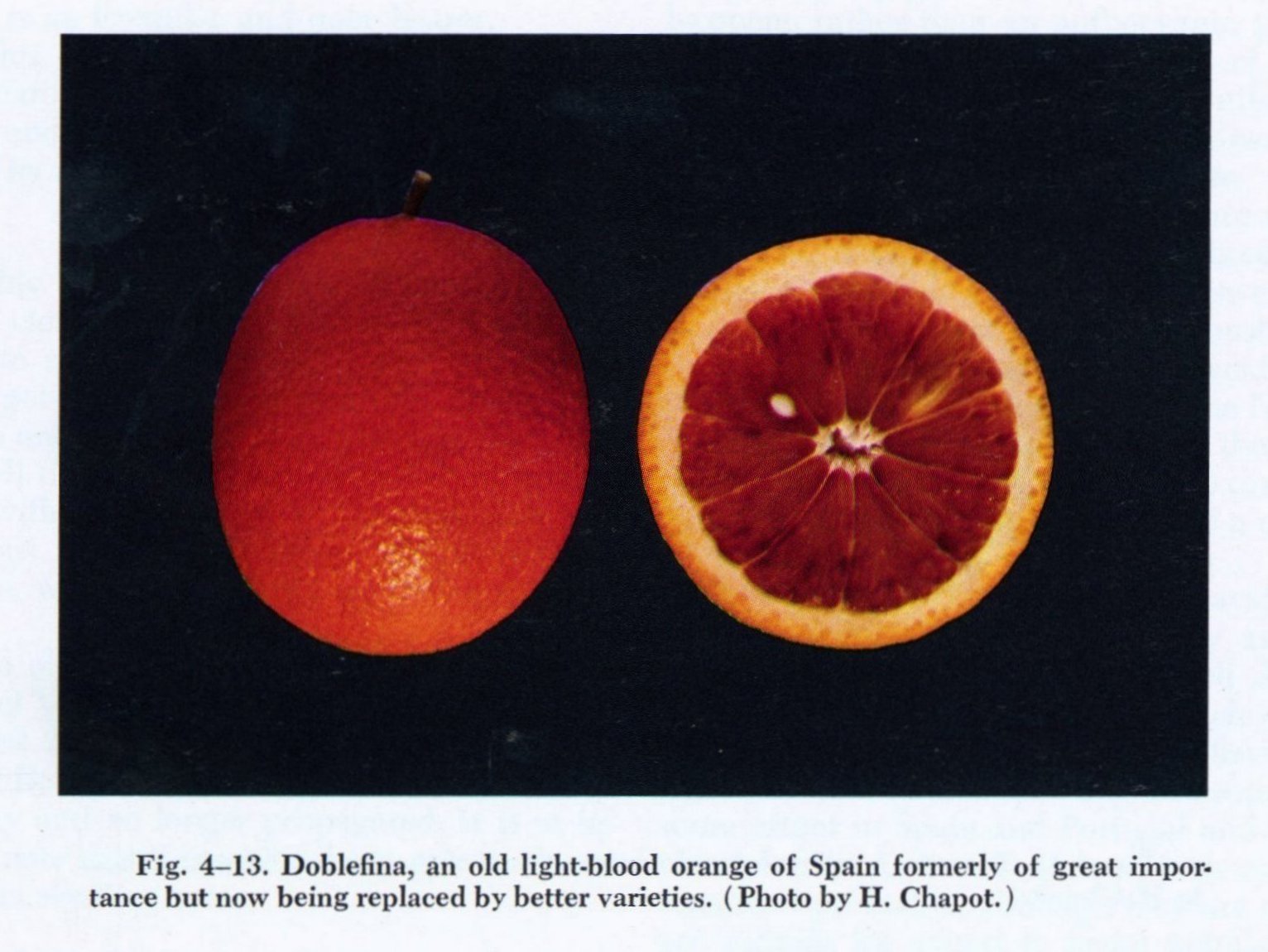
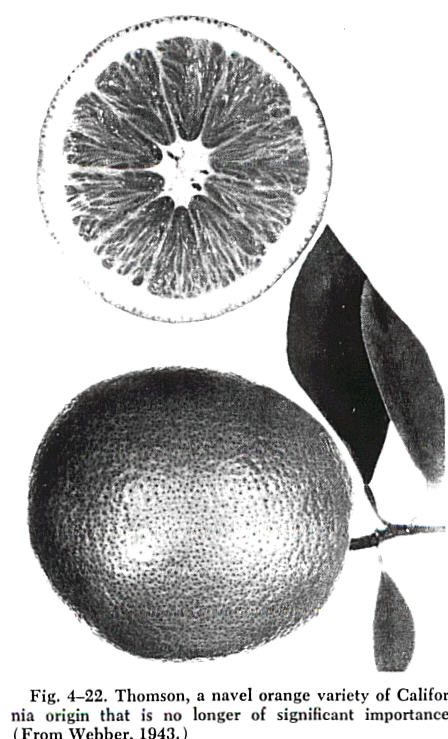
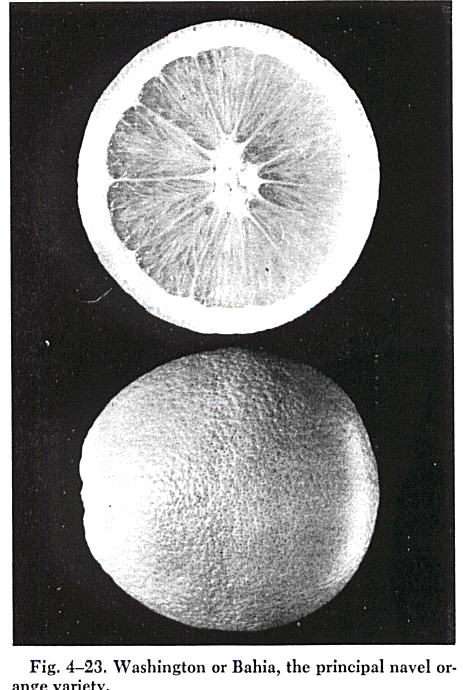
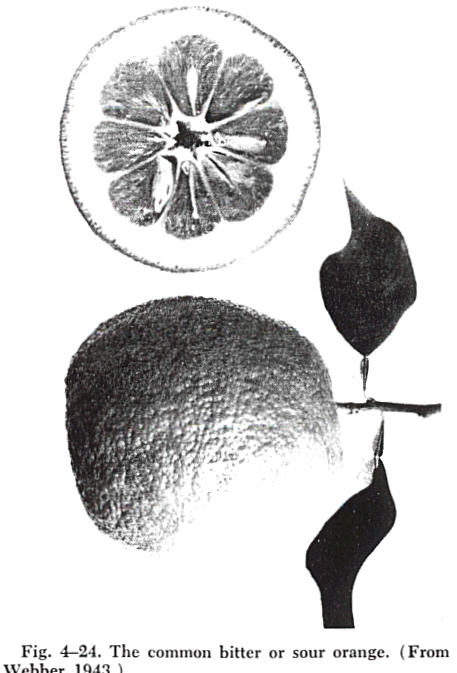
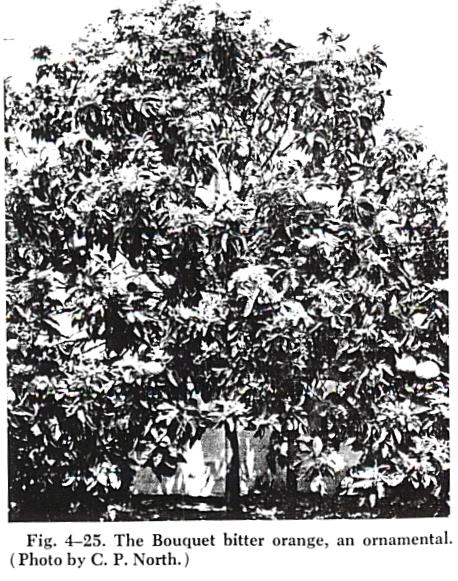
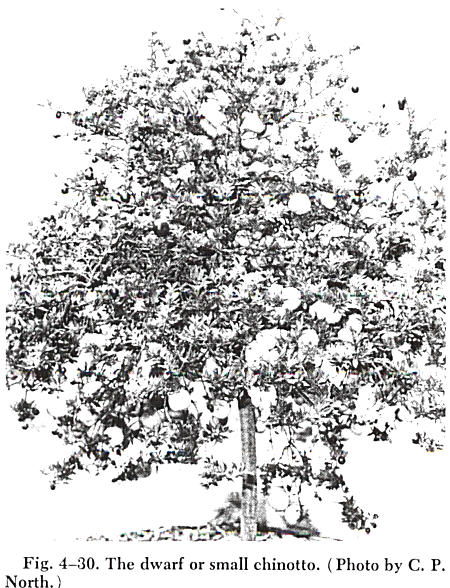
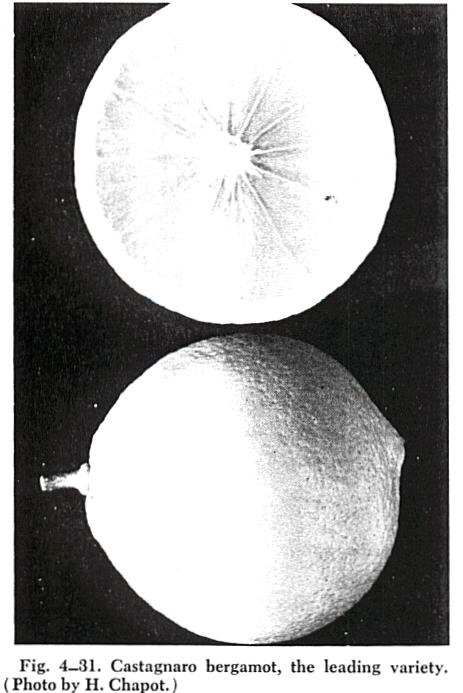
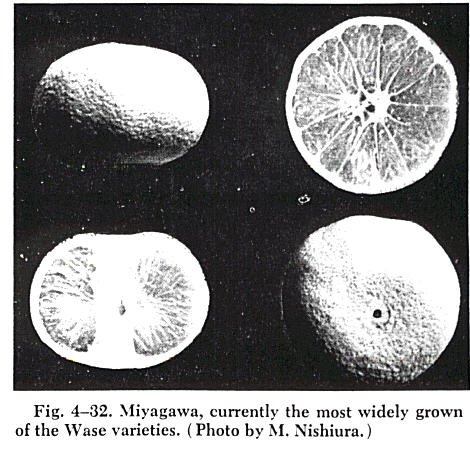
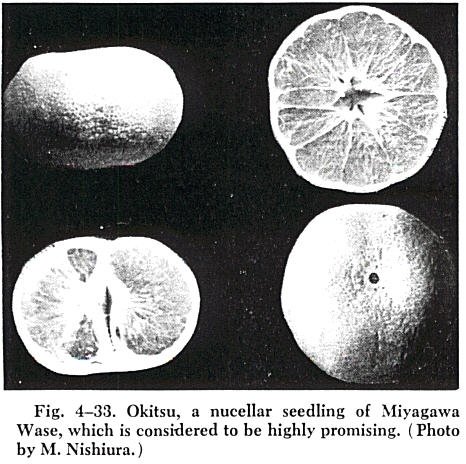
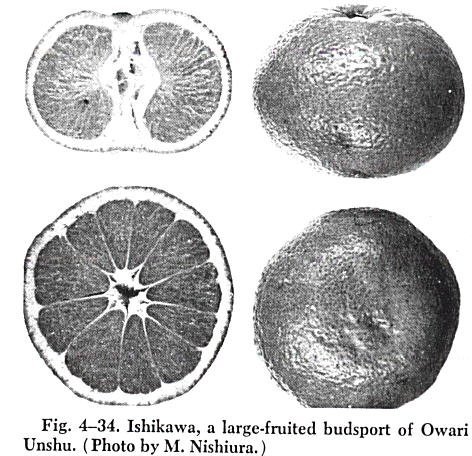
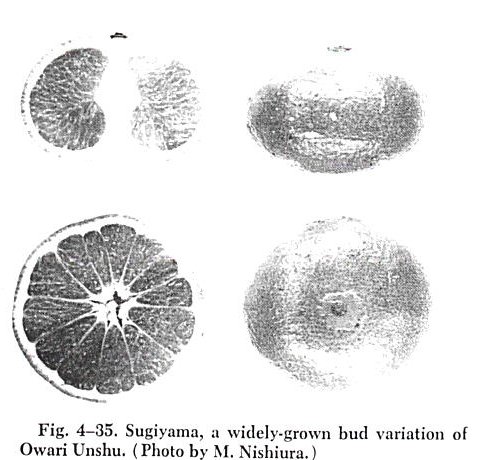
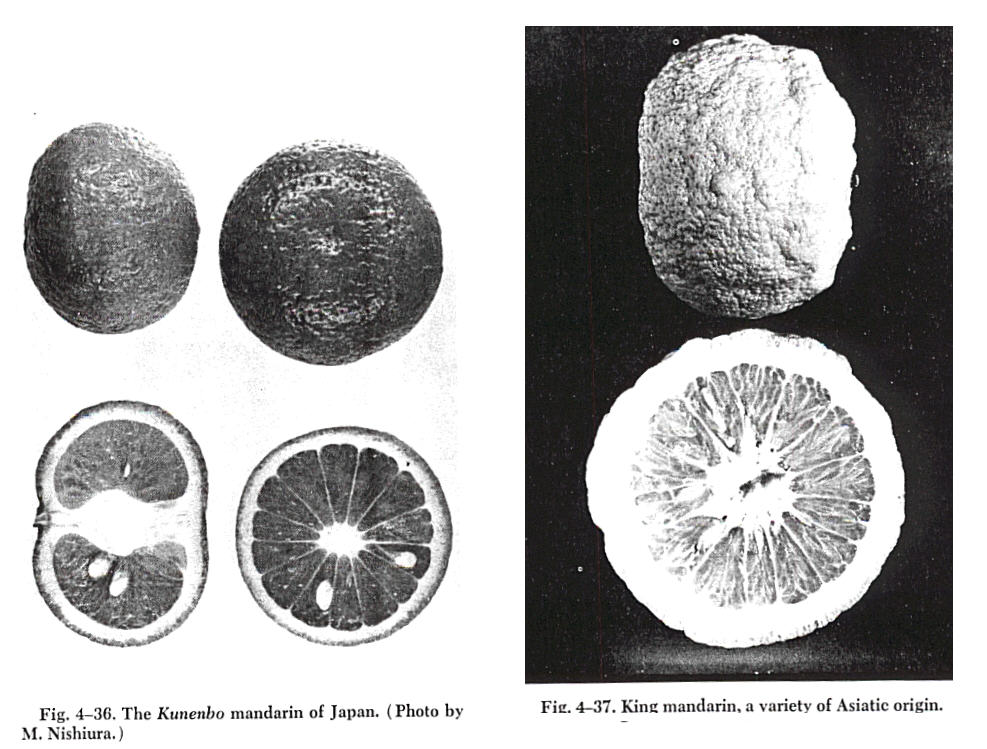
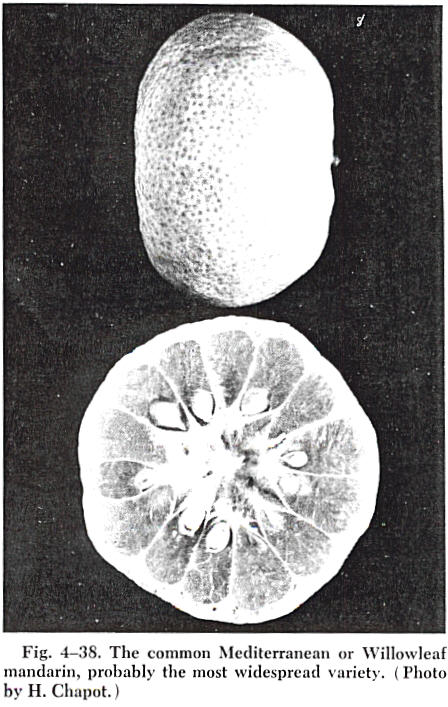
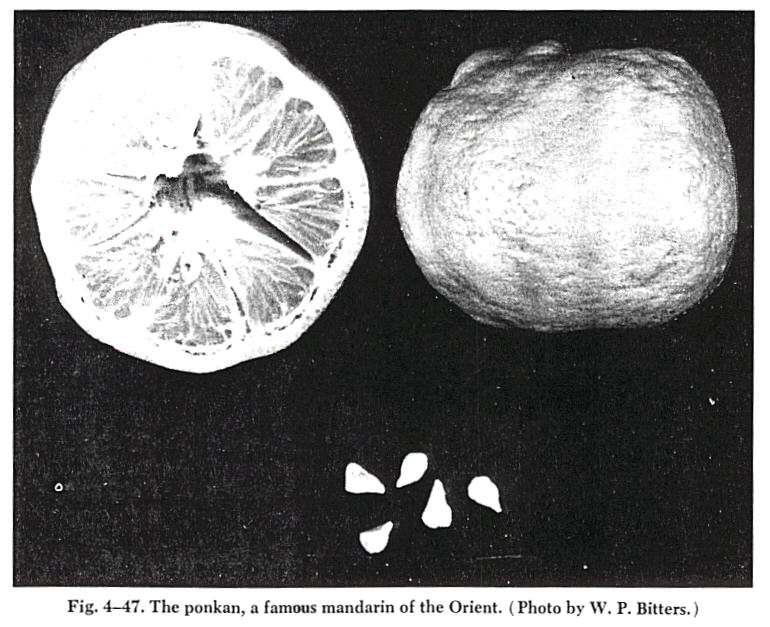
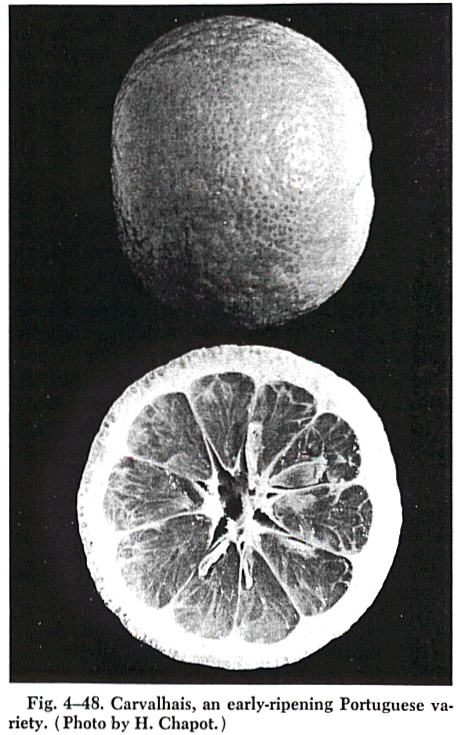
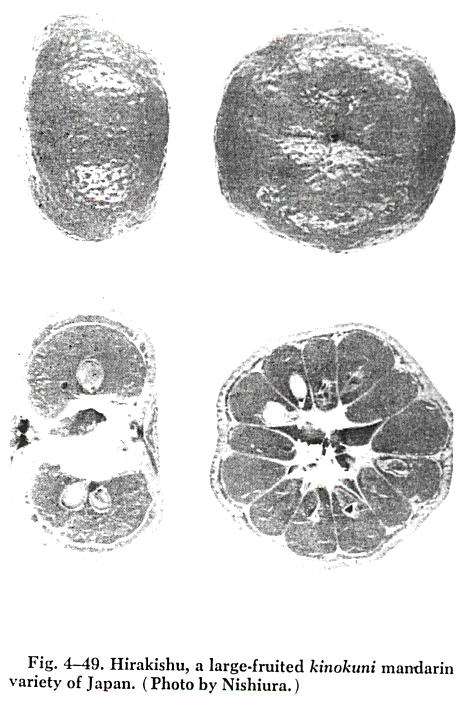
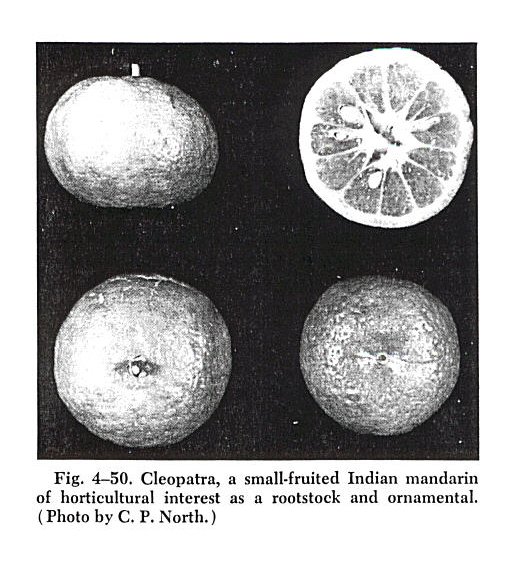
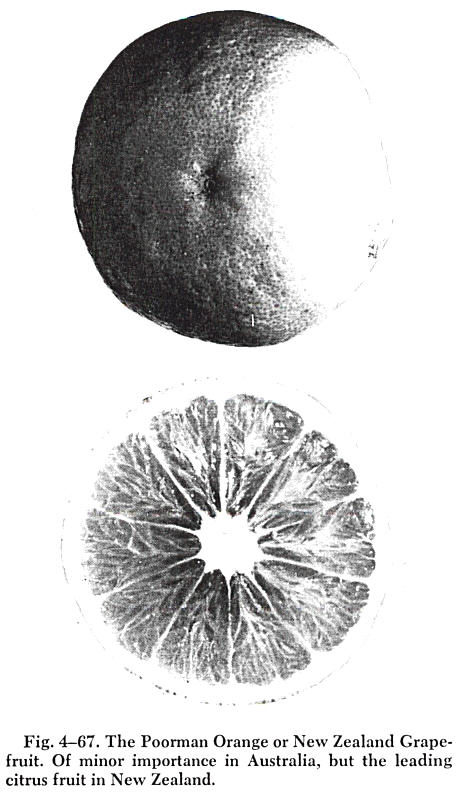
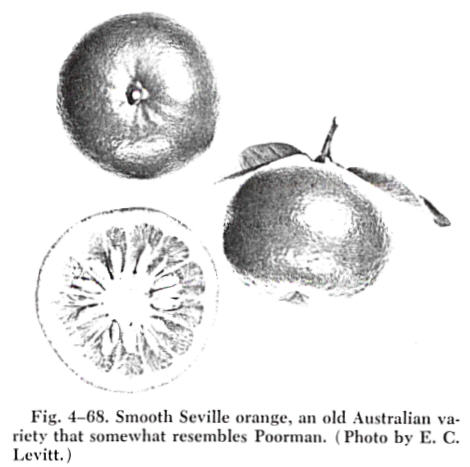
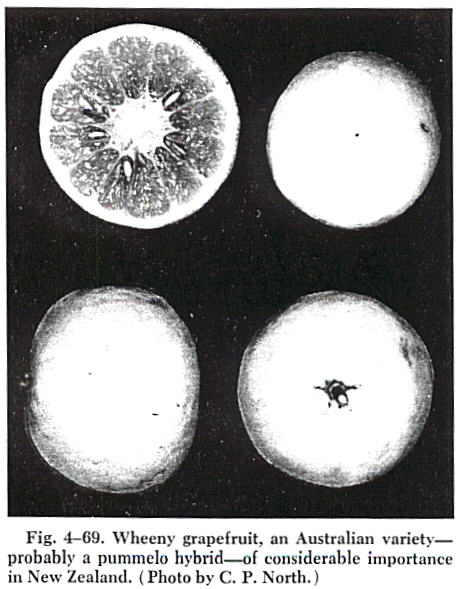
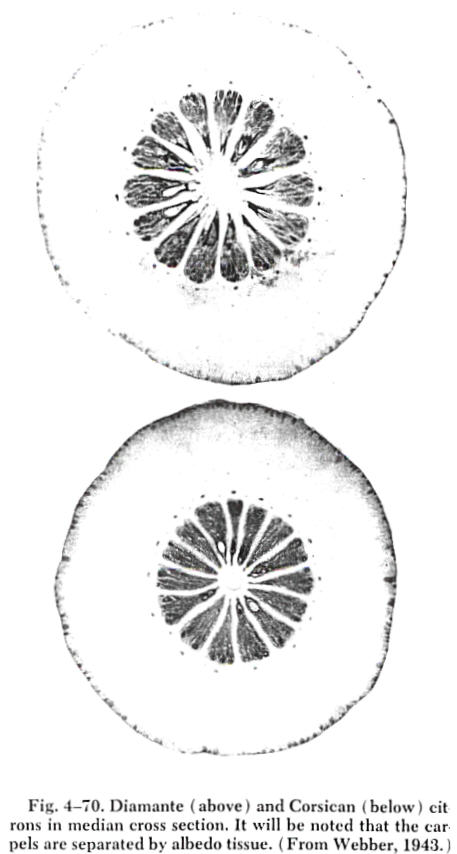
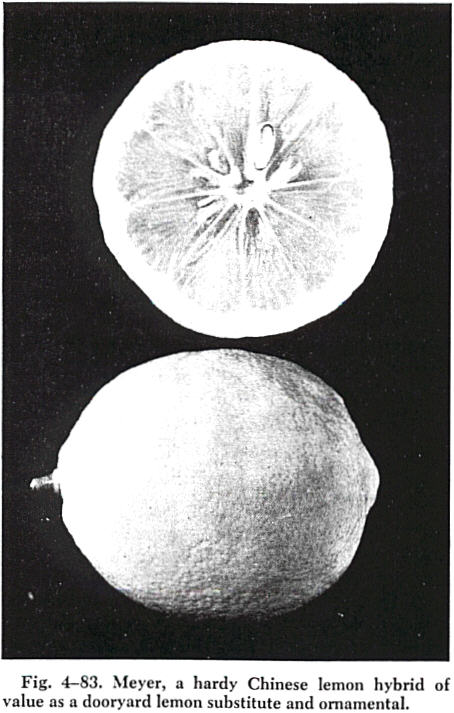
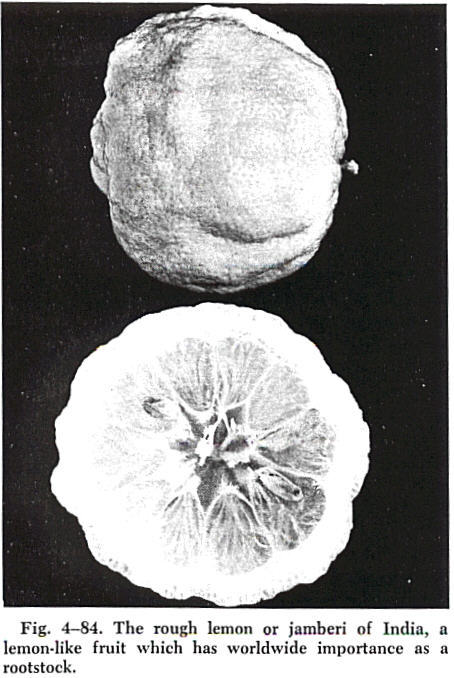
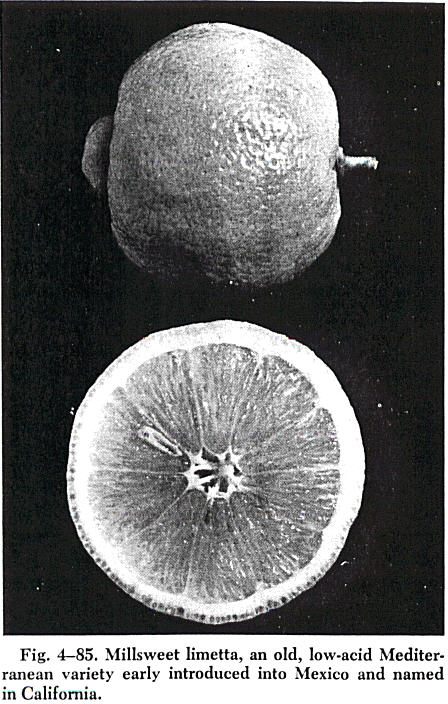
CHAPTER 4
Horticultural Varieties of Citrus
BY ROBERT WILLARD HODGSON
HORTICULTURAL CLASSIFICATION
In general appearance and
other respects, the citrus fruits of principal commercial importance fall into
four, reasonably-well-defined horticultural groups: the oranges, the mandarins,
the pummelos and grapefruits, and the common acid members. The
common acid group includes three subgroups—the citrons,
lemons, and limes. While the writer's competence does not extend
to all the citrus fruits that have horticultural importance, the considerable
number with which he is acquainted all exhibit horticultural resemblances with
one or more of these groups and subgroups that suggest some degree of
relationship. In most instances, it is not difficult to determine
the group of closest resemblance and probable or possible
relationship. Therefore, in this treatment, for each of the natural
groups presented there is a subsection covering fruits of horticultural
importance that most closely resemble the group in question. In
some instances, however, lack of first-hand acquaintance with a fruit has
necessitated provisional placement.
In
addition to the fruit groups mentioned above, all of which belong to the genus
Citrus, there are the kumquats, which belong to the closely related genus
Fortunella, and the so-called but much more distantly related trifoliate
orange, Poncirus trifoliata (L.) Raf. The kumquats comprise a
group of considerable importance for their fruits. The trifoliate
orange, together with its hybrids, is of significance as a
rootstock.
The Oranges.—The principal
members of the orange group are the sweet orange and the bitter orange, which
though similar in many respects have important differences.
Four kinds of
sweet oranges are recognized:
1. The common
orange (blond orange of the Mediterranean), which is much the most important of
the four and contains a large number of
varieties.
2. The sugar or acidless
orange, which is of minor importance and so lacking in acid that it is insipid
in flavor.
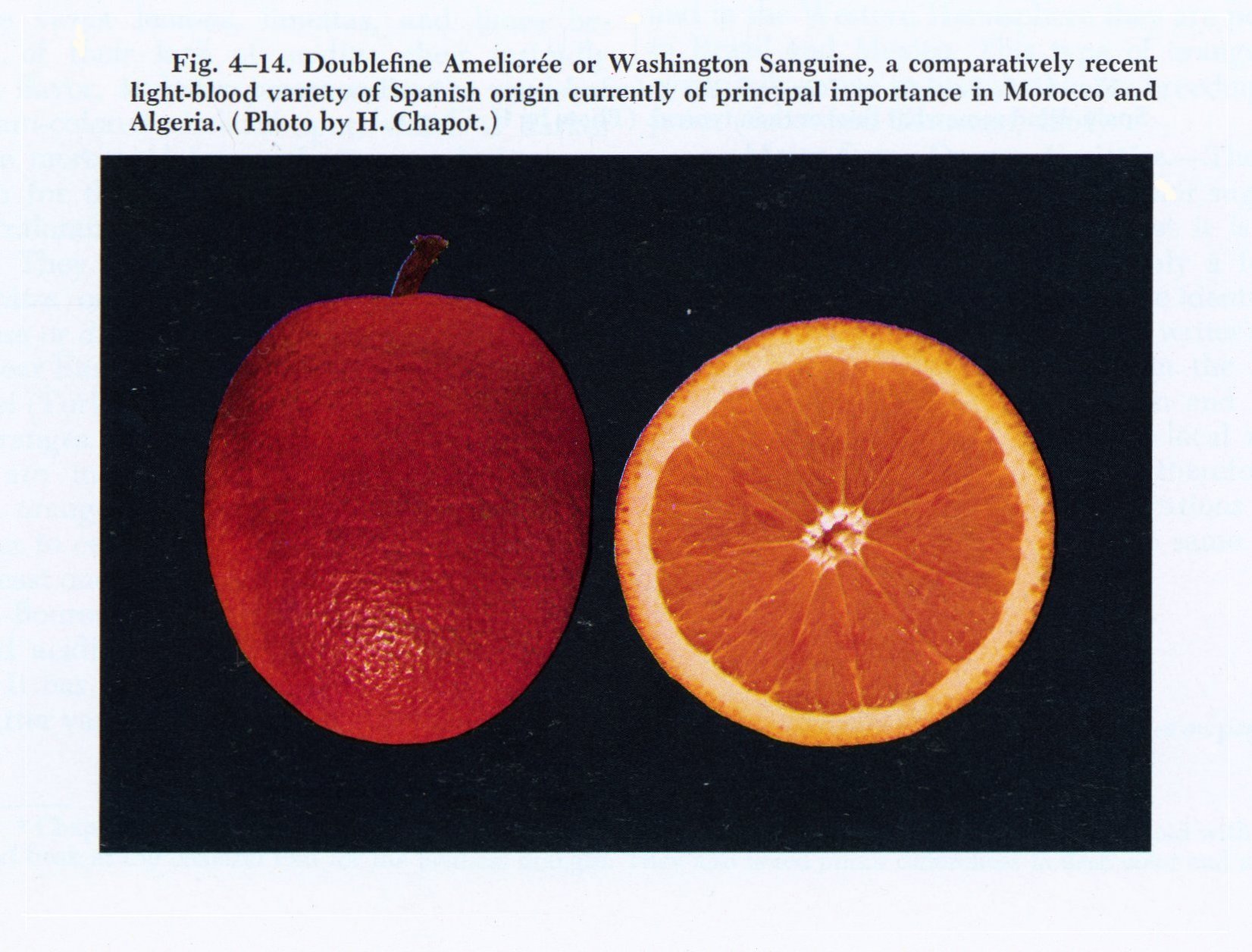
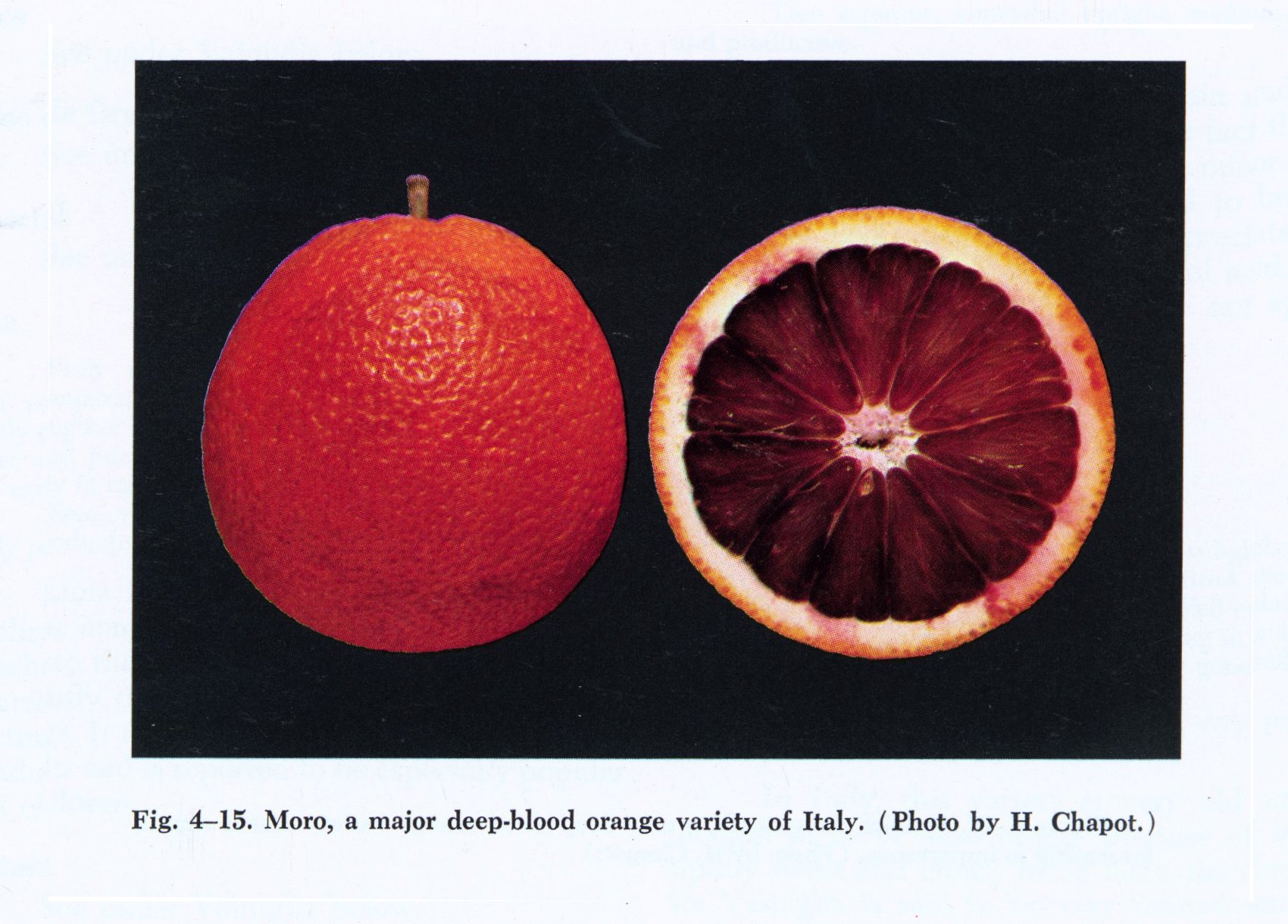
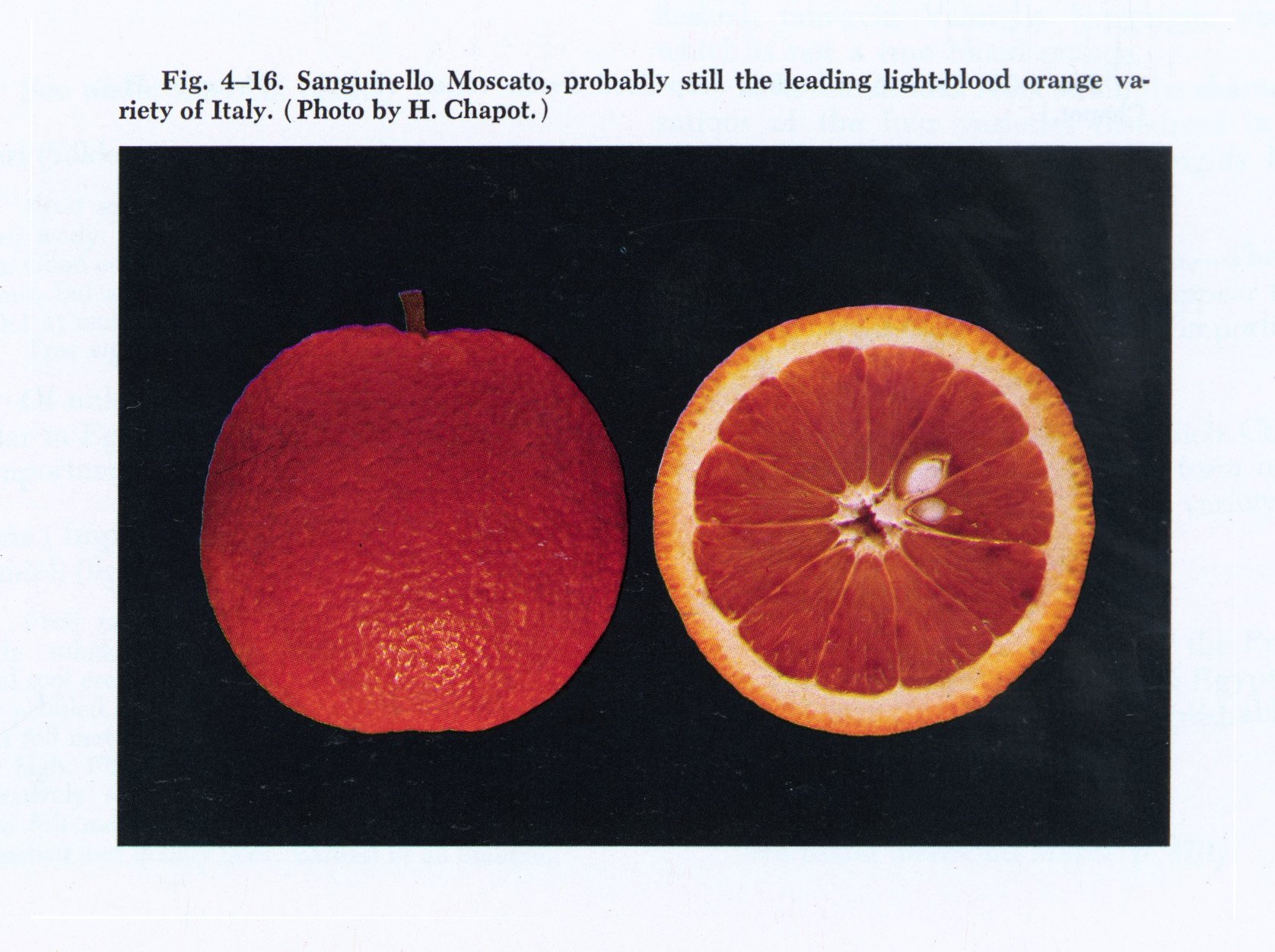
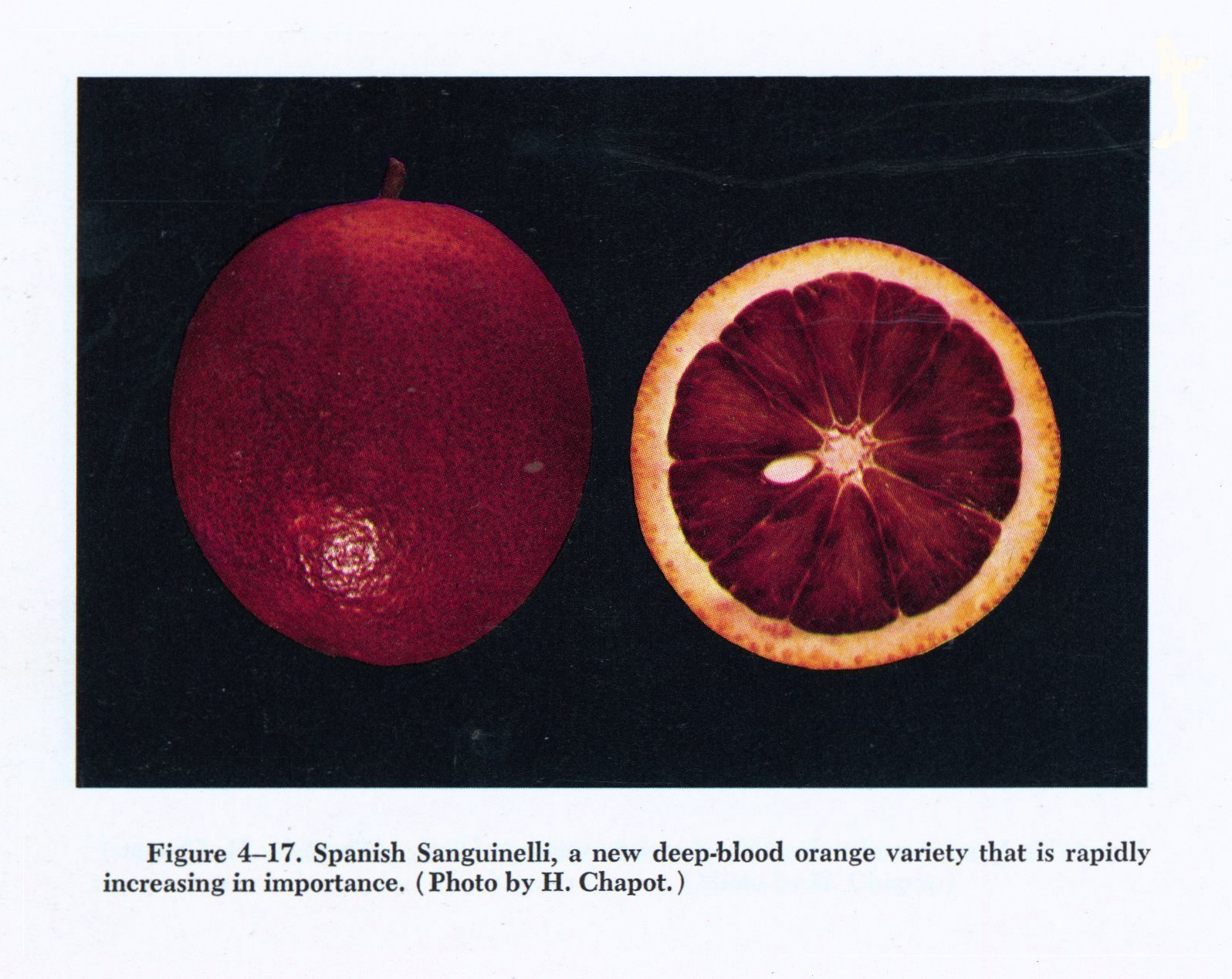
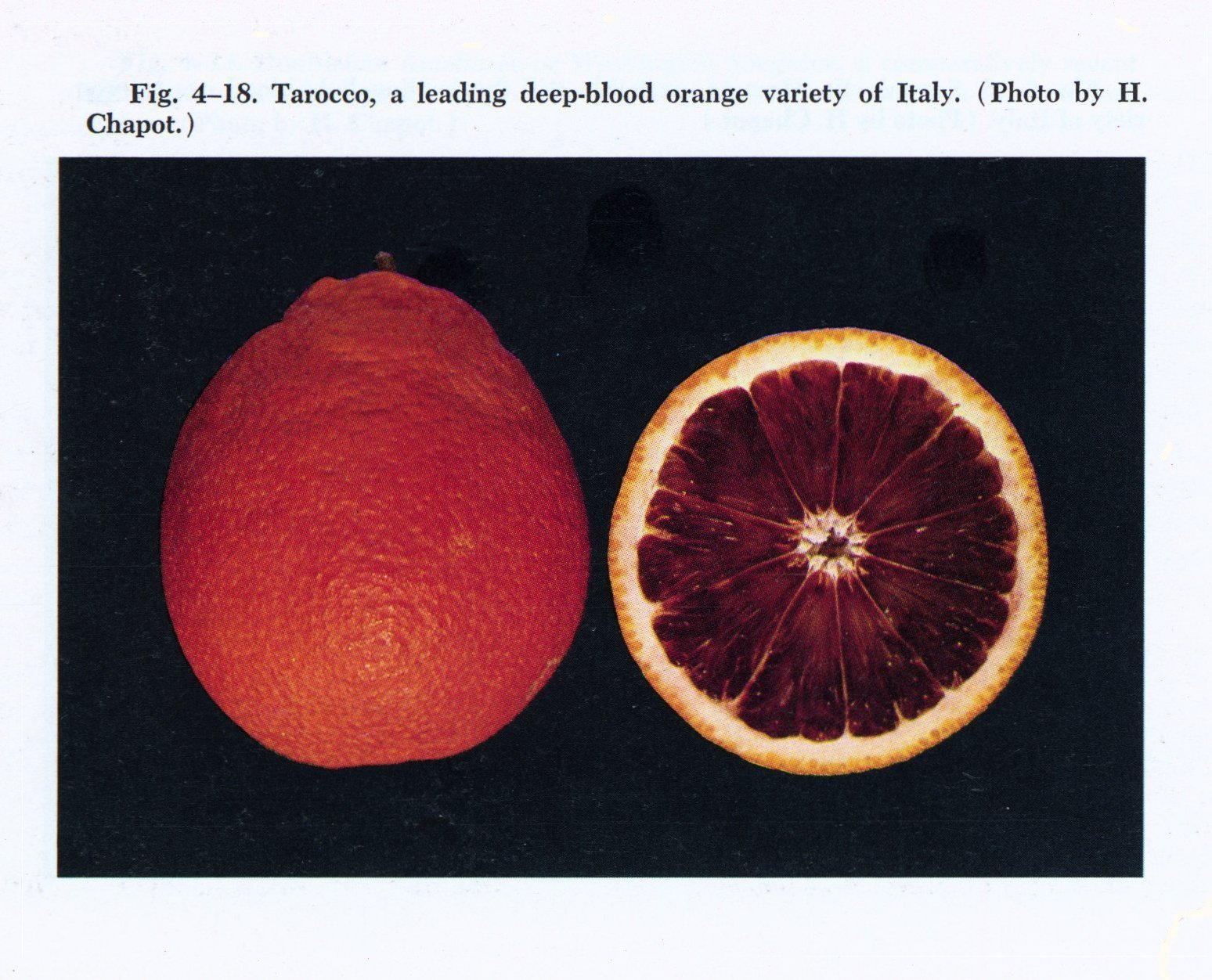
3. The pigmented or blood
orange, which is of considerable importance in Europe and includes two
categories: (a) the light blood oranges; and (b) the deep blood
oranges.
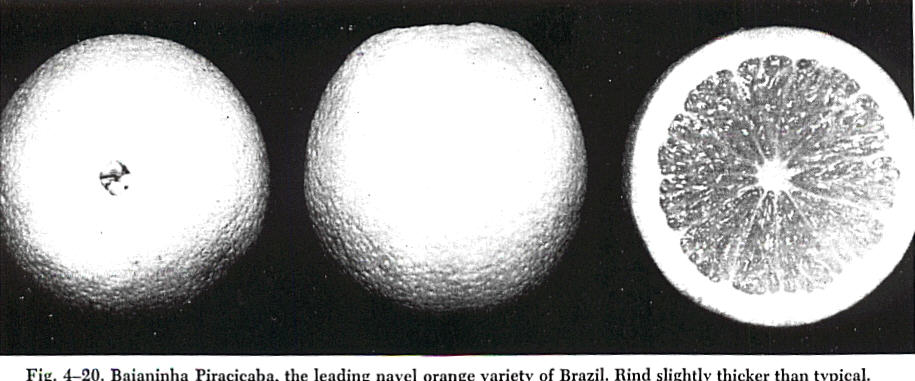
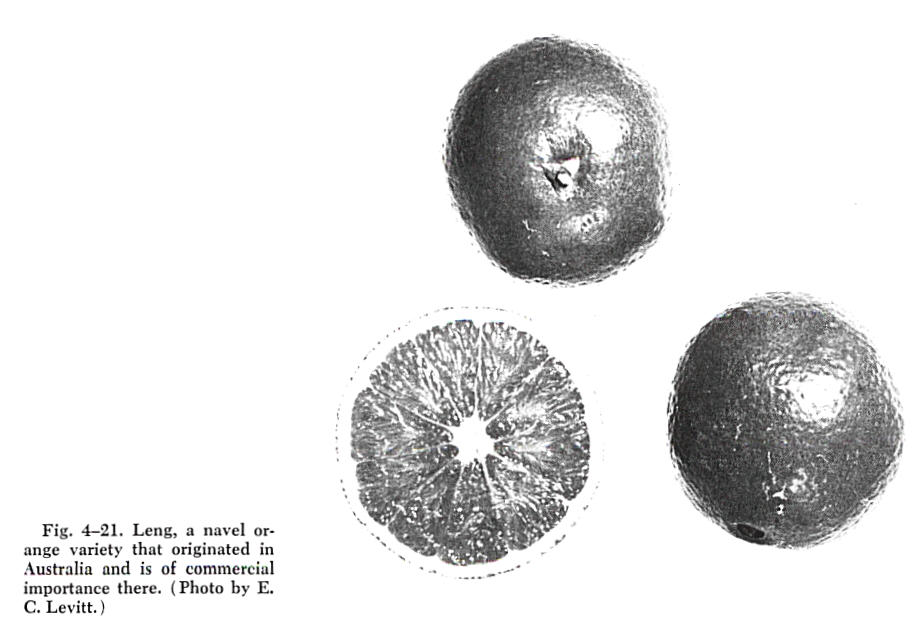
4. The navel orange, which is of
great importance and represented mainly by the Washington navel
variety.
The following three kinds of fruit
are recognized among the bitter or sour oranges
proper:
1. The common bitter or sour orange
that is used principally as a rootstock and for the preparation of
marmalade.
2. The bittersweet orange, the
fruit of which is similar to the common bitter orange but less
acid.
3. The variant bitter oranges, grown
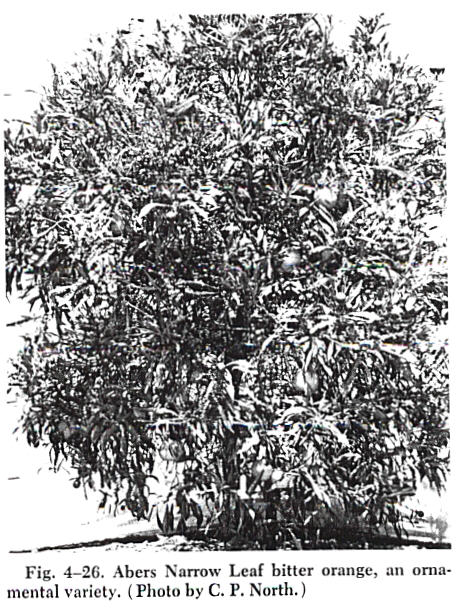
primarily as ornamentals and for the flowers, from which neroli oil is
extracted.
Mediterranean fruits of
horticultural importance that are obviously closely related to the bitter
orange include:
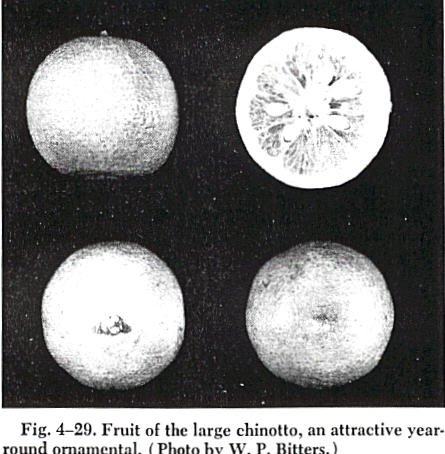
1. The myrtle-leaf orange or
chinotto, grown mostly as an ornamental.
2.
The bergamot, grown primarily for its distinctive rind oil that constitutes the
base of cologne water and has other perfumery
uses.
Oriental fruits that more closely
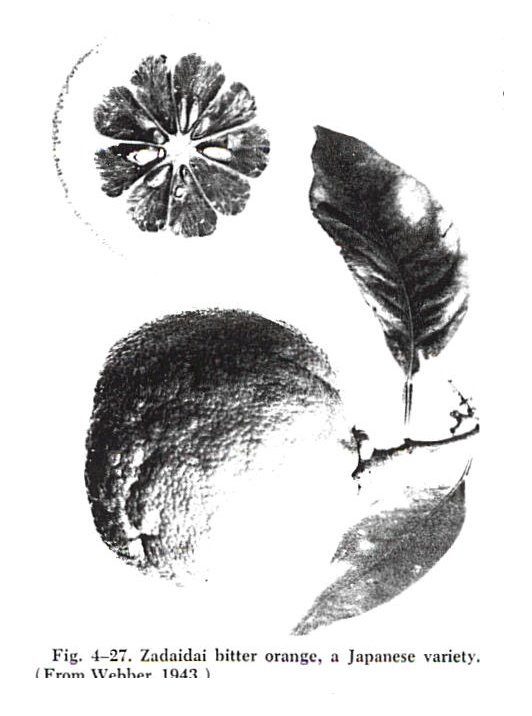
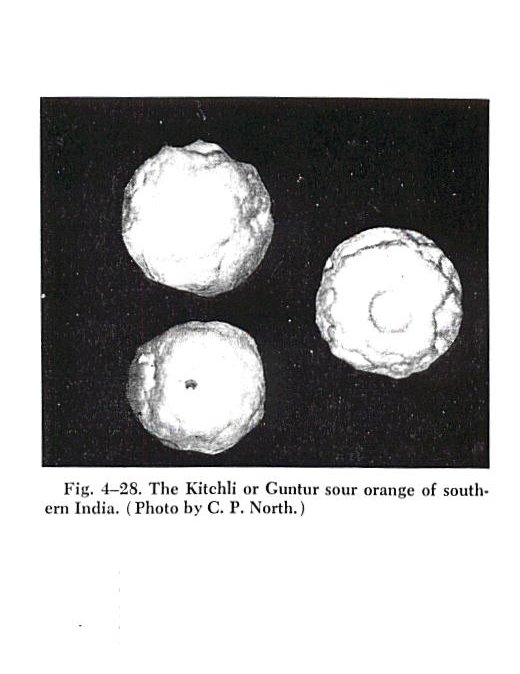
resemble the bitter orange than any other include the Naruto and Sanbô
of Japan, the Kitchli of India, and the Nanshôdaidai of
Taiwan.
The Mandarins.—Because of the
remarkable diversity of the mandarins and the writer's lack of first-hand
knowledge of many of the Oriental members, considerable difficulty was
experienced in developing a satisfactory horticultural classification for this
group. In this treatment, therefore, the mandarins are presented in
the following classes:
1. The satsuma
mandarins (Citrus unshiu Marcovitch), which are of great
importance in Japan and consist of many
varieties.
2. The King mandarins (Citrus
nobilis Loureiro), which have considerable importance in southeast Asia but
contain few varieties.
3. The Mediterranean
mandarin (Citrus deliciosa Tenore), which is of principal importance in
the Mediterranean basin.
4. The common
mandarins (Citrus reticulata Blanco), which have worldwide importance and
are represented by numerous varieties.
5. The
small-fruited mandarins, which are of considerable importance in the Orient and
consist of many varieties.
The mandarin-like
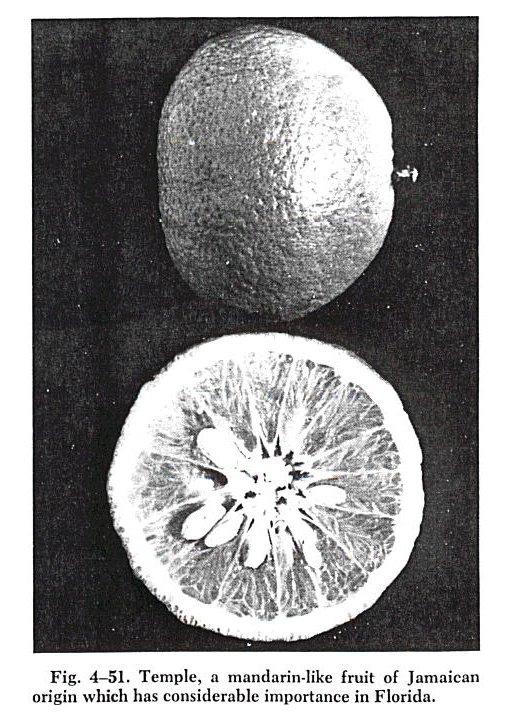
fruits include the synthetic tangors; the so-called natural tangor, Temple;
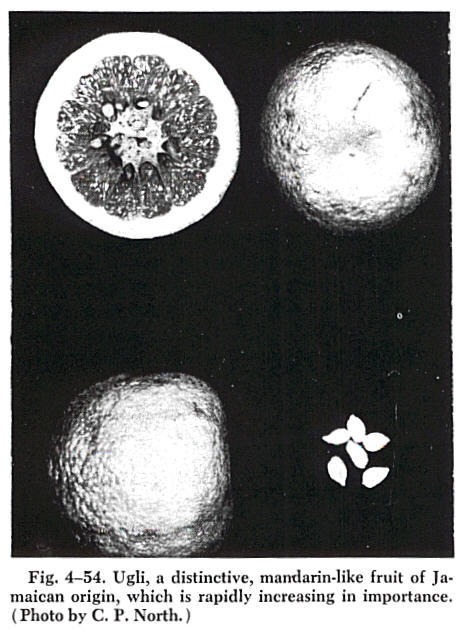
many of the synthetic tangelos; the so-called natural tangelo, Ugli; and the
Calamondin and Rangpur of the Orient, the latter of which includes
the varieties Kusaie and Otaheite.
The
Pummelos and Grapefruits.—While similar in many respects and overlapping in
certain characters, horticulturally the pummelos and grapefruits comprise
separate classes, each of which consists of both non-pigmented and pigmented
varieties. Additionally, the pummelos contain both common acid and
acidless or sweet varieties.
Fruits that more
resemble the grapefruit or pummelo than any other include a number of synthetic
tangelos; the so-called natural orangelo, Chironja of Puerto Rico; the
Poorman, Smooth Seville, and Wheeny grapefruit of Australia; and the
Natsudaidai, Hassaku, Banokan, Hyuganatsu, Kinkôji, and
Kinukawa of Japan; and the Attani of
India.
The Citrons.—The citrons, like
the other members of the common acid group, fall into two classes—the acid and
the sweet—each of which contains several
varieties.
Fruits more resembling the
citron than any other include the so-called Cuban shaddock and Ponderosa lemon,
the lumias of the Mediterranean, and the giant-fruited citrons of
India.
The Lemons.—The lemons, like the
citrons, consist of the common or acid varieties,which are numerous and
important, and the comparatively few and minor sweet or acidless
varieties.
Of the fruits that most closely
resemble the lemons, those of principal horticultural importance are the
limettas of the Mediterranean, the jamberi or rough lemon, the
galgal and karna of India, and the so-called Meyer lemon of
China.
The Limes.—Like the citrons and
lemons, the limes include both acid and sweet varieties,but in addition
the sour limes consist of two kinds—the small-fruited Indian, West Indian, or
Mexican lime and the large-fruited Tahiti or Persian lime, both of which have
very few varieties.
The lime-like fruits of
principal horticultural importance include the synthetic lemonime, Perrine;
several so-called lemons in India that appear to be natural lemonimes; and the
bigeneric limequats (lime X kumquat), of which there are a few lime-like
varieties.
The Kumquats.—The principal
fruits of horticultural importance or interest of the genus Fortunella
are several kinds or varieties of the kumquat, the bigeneric, so-called
orangequat, and the trigeneric citrangequats, of which there are a few
varieties.
The Trifoliate Orange.—Of
the genus Poncirus, the trifoliate orange and some of its bigeneric
hybrids—notably the citranges—are important primarily for their value as
rootstocks. A few of the citranges also approach
edibility.
THE NATURE AND CONSTANCY OF CHARACTERS IN
CITRUS
Fruit and Tree Characters
In
addition to the common characters possessed by other fruits, such as size,
shape, color, form of the basal (stem) and apical (stylar) ends, flavor, and
general seed features, the citrus fruits exhibit certain characters associated
with: (1) the anatomy of the distinctive hesperidium fruit; (2) their degree of
parthenocarpy; and (3) their degree of polyembryony. Among the
distinctive anatomical characters are those relating to the rind (flavedo and
albedo) and inclusions (oil glands), the endocarp (fruit segments and juice
vesicles), the central column or axis, and special structures that are or may
be present in the apex (areole, mammilla, navel). Seedlessness
characterizes certain groups and varieties and monoembryony is exhibited by
some.
External Fruit
Characters.—Citrus fruits range in size from very small to very
large. Among the smallest are the kumquats, Calamondin, and some of
the acid limes, the greatest dimension of which may scarcely exceed an inch and
a quarter (3 cm). At the other extreme are the pummelo and citron
which may attain a foot (30 cm) or more in diameter or length. While
the largest of the citrus fruits are pummelos, the heaviest are citrons because
of their much greater rind density. Some citrons attain weights of
10 to 12 pounds (approximately 4,500 to 5,550 grams). Considering
the citrus fruit groups as a whole, generally the oranges are medium-small to
medium in size, the mandarins small to medium, the grapefruits medium-large to
large, the lemons medium-small, the acid limes very small to small, the
pummelos large to very large, and the citrons medium-large to very
large. The size range within each fruit group is variable, however,
and is greatest in the mandarins, pummelos, limes, and oranges, each of which
has varieties of smaller or larger size than the group
average. These are referred to as small-fruited or large-fruited
varieties of each group.
The shapes exhibited
by the citrus fruits (fig. 4-1) range from round through subglobose and oblate to
obovoid on one extreme and from broadly pyriform to ovoid, oblong, elliptical,
and cylindrical on the other. In general, the oranges are round or
slight modifications thereof, the mandarins oblate, the grapefruits and
pummelos subglobose, the lemons elliptical, and the limes oval. The
citrons are highly variable but mostly cylindrical, and some of the pummelos are
pyriform.
Superimposed on the general shape,
and in some cases contributing thereto, are the basal and apical characters
that may be present. These characters may be rounded, flattened, or
depressed in form, the latter form giving rise to a
basin. Likewise, they may be furrowed or ribbed. Other
basal characters that may occur include a neck, shoulder, or
collar. Other apical characters include the areole, which may be so indistinct that it is not evident, a
nipple (mammilla), or a navel. The neck character seems to occur
oftenest in the lemons and mandarins and the navel most often in the oranges
and mandarins. The mammilla appears to be confined largely to the
limes, lemons, and citrons. In a few fruits, notably some of the
citrons and the bergamot, a certain percentage of the fruits retain the
style.
The smoothness of the rind surface,
which is highly variable, is in part determined by the size and position of the
oil glands in the flavedo, which may give rise to small papillae or
pits. In addition, the rind may be rough, wrinkled, bumpy, or
ribbed. Most of the citrons exhibit the bumpy rind character, and
many lemons are more or less ribbed.
The
primary color of the citrus fruits ranges from pale yellow to
orange-red. The limes, lemons, citrons, grapefruits, and pummelos
exhibit varying shades of the former and the oranges and mandarins of the
latter. Superimposed on the primary color are various shades of pink
or red exhibited by the pigmented grapefruits and pummelos and the blood
oranges.
Internal Fruit Characters.—For
the most part, the internal characters of the citrus fruits are related to the
distinctive structure of the hesperidium and concerned with the rind, fruit
segments and inclusions, the central axis or medulla, and the
seeds.
For the citrus fruit groups as a whole,
the range in both thickness and consistency of the rind is very great—from the
extremely thick rind of some of the pummelos and the citrons to the very thin
peel ofthe Indian acid lime, and from the soft, spongy nature of the
albedo of the pummelo to the hard, dense fleshiness of the albedo of the
citrons. The range within each fruit group is also variable, giving
rise to both thin-skinned and thick-rinded varieties. The greatest
range in rind thickness is exhibited by the pummelos, citrons, and
mandarins. Likewise, the range in degree of adherence of the rind
to the fruit segments is very great—from the citrons, in which it cannot be
separated by peeling, to the mandarins, in some of which it is almost completely
loose at full maturity.
Characters relating to
the oil glands (in the flavedo) and their contents are also highly variable and
appear to be distinctive for many of the citrus fruits. These
include the number, shape, size, arrangement, and position of the oil glands,
and the kind, amount, and aroma of the oils. Some of the aromas may
be quite distinctive—fragrant as in the lemon or pungent as in the bitter
orange.
Among the principal characters of the
edible portion of the fruit or pulp are the number of segments and the degree
of their adherence to each other, the texture of the carpellary membranes, the
form, size, and texture of the juice sacs or vesicles, and the color, amount,
and flavor of the juice. The number of segments averages highest in
the pummelos, grapefruits, and citrons, and lowest in the kumquats, Calamondin,
and acid limes. The number of segments in the other fruits is
intermediate. Their attachment to each other is tightest in the
citrons and loosest in the mandarins. The juice vesicles vary
greatly in size and form, somewhat in texture, and are distinctive for many of
the citrus fruits. In general, juice color corresponds somewhat with
rind color, the range extending from pale green in the acid limes to deep
orange in some of the oranges and mandarins. Juice color is light to
deep pink in the pigmented grapefruits and pummelos and may be dark red in the
deep blood oranges. The flavor of the juice varies greatly, depending
principally on the total soluble solids content, the sugar-acid ratio, and the
nature and content of essential oils. Flavor ranges from insipid or
flat to sweet, rich, or sour. In some fruits, there is a
characteristic mild to strong bitter aftertaste. A pleasant aroma
characterizes the juice of some of the mandarins and oranges.
The size and solidity of the central column
(columella or core) varies greatly at maturity and may be somewhat affected by
climate and other factors. In most of the citrons and pummelos, it
is very large, while in the acid limes it is quite small. In some
fruits, such as the acid limes and citrons, the column retains its solidity as
the fruit develops, whereas in the mandarins it breaks down early and at
maturity all that remains are the vascular bundles which traverse
it. It may therefore be solid (closed), semi-solid, or hollow
(open). One of the distinctive differences between sweet and bitter
oranges consists in the much greater degree of openness of core exhibited by the
latter.
The seed content of citrus fruits is
highly variable and for some groups and varieties constitutes a distinctive
character, although it may also be affected by climate and other
factors. Thus, the navel oranges, satsuma mandarins, and a few other
varieties are usually seedless, since they rarely produce viable ovules and
pollen. Even though viable pollen is produced in abundance, many of
the principal varieties regularly produce few or no viable ovules and hence are
commercially seedless (none to ten seeds). When self-pollinated,
some varieties are nearly seedless, whereas they are seedy when
cross-pollinated. In the seedy varieties, the number of
seedsmay range from one to four or more per fruit segment.
The seeds are highly distinctive for the
different citrus fruits and vary greatly in size, shape, surface texture, and
somewhat in color. Internal characters include color of the inner
seed coat, the chalazal spot and cotyledons, and the degree of
polyembryony. The pummelos and citrons are regularly monoembryonic,
whereas the grapefruits, Indian acid lime, and many of the mandarins are highly
polyembryonic. The oranges and lemons are usually
intermediate.
Tree Characters.—Normal
season of maturity is a varietal character of great importance that is
determined by the interaction of the environment and the total heat
requirement of the tree. While, as might be expected, the citrus
fruits as a whole are characterized by a wide range in heat requirement for
fruit maturity, some of them—notably the mandarins and sweet oranges—exhibit
surprisingly large differences in varietal heat
requirement. As a consequence, there are very early, early,
midseason, and late-maturing varieties for both of these fruits, extending over
a maturity period of several months. Of importance in this
connection is still another varietal character determined by the tree: the
ability to hold or store the fruit for a lengthy period without appreciable
impairment in quality or loss from dropping. The Valencia orange
variety is outstanding in this regard.
The
range of variation in tree growth habit exhibited by the citrus fruits as a
whole is very wide—from the straggly, shrub-like citron to the large, highly
symmetrical trees of most of the sweet oranges and grapefruits and some of the
mandarins. Within each fruit group, however, the range of growth
habit is highly variable. The grapefruits and sweet oranges show the
narrowest range and the mandarins the widest. Certain varietal
groups, such as the satsuma mandarins and navel oranges, are characterized by
growth habits so distinctive that they are useful in
identification. This is true also of certain groups of lemon
varieties, with particular reference to vigor, density of foliage, and degree
of thorniness. In addition, some varieties of oranges and mandarins
have leaves of distinctive size, form, color, or other
features.
Descriptive Terms, Definitions,
and Forms.—Because it remains the best presentation available in English and
may therefore be of value to teachers, students, and technicians, Webber's
(1943) outline for the description of citrus fruits is
reproduced.
The foregoing outline is designed
for use as a printed blank. Under each heading the most common
descriptive terms are given so that in describing a fruit sample the terms
applying can be checked. If the fruit varies in a certain character,
the two or more descriptive terms applicable should be checked. The
outline is clear in most details, but a few characters may require
explanation. Definitions of most of the terms used may be found in
botanical glossaries and dictionaries.
Color
should be carefully compared when possible with some standard color charts,
such as those of Ridgway (1912).
The D/H index
given under size is obtained by dividing the diameter of a fruit by its height
(distance from stem to apex). The average D/H is obtained by
totaling the indices of all the individual fruits measured and dividing by the
number of fruits.
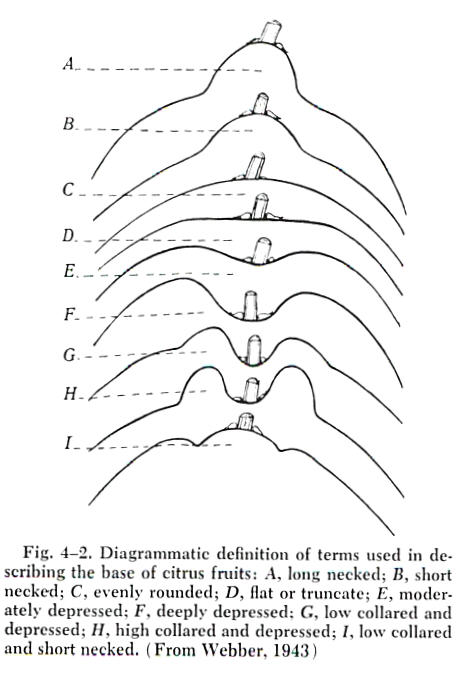
The descriptive terms
applied to the base of citrus fruits willbe readily understood by an
examination of figure 4-2.
The areole is the area at the apex of the fruit which is usually set
off by a more or less distinct circular furrow surrounding the stylar
scar. In descriptions, the circular furrow is referred to as the
areole and the area within it as the areolar area.
The inner seed coat is the membranous
covering under the thick, leathery exterior coat. The chalazal spot
is the round area on the inner seed coat at the chalazal end of the seed, which
commonly is characteristically colored.
The
work of Chapot (1955a) in the descriptive pomology of the citrus fruits
is outstanding. His monograph on seed characters in Citrus
(Chapot and Praloran, 1955) is a contribution of great importance and
significance, as are also his numerous other papers.
Constancy of Characters
While the
botanical characters relating to the leaves, flowers, fruits, and seeds
are sufficiently distinctive and constant to permit relatively easy
determination of species, botanical varieties, and certain subspecies groups,
these characters nevertheless exhibit a considerable degree of
variability. Horticultural characters of both tree and fruit,
by means of which varietal identification can be made, are extremely variable,
however, and many of them are highly lacking in constancy. This
results in numerous citrus fruit varieties which are distinguishable with
difficulty, if at all.
Since constancy of
citrus characters varies greatly, descriptions overlap slightly and
identification may be somewhat blurred. Such tree characters as
distinctive growth habit, comparative season of fruit maturity, and
ability to store the fruit on the tree are relatively stable and constant in a
subtropical climate. As would be expected, the most constant fruit
characters are those related to the special anatomical features of the fruit:
the presence or absence and nature of the areole, mammilla, or
navel. Degree of seediness and comparative acidity of
the juice are variable, of course, but still reasonably
constant. Comparative size and form of the fruit,
comparative color, and thickness and adherence of the rind, while highly
variable among varieties, exhibit a reasonable degree of constancy within a
variety and hence are useful.
Some citrus tree characters and most fruit characters are
markedly affected by environmental influences. Indeed, these are of
very great importance, for they largely determine the distinctive
characteristics of the fruit upon which market reputation and consumer
preference are based. The principal environmental influences
undoubtedly are climate and rootstock. Soil type and cultural
practices may also affect fruit characteristics, although usually to a minor
degree.
Climatic Effects.—Among tree
characters, period of fruit maturity is undoubtedly of greatest importance and
is determined by the nature of the climate. Thus, the Valencia
orange is horticulturally mature by January in the very hot, dry, low-elevation
desert of southern California, but does not attain maturity until the following
June in the cool, mild, equable coastal valley regions. Ability of
trees to hold their fruit is also affected by the nature of the climate during
and after maturity; this character is minimized by warm night conditions after
maturity. Even certain aspects of tree growth habit—compactness of
tree and density of foliage—are influenced by climate; these tendencies are
accentuated in dry and very cool climates.
The effects of climate factors on fruit characters are much more striking,
however, and are sometimes remarkable.
While
there are numerous factors that may affect fruit size, climatic conditions
characterized by high heat and humidity during the growing season make for
large fruit. Thus, the large-fruited Washington navel orange, which
attains ideal size in California, reaches undesirably large size in the humid,
semitropical climates which characterize Brazil and Florida. In
contrast, the small-fruited Hamlin orange never attains a commercially
acceptable size in the arid, cooler subtropical climate of the southern
California coastal region but does become sufficiently large in Florida and
Brazil. In this general connection, it may be pointed out that the
"small fruit" problem is restricted to medium-sized varieties in arid regions
and in seasons of marginal or below average heat, whereas the "large fruit"
problem is confined to large-fruited varieties in regions or in seasons of
above-average heat or humidity.
Fruit form
may be profoundly modified by climatic factors. In general, the axis
is longer in regions of low atmospheric humidity, and vice
versa. Thus, an oval variety, such as Shamouti orange, may range
from short-oblong (almost round) to long-elliptic depending on
climate. Likewise, the average shape, within any given round variety
of orange, may range from subglobose to oblong, with accompanying differences
in diameter-height (D/H) index from well above 1 to considerably below that
value. The factors which function to increase length of the fruit
also appear to favor or accentuate the tendency to develop a neck in the
mandarins and a pyriform shape in the grapefruits. Therefore, the
same variety may exhibit significantly different fruit forms in regions of
different climatic conditions.
It has long
been recognized that color is markedly affected by the temperature regime
during the ripening period and thereafter. Maximum color intensity
develops when the fruit is subjected to considerable chilling—normally the
result of cold nights. In arid, subtropical climates, this is
assured by the prevalent cool nights (associated with the wide diurnal
fluctuations in temperature) which characterize the fall and winter
months. Primarily because of warmer nights (associated with small
diurnal temperature variations), color development in semitropical climates is
much slower and the intensity ultimately attained considerably lower, with the
possible exception of some of the mandarins, notably Dancy
tangerine.
Other fruit characters materially
affected by atmospheric humidity during the growing season include rind
surface, thickness, texture and adherence, texture of the flesh (juice vesicles
and carpellary membranes), and juice content. Thus, in semitropical
regions such as Florida, the rind is smoother, thinner, softer, and more
tightly adherent, the flesh and carpellary membranes are tenderer, and the
juice content is higher than in such subtropical regions as
California.
Flavor is markedly influenced by
the same conditions that are primarily responsible for the intensity of color
development, namely, degree of fluctuation between day and night
temperature. Wide diurnal fluctuation appears to promote sugar
accumulation and acid formation, and vice versa. In general,
therefore, the fruit grown in arid subtropical climates is more strongly and
richly flavored than that produced in semitropical or tropical
climates. Fruits or varieties that are characterized by relatively
high acidity, however, such as the kumquats and some of the mandarins (for
example, King and Kara) and their hybrids (for example, Temple tangor and
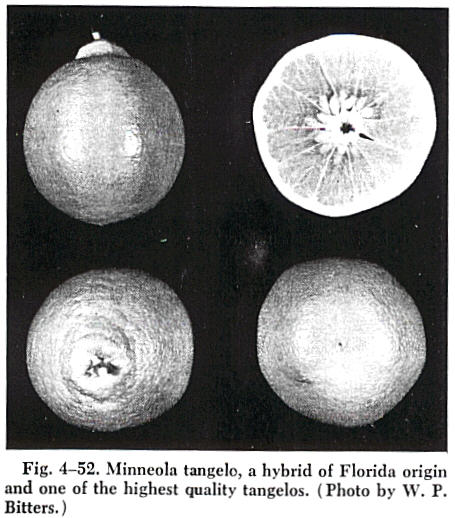
Minneola and Seminole tangelos) are more pleasantly flavored in semitropical or
tropical climates, and vice versa. The same seems to be true with
respect to the bitterness that characterizes most of the grapefruits and some
of their hybrids (notably Sampson tangelo). Since individual tastes
differ so greatly, it is meaningless to argue as to the superiority or
inferiority of one over the other. The important fact is that they
exhibit distinctive differences.
Likewise,
the characteristics of the areole, mammilla, and navel are subject to climatic
modification. In general, these modifications are more pronounced
and prominent in arid than in humid climates. In the hot
semitropics, the areolar furrow, which may be prominent in the arid subtropics,
is usually absent and the nipple much less well developed or even suppressed to
the degree that it is scarcely discernible, if at all. In subtropical
regions, it has long been recognized that the size and prominence of the navel
in the navel oranges varies considerably among climatic zones, from season to
season, and even between the exterior and interior parts of the
tree.
A most remarkable illustration of the
interactions between climatic factors and fruit characteristics is afforded by
the Nagpur mandarin in central India, where climatic conditions induce the
production of several periods of bloom peryear and, thus, provide a
choice of the bloom to be employed—spring or fall. Many of the
growers use the spring bloom for part of the orchard and the fall bloom for the
remainder. The characteristics of the fruit in the two crops are
remarkably different. The spring-bloom fruit is larger, flatter in
form, paler incolor, and notably less acid. Its sugar-acid
ratio averages approximately double that of the fall-bloom
fruit. Bonavia (1888-90) has described numerous other more striking
illustrations in India, where there is doubtless a wider range of citrus
species and forms and of climatic conditions than exists
elsewhere.
Another less spectacular
illustration is exhibited by the lemon, most varieties of which have two
principal periods of bloom—spring and late summer or early fall—but are more or
less everflowering and everbearing. In Italy, the crops resulting
from the flowers produced at various times during the year have been named and
accurately described (Casella, 1935b). There are clearly
greater differences between some of them, notably Primofiori (spring) and
Verdelli (summer) than between many lemon
varieties.
Rootstock Effects.—Although
rootstocks may effect growth habit to some degree, their principal effects on
tree characters are concerned with period of fruit maturity and ability
of the tree to hold or store the fruit. On certain rootstocks,
notably the rough lemon and Indian or Palestine sweet lime, the acidity
attained by most citrus fruits is significantly reduced as compared to such
common rootstocks as sour or sweet orange. As a consequence, on
these rootstocks maturity is advanced as judged by taste or measured by the
sugar-acid ratio. The flavor is not rich, however, for the total
soluble solids content of the juice is likewise usually low. On
certain other rootstocks, notably trifoliate orange, the soluble solids are
significantly increased, with the result that although a corresponding
sugar-acid ratio is attained at approximately the same period the fruit has a
richer flavor. Earliness of commercial maturity, as measured by
either the sugar-acid ratio or acid content of the juice, may therefore be
markedly affected by the rootstock employed. Closely associated with
these effects is the ability of trees to hold or store the
fruit. The rough lemon as a rootstock causes the fruit to lose
quality—both juice content and flavor—and to drop earlier than normal, whereas
the bitter orange as a rootstock seems to prolong the period of satisfactory
storage on the trees.
Theprincipal
fruit characters that may be affected by rootstocks include size,
color, rind thickness, juice content, and flavor. Thus, orange size
is usually somewhat larger on the trifoliate and bitter orange rootstocks and
smaller on sweet orange. Color is sometimes paler on the rough
lemon and Palestine sweet lime rootstocks and the thickness of rind is
generally greater, with a corresponding reduction in juice
content. And, as brought out above, flavor is richer on certain
rootstocks than on others. With the exception of flavor, however,
rootstock effects on fruit characters are usually less marked than those caused
by climatic factors.
Soil
Influences.—That the soil may affect tree characters and fruit
characteristics is a belief of long standing that finds support in
observational evidence. It appears that average fruit size is larger
and maturity is slightly earlier on the lighter-textured soils, but that the
color is likely to be paler, the rind thicker, and the flavor
poorer. And it is generally agreed that the fruit holds on the
trees better on the finer-textured soils.
Soil
differences are usually small, however, unless accentuated by rootstock
effects. Thus, the undesirable influences of the rough lemon
rootstock are increased by sandy soils and reduced slightly by silty
soils.
Limitations of Descriptive
Pomology.—From the foregoing, it is clear that the horticultural characters
concerned in the identification and description of citrus fruit varieties are
so variable and subject to such profound environmental modification that the
problems presented are difficult indeed. Thus, on the basis of fruit
characters alone it isimpossible to identify many
varieties. And it is difficult or impossible to accurately identify
numerous varieties on the basis of both tree and fruit
characters. It is highly probable that there are far fewer
varieties than the lists available indicate. This is further
suggested by the absence of comprehensive and dependable varietal keys for
countries and regions where citriculture has been practiced longest and where
varieties are most numerous.
With regard to
varietal description, even though the sampling provides representative
materials, it is obvious that detailed and exact descriptions are accurate and
meaningful only for a given environment or similar conditions of climate and
rootstock. Thus, descriptions of the same varieties in different
countries or states often fail to correspond in important
respects. Perhaps the best illustration is afforded by the
differences between Florida and California varieties. Detailed
descriptions of Florida varieties grown in California are far from accurate for
Florida conditions, and vice versa.
VARIETAL DEFINITIONS AND MODES OF
ORIGIN
Irrespective of mode of origin
and method of reproduction or multiplication, a horticultural variety
(cultivar) consists of a named or otherwise designated group of plants
representing one of the many genetically different kinds of any given
cultivated plant species or botanical variety (Frost, 1943, p.
837). In citrus, as with most other fruits, a horticultural variety
traces back to a single parent tree or individual mutant branch which has been
multiplied by vegetative or asexual means, such as cuttage or
graftage. To provide a more precise name for a group of such plants,
Webber (1903) introduced the term clone. Citrus varieties or
cultivars are therefore clonal
varieties.
Complicating the situation to
some degree is the fact that in most citrus varieties the existence of the
phenomenon of polyembryony makes available apomictic seedlings of nucellar
origin. These are genetically identical with the seed parent, but
may exhibit physiological differences of some magnitude and duration that
apparently relate to age from seed propagation and diminish with time until they
ultimately disappear. These probably should be regarded as juvenile
characters. Because of these differences, it has become desirable to
distinguish between the parent, original, or "mother" clonal selection or
budline and the nucellar or "daughter" clonal line of the same
variety. For various reasons, in California and increasingly so
elsewhere in the United States, nucellar or young clonal budlines or selections
are rapidly displacing parent or old clonal budlines, and this trend seems
certain to extend to other countries.
Another
complicating factor is the existence within certain varieties, notably among
lemons in California, of slight but consistent variations that can be detected
with certainty only by growing considerable numbers of trees of different
progenies in close proximity. These differences are evident mainly in
comparative habit of growth, vigor, density of foliage, and sometimes in
fruitfulness. Presumably, such variations have arisen as seedlings
or undetected budsports, principally the latter, and have unintentionally been
propagated. Since the differences are small and detectable with
difficulty, they have commonly been referred to as
strains. While this type of delineation is well established
in California, and to some extent elsewhere, and may appear to have certain
advantages, it is technically incorrect according to the International Code
of Nomenclature for Cultivated Plants (Anonymous, 1961, p.
13). So-called strains which exhibit desirable characteristics and
are considered worthy of distribution therefore should be given varietal
designations irrespective of origin or degree of resemblance to already named
varieties.
The selection and naming of
outstanding old bearing trees as sources of propagation materials is currently
widespread in California and to some extent elsewhere, having been greatly
stimulated by the extensive studies initiated about 1909 by Shamel (1943) and
his associates. Unfortunately, these old bearing selections have
commonly been incorrectly referred to as strains instead of clonal
selections or budlines. Almost without exception they have been
found to be identical with the variety in question. Whatever
differences in behavior they may have exhibited, if any, are attributable to
the nature and degree of virus orother infections they
carry. There have been a few such selections, however, that
apparently are different and represent undetected bud variations in the parent
tree or an error in its bud parentage. These are in reality new or
different clonal varieties.
In common with
other fruits, citrus varieties may originate as chance seedlings, budsports
(somatic mutations), or hybrids resulting from plant breeding. Most
of the varieties currently grown doubtless originated as chance
seedlings. This is known to be true for most of the orange and
grapefruit varieties discovered in Florida. This mode of origin is
no longer operative to an important degree, however. Some varieties
are known to have originated as limb sports, notably numerous navel orange and
satsuma mandarin varieties and the pigmented grapefruit varieties. A
few promising varieties resulting from breeding programs in Florida and
California have been introduced and others are in
prospect.
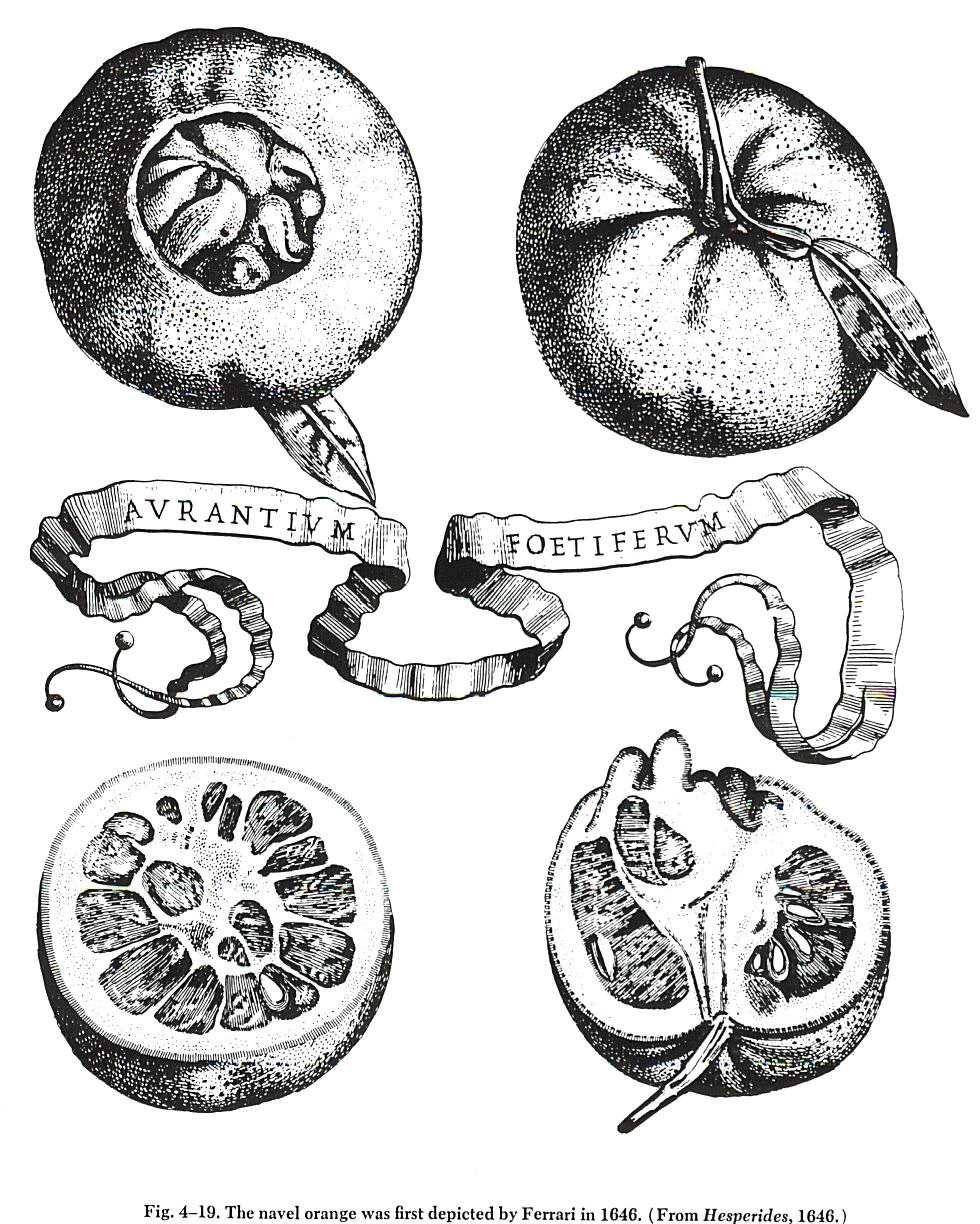
The early literature (Han Yen-chih
[1178], 1923; Ferrari, 1646; and Bauhin, 1650) does not indicate specific
recognition of the horticultural variety concept, although it is suggested by
descriptions of numerous kinds of oranges, mandarins, lemons, and citrons, and
references to the budding and grafting of seedling trees. By the
nineteenth century, however, there can be little doubt that the concept was
recognized, since Gallesio (1811) described accurately eight kinds of orange and
Risso and Poiteau (1818-22) described and figured forty-two varieties of citrus
fruits.
The first relatively adequate
horticultural classification of the citrus fruits and description of their
varieties in the United States is that of Hume (1904, 1926) and the most recent
and comprehensive that of Webber (1943). In California, Spalding
(1885) was perhaps the first to attempt the listing and description of
varieties, followed shortly by Lelong (1888), who presented much more detailed
and accurate characterizations. For descriptions of Mediterranean
varieties, the reader is referred to Casella (1935a), Rebour (1950), and
Gonzalez-Sicilia (1963).
THE PRINCIPAL VARIETIES AND THEIR MOST
DISTINCTIVE CHARACTERISTICS
Because of
the remarkable potency of environmental influences on citrus fruit characters, detailed
varietal descriptions will not be attempted. Instead, the objective
is to present the most distinctive characteristics that will be helpful in
identification and evaluation. Insofar as practicable, this is done
for all varieties currently of commercial importance or likely to become
important. Less detailed treatment is given to varieties of
declining or limited local importance. Lack of information requires
that for many such the characterizations be sketchy and
incomplete.
The sources of information used
include the personal knowledge of the author based on observation and study of
the principal collections in the United States and considerable travel abroad,
the literature of the past four decades, and personal communications from
horticulturists in many parts of the citricultural
world.
The horticultural classification employed in the sections that follow
is that of the author and is outlined at the beginning of the
chapter. Obviously, it is both arbitrary and empirical in
considerable degree and hence subject to valid differences of
opinion. Since the classification is based primarily on resemblance,
it has seemed best to place the known and presumed hybrid varieties in those
groups they most resemble, irrespective of parentage, known or
presumed. In some cases, resemblances are so tenuous that
classification is difficult and provisional, and in others lack of information
may prove responsible for errors.
For the most
part, the botanical nomenclature used is that of Tanaka (1954), whose system
though excessively detailed is much more comprehensive than the rigidly
restricted classification of Swingle (1943) and hence, in the opinion of the
writer, more useful. However, the use of Tanaka's binomials is
primarily for the convenience of the reader and should not be interpreted as an
unqualified acceptance or endorsement of his classification in
toto. Indeed; on the basis of the natural groups and
horticultural varieties with which the writer is personally acquainted he
cannot accept a number of the species in question. Moreover, he
frankly disclaims competence to pass judgment on many others. It is
his general conclusion, however, that these two classification systems
represent extremes and that somewhere between them there will ultimately emerge
a more supportable and generally acceptable system of botanical classification
and nomenclature.
With the exception of
those varieties whose origin is unknown, such as the Valencia orange, or which
are widespread under names given elsewhere than in their country of origin,
such as the Washington navel orange, the names used are those employed in the
respective countries of origin or their English equivalents. The
principal synonyms are given in parentheses. Insofar as practicable,
the varieties described in the following sections are presented in two groups
for each fruit: major and minor. Major varieties are those currently
of principal economic importance or which because of their promise seem likely
to become so. Minor varieties are those currently of comparatively
little importance or primarily of historical or other
interest. Within each group, the varieties are listed in
alphabetical order.
THE SWEET ORANGE (CITRUS SINENSIS [L.]
OSBECK)
In common with most of the
other citrus fruits of commercial importance, the sweet orange appears to be
native to the region comprised by northeastern India and adjoining portions of
China and Burma. It appears to have been first grown commercially in
southern China. Its cultivation in the upper Mediterranean basin
has generally been considered to date back to approximately the middle of the
fifteenth century; not long thereafter it reached the Western
Hemisphere. However, Tolkowsky (1938) has adduced evidence of a much
earlier European introduction (200-300 A.D.). The sweet orange is
the naranja of Spain, arancio of Italy, laranja of
Portugal, orange of France and English-speaking countries, the malta of
India, and kan of Japan.
The sweet
orange is dominant in the citricultural world, since, with the exception of the
Orient where the mandarin is preferred, no other citrus fruit is so universally
liked and used. It is much more widely distributed and grown than
any other and currently comprises about two-thirds of the total world production
of citrus fruits, which in 1965 was almost 600 million 70-pound box
equivalents, and is increasing rapidly. The United States was much
the largest producer of oranges with approximately 121 million boxes followed
by Spain (55 million), Brazil and Italy (24 and 37 million, respectively),
Mexico and Argentina (24 and 20 million, respectively), Israel (23 million),
and Morocco and South Africa (16 and 15 million, respectively). Six
other widely-distributed countries produce 5 million to 10 million boxes
annually and eleven others a million boxes or more. The remaining
citrus fruits are produced by about two dozen other widely distributed
countries. Moreover, both planting and production will certainly
increase during the coming decades. As this chapter went to press in
1967, the Florida orange crop alone was estimated at 143 million
boxes.
With the exception of the mandarin and
bitter or sour orange, the sweet orange tree is the hardiest of the citrus
fruits of commercial importance. The mandarin fruit is much more
susceptible to frost injury, however.
In most
parts of the world, the sweet orange is still used primarily as a fresh fruit
for eating out-of-hand or serving as a dessert. In the United
States, however, and increasingly so elsewhere, the principal use now is for
the juice, which is extracted and served fresh or preserved by chilling,
pasteurization, and concentration (see chap. 2, p. 47 [text version, Revised
Ed.]). The single-strength canned juice now available is a
reasonably satisfactory substitute for freshly expressed juice and keeps
relatively well. Much the best product, however, in that it is
acceptable as a substitute to all but the most discriminating palates, is the
frozen juice concentrated under vacuum, which of course, requires freezing
storage. The consumer acceptance of this product has been
phenomenal, and much the greater part of the Florida production is now utilized
in this form. The use of oranges for juicing, enhanced by the
spectacular success of frozen concentrate, has materially increased the
consumption of oranges in the United States and brought about greatly
increased production in Florida.
Valuable
byproducts are also obtained from the rind of fruit sent to processing plants
for juicing. Principal byproducts are essential oil, pectin, and
cattlefeed.
The sweet oranges naturally fall
into four kinds: the common oranges, acidless oranges, pigmented oranges, and
navel oranges. They may also be distinguished on the basis of season
of maturity as early, midseason, and late. In some of these groups,
possibly all, there are variegated varieties of local importance as
ornamentals, such as the dwarf variety Fuya Menuda.
These comprise the ordinary or common oranges
which in the Mediterranean basin are referred to as the white or blond orange
(blanca of Spain, biondo of Italy, blonde of France) to
distinguish them from the pigmented or blood orange. The
characteristics of the common oranges are so well known as scarcely to require
comment. Indeed, the distinctive color—a combination of red and
yellow—has for centuries been used as the common name of this fruit, in which
connection it may be of interest to note that yellow-fruited orange varieties
have long been known (such as the Prata of Spain and Tenerife of the Canary
Islands).
In most of the older
orange-producing countries, there still remains a considerable production of
sweet oranges from seedling clones grown either as seedlings or budded
trees. In Spain and Italy, these are usually referred to as
comuna or comune (Biondo di Spina
or di Arrudi), respectively, and in Florida as Florida Common. In
North Africa and the Near East, they are called beladi or beledi
(various spellings), bizri (when grown as seedlings), and Bordugal
(Portugal). They are known as criolla in Argentina and
Uruguay, caipira in Brazil, and corriente in
Mexico. And finally, in South Africa and Australia, they are called
Cape Seedlings and Paramatta Seedlings,
respectively.
In general, the seedling clone
trees are vigorous, large, somewhat thorny, productive, and long-lived, but the
fruit is commonly coarser in texture and seedier than most named
varieties. With minor exceptions, the propagation and planting of
these seedling clones has been abandoned in favor of better, named
varieties. It must be remarked, however, that under certain
conditions these seedling clones are sometimes more profitable than the named
varieties available and hence will continue to be used. So long as
they remain profitable, there is little incentive for growers to replace such
orchards.
As might be expected, the common
sweet oranges are the most widely grown and commercially the most important of
the four kinds of sweet oranges. There is reason to believe that
they constitute about two-thirds of total orange production.
They are not only the oldest, largest, and
most extensively cultivated kind of sweet oranges, but they include more
varieties than any other.
Major Common Orange
Varieties.—Descriptions are presented below of those common orange varieties
grown on an extensive scale, increasing in importance, or which the author
believes have qualities of major significance.
Barão
Fruit medium-small, ovoid to
oblong; base with occasional radial furrows; seeds comparatively
few. Rind medium-thick and surface smooth. Color deep
orange when ripe. Flesh well-colored; coarse, firm in texture; juice
content below average; flavor rich and sweet. Medium early in
maturity.
Tree vigorous, upright,
medium-large; foliage dense; very productive.
This Brazilian variety (Moreira and Filha, 1963) is of unknown origin,
presumably a chance seedling, and does not meet the requirements of the
processing industry or export trade. It is said to be much
appreciated by the Brazilian populace.
Bedmar
See under Berna.
Belladonna
Fruit medium-large,
oblong to oval; base commonly with small, slightly furrowed basin; areole faint
or lacking; seeds few or none. Color deep orange at
maturity. Rind medium-thick, tightly adherent as are also the
segments; surface finely to coarsely pebbled. Flesh moderately juicy
and flavor pleasant. Early midseason in maturity, but holds well on
tree for several months. Stores and ships
well.
Tree vigorous, medium to large,
symmetrical, and productive.
An old Italian
variety of unknown origin, Belladonna is widely grown in Italy and ranks second
there only to Calabrese.
According to Casella
(1935a), the fruits of Belladonna and Calabrese have close resemblances,
but the former averages larger, is better colored, and has a thicker and
somewhat coarser rind. The season is altogether different as are
also the trees. Both varieties are of excellent quality.
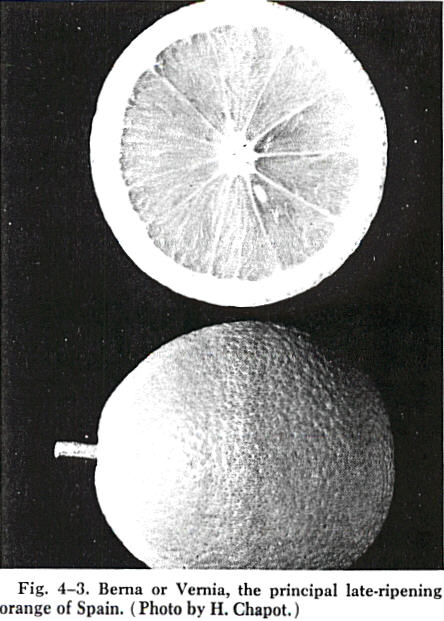
Berna (Bernia, Verna, Vernia,
Verda, Bedmar) (fig. 4-3)
Fruit medium-small,
oval to ellipsoid; base commonly with faint radial furrows; apex slightly
depressed; seeds few or none. Well-colored at full maturity, but
regreens thereafter. Rind medium-thick, firm; surface finely
pebbled. Flesh well-colored; moderately juicy; flavor
sweet. Fruit holds especially well on tree with good quality and
ships well. Late in maturity, but earlier than Calabrese of Italy
and Valencia.
Tree slow-growing, compact,
medium-small in size, and slow to bear but productive. Somewhat
inclined to out-of-season flowering and production of worthless off-season
fruits. Usually has a few long and narrow
leaves.
This distinctive variety is of
Spanish origin but is grown also in Morocco and Algeria. It is one
of the latest maturing of all Mediterranean varieties and holds on the trees as
well as Valencia or better but is smaller and of poorer
quality.
Several clones of the Berna are
recognized, one of which is characterized by greater tree vigor and round fruit
of higher juice content. A selection named Alberola is said to be of
superior quality. A highly similar, if not identical, variety is
Peret.
Biondo Comune (Nostrale Liscio)
Fruit medium
to medium-large, subglobose to round; basal cavity small and deeply furrowed;
apex flattened or slightly depressed; seedy. Color yellowish-orange
at maturity. Rind medium-thick and surface finely to moderately
pebbled. Flesh very juicy and flavor pleasant when fully
mature. Medium early in maturity, but holds well on tree and ships
well.
Tree vigorous, hardy, large, and
productive.
One of the oldest Italian
varieties and of unknown origin, Biondo Comune has been little planted in
recent decades and doubtless will ultimately disappear. It still
comprises the bulk of production of common sweet oranges in some of the oldest
Italian districts.
Biondo Riccio
Fruit large, globose;
base slightly flattened and deeply furrowed; apex slightly depressed;
seedy. Well-colored at maturity. Rind medium-thick and
surface coarsely pebbled and somewhat rough. Flesh juicy and flavor
pleasant when fully ripe. Medium early in maturity and ships reasonably
well.
Tree moderately vigorous, highly
productive, and hardy.
Another very old
Italian variety of unknown origin, Bionao Riccio has not been planted for years
but is still important in some of the oldest Italian districts.
Biondo di Spina
See under common oranges.
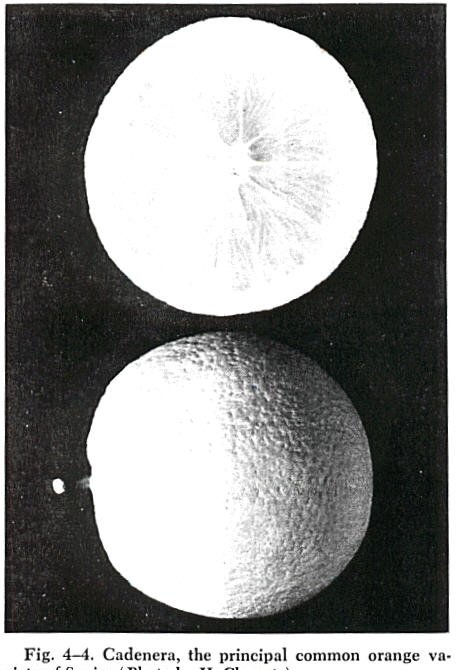
Cadenera (Cadena Fina, Cadena sin
Jueso, Orero, Valence san Pepins, Precoce de Valence, Precoce des Canaries) (fig.
4-4)
Fruit medium-sized, globose to
slightly oval; apex somewhat depressed; areole ring faint or lacking; seeds few
or none. Moderately well-colored. Rind medium-thin and
surface smooth to finely pebbled. Flesh very juicy and flavor and
aroma excellent. Holds well on tree and retains
quality. Medium-early in maturity (preceded by Salustiana and
Hamlin).
Tree vigorous, hardy, large, and
productive.
Of Spanish origin, presumably a
chance seedling, Cadenera appears to be the most important variety in Spain, its
production being exceeded only by only by comuna, which, as noted
earlier, consists of a group of unnamed similar or identical seedling
clones. It is important also in Morocco and Algeria and hence ranks
high among major orange varieties. Because of its excellent quality,
it is well and favorably known in European markets.
Cornice appears to be a selection of Cadenera
(Chapot, 1948) but Cadena Punchosa is an inferior variety no longer being
planted.
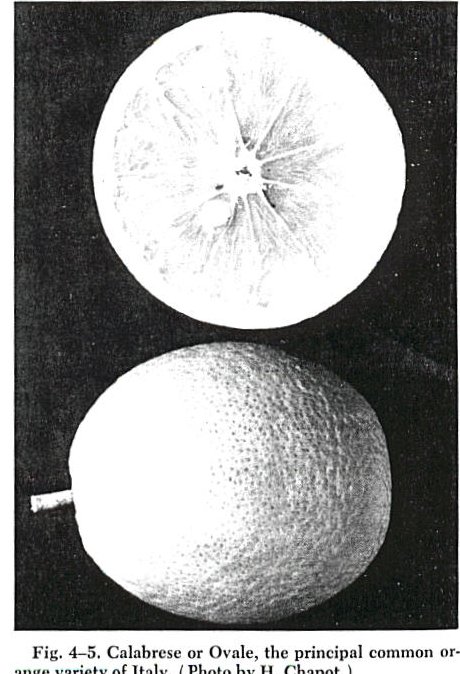
Calabrese (Ovale) (fig. 4-5)
Fruit medium-large,
oval; base commonly with low, narrow, slightly furrowed collar; areole faint or
lacking; seeds few or none. Well-colored at maturity, but regreens
if held on the tree long thereafter. Rind medium-thick, very tightly
adherent; surface finely pebbled. Flesh juicy and well flavored at
maturity. Holds especially well on tree with little loss in quality
and stores and ships well. Late in maturity (the latest of Italian
varieties and approaching Valencia).
Tree of
good vigor and size, slow growing, somewhat irregular in form; leaves
light-green and of somewhat distinctive color and
appearance. Pronounced tendency to produce out-of-season bloom and
fruit. Sensitive to cold, heat, and desert winds, but productive
under favorable conditions.
Calabrese is the
preferred name to distinguish this important variety from others of oval form.
Of unknown origin, this old Italian variety
is widely grown and for decades has ranked as first in importance among common
sweet orange varieties in Italy, a position it seems destined to maintain
because of its many excellent features.
California Mediterranean Sweet
See
under Maltaise Oval.
Castellana
Fruit medium-sized,
subglobose to spherical; moderately seedy. Color light
orange. Rind medium-thin and surface somewhat
granular. Flesh color pale; juice abundant, low in acidity; flavor
sweet. Holds on tree moderately well but loses
quality. Medium early in maturity.
Castellana is said to be the principal variety in the Almería Province of Spain
where it matures earlier than elsewhere. It is no longer being
planted, however.
Clanor (Clanwilliam, Clan William)
Fruit medium-large, globose to oblong; seeds relatively few. Rind
medium-thin, tough, leathery; surface moderately pebbled. Flesh
melting, juicy; flavor good. Late midseason in
maturity.
Tree vigorous, upright in growth
habit; foliage dense; a regular and heavy
bearer.
This South African variety from
western Cape Province traces back to two apparently identical trees in the
30-year-old William van Wyk orchard of the Kanolvlei farm that had been layered
from old Clanwilliam seedling orange trees on the Rondegat farm. The
selection was made by P. Nortier of Clanwilliam in
1930. Clanor has gained rapidly in popularity and currently is
recommended as one of the best midseason varieties for planting in South
Africa.
Clanwilliam
See under Clanor
above.
Garey's Mediterranean Sweet
See
under Pope.
Glen Summer
See under Pope.
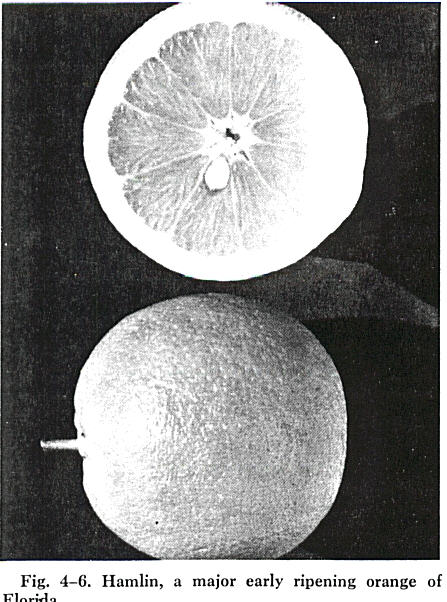
Hamlin (Norris) (fig. 4-6).
Fruit medium-small,
globose to slightly oblate; sometimes with low radially furrowed collar and
faint areolar ring; seeds very few or none. Well-colored at maturity
(one of the best in Florida). Rind thin, with smooth, finely pitted
surface. Flesh well-colored; tender, juicy, lacking in acid; flavor
sweet. One of the earliest to
mature.
Tree moderately vigorous,
medium-large, productive, and more cold-tolerant than
most.
The Hamlin variety originated as a
chance seedling in an orchard near Glenwood, Florida, which was planted in
1879, and was named for the owner, A. G. Hamlin, at the time its value was
recognized some years later. It came into prominence following the
great Florida freeze of 1894-95 as a rival of Parson, the only other variety of
similar early maturity, and has gradually replaced it. Currently,
it is a major variety in Florida, of considerable importance as an export
variety in Brazil, of limited importance in South Africa and elsewhere, and
possibly the world's principal variety of very early maturing common sweet
orange.
In semitropical climates characterized
by high heat and humidity, this variety produces fruit of satisfactory size for
marketing fresh, although the eating quality is generally somewhat
disappointing. In arid, subtropical climates, fruit size is
commonly smaller than desirable though the quality may be
satisfactory.
Hart's Tardiff
See under Valencia.
Hitmali
See under Khettmali.
Homosassa
Fruit medium-sized,
subglobose to ellipsoid; base evenly rounded to slightly collared and basal
area somewhat furrowed; apex evenly rounded; areolar furrow indistinct or
lacking; moderately seedy. Well-colored at maturity. Rind
medium-thick, smooth, and finely pitted. Flesh medium-tender, juicy;
flavor good. Midseason in maturity.
Tree vigorous, large, productive, and hardy.
According to Webber (1943), Homosassa isone of the oldest Florida
varieties, having originated as a seedling selection in the orchard of a Mr.
Yulee at Homosassa. The selection must have been planted not later
than 1865, for in 1877 the Variety Committee of the American Pomological
Society recommended it as a first-class variety. It was extensively
planted for some decades, and there are old orchards still in
existence. Like certain other Florida varieties, however, Homosassa
is of indifferent quality in arid climates and has not achieved commercial
importance elsewhere.
Jaffa (Florida
Jaffa)
Fruit medium-sized, globose to slightly
ellipsoid or obovate; basal end commonly collared and with radial furrows;
areole inconspicuous or absent; seeds comparatively
few. Well-colored under favorable conditions. Rind
medium-thick, finely pitted, and moderately pebbled. Flesh color
light orange; medium-tender, juicy; flavor good. Stores poorly on
tree, but ships rather well. Midseason in
maturity.
Tree vigorous, upright,
medium-large; foliage dense; cold-resistant; moderately productive, but with
alternate bearing tendency.
In the literature
and otherwise, this variety has sometimes been confused with Shamouti or
Palestine Jaffa, the principal variety of Palestine and Israel, which it
resembles only slightly. On the other hand, it somewhat resembles
Joppa. Almost certainly both Jaffa and Joppa are clones of the
Palestine beledi seeding group. Jaffa was introduced into
Florida by H. S. Sanford about 1883, whether as budwood or seeds is not known,
but presumably the latter. Joppa was named about 1877 in California
as a seedling from seeds obtained in Joppa, Palestine. In this
general connection, it is of interest to note that Shamouti is considered to
have originated as a limb sport in a Palestinian beledi
tree.
Because of its comparatively low seed
content, cold resistance, and good quality, Jaffa early became popular in
Florida and attained the status of a major midseason variety. The
greater productivity and superior quality of Pineapple, however, soon caused it
to lose favor, although Jaffa still remains important there and to some extent
elsewhere. For processing, however, Jaffa's susceptibility to
Alternaria blossom-end infection is a further cause for its decline in
popularity in Florida.
Joppa
Fruit medium-sized, globose to slightly oblong; seeds comparatively
few. Well-colored under favorable conditions. Rind
medium-thin and slightly pebbled. Flesh color light orange;
medium-tender, juicy; flavor rich. Midseason in
maturity.
Tree vigorous, upright, with rather
stiff thornless branches and stout branchlets; precocious, and
prolific.
This variety, not to be confused
with the Jaffa above, originated in 1877 from seed imported from Joppa,
Palestine, by A. B. Chapman of San Gabriel, California. It never
attained commercial importance in California or in Florida, where it was early
introduced, but it was popular for some decades in South Africa and still has
limited importance in Texas.
In comparison
with Jaffa, the fruit averages smaller and is less oblong, the rind texture is
finer, and the season of maturity is earlier. The tree is more
upright, has thicker branchlets, and is more precocious. In general
appearance, Joppa resembles Shamouti more than Jaffa. In South
Africa, it is reported (Marloth and Basson, 1955) that on rough lemon rootstock
Jaffa and its seedlings exhibit budunion "crease" whereas Joppa and its
derivatives do not. Addorosa is a local synonym in South
Africa. The Fukuhara variety of Japan is considered to be a bud
variation of Joppa.
Khalily White
See under Shamouti Masry.
Khettmali (Khatmali,
Hitmali)
Fruit medium-large, round to somewhat
oblong; areolar ridge usually well-developed (from which the name is derived);
seeds very few. Well-colored at maturity. Rind
medium-thin, tough, leathery; surface moderately pebbled; peels
readily. Flesh moderately firm, very juicy; flavor
excellent. Holds well on tree. Midseason in maturity,
but later than Shamouti.
Tree vigorous and
consistently productive.
This variety appears
to have originated in Lebanon, where it is highly regarded and second only in
importance to Shamouti. From the description, it is clear that
Hitmali of Israel and Khettmali are identical.
Macetera
Fruit medium-sized,
subglobose to globose; apex slightly depressed; seeds few. Rind very
thin, smooth, and finely pebbled. Color pale. Flesh
tender, juicy, and with special flavor and fragrance. Fruit holds
well on tree, but sensitive to frost. Midseason in
maturity.
Tree robust, large-sized, and
somewhat thorny. A regular and good
bearer.
This high-quality, old Spanish variety
is said to be increasing in importance, especially in Alicante Province, but
its thin rind and juiciness make it a poor shipper and keeper. It is
considered excellent for processing.
Malta (Malta Common)
Malta is a
seedy, midseason orange of good color and flavor, but without distinctive
characteristics, which is widely grown in the Punjab region of India and West
Pakistan. The trees are vigorous and productive.
It is similar to and indistinguishable from
beladi of the Near East and North Africa and comuna of Spain and
Italy and doubtless was introduced from the Mediterranean.
Maltaise Blonde (Maltaise, Petite Jaffa, Portugaise
Blonde)
Fruit medium-large, oval; seeds very
few or none. Moderately well-colored at maturity. Rind
medium-thick, leathery; surface smooth and finely pebbled; peels
easily. Flesh moderately well-colored; juicy; flavor
mild. Does not hold well on tree, but if properly handled stores and
ships well. Midseason in maturity.
Tree vigorous and characterized by open growth habit, thick branchlets, and
large, broad leaves. Low in
productivity.
Both the tree and fruit resemble
Shamouti (Palestine Jaffa) and it is evident that they are closely
related. Markedly similar also is Shamouti Masry (Khalily White) of
Egypt, which is believed to have originated as a limb sport of
Shamouti.
The Maltaise Blonde variety, of
unknown origin, is of limited importance in North Africa except in Tunisia,
where it is popular and grown commercially.
Maltaise Ovale (Maltese Oval, Garey's or California Mediterranean
Sweet)
Fruit medium-sized, spherical to oval;
basal collar radially furrowed; seeds relatively few. Color pale at
maturity and some tendency to regreen. Rind medium-thick; surface
somewhat pebbled; peels readily. Flesh pale-colored; moderately
juicy; flavor mild. Medium-late in
maturity.
Tree vigorous, large, spreading, and
drooping; leaves long, narrow, somewhat rumpled, and of paler color than
most. Distinctive in appearance.
This is an old Mediterranean variety of unknown origin which was introduced
into California about 1870 by T. A. Garey, a pioneer citrus nurseryman of Los
Angeles, and distributed under the name Mediterranean Sweet. At
about the same time, it was brought to Florida and distributed under the name
Maltese Oval. It is not the same, however, as the midseason variety
introduced into Florida a few years later and distributed as Mediterranean
Sweet.
Under its California name, this variety
soon became important as a midseason variety, maturing between the superior
Washington navel and Valencia oranges. With the expansion of the
California industry into areas of different periods of maturity, overlapping
production of these two varieties resulted. As a consequence,
Mediterranean Sweet rapidly lost favor and was replaced. In the
meantime, it was introduced into South Africa where it still retains some
importance as a midseason variety, although it is no longer
planted.
Two clones are recognized in
California which differ only in fruit form, one being prevailingly round and
the other oblong to oval.
Marrs (Marrs
Early)
Fruit medium-large, round to slightly
oblate; moderately seedy (depending on pollination). Well-colored
under favorable conditions. Rind medium-thick, and surface smooth
and finely pitted. Flesh well-colored; juicy, lacking in acid;
flavor sweet. Holds well on tree with little loss in
quality. Earliest inlegal maturity because of low acidity,
but for better juice content and quality should be left on tree somewhat
later.
Tree moderately vigorous, precocious,
and prolific. Marked tendency to bear fruit in
clusters. Smaller than most other varieties, presumably because of
early and heavy bearing.
According to Waibel
(1953), this variety was found in 1927 on the place of O. F. Marrs, Donna,
Texas, where it is said to have occurred as a limb sport in a group of navel
orange trees obtained from California. Although propagated to a
limited extent earlier, trees were not available for commercial planting until
1940.
Because of its early and heavy bearing
and good fruit size, Marrs is currently a popular early maturing variety in
Texas. Its principal fault for processing is the low acidity of the
juice.
Mediterranean Sweet
See under Maltaise Ovale.
Mosambi
(Mosambique)
Fruit medium-large, slightly
oblate to globose or broadly obovoid; areolar ring regularly shallow;
moderately seedy. Color light yellow to pale orange at
maturity. Rind medium-thick; surface moderately to roughly pebbled,
and faintly striped with narrow, longitudinal grooves and
ridges. Flesh color straw-yellow; somewhat firm, juicy; flavor
insipid because of very low acidity. Early in
maturity.
This very distinctive variety is of
unknown origin, but the name, of which there are numerous spellings, suggests
that it was taken from Mozambique, East Africa, to India, presumably by the
Portuguese. The brown color of the chalazal spot indicates that it
does not belong to the sugar orange group, as some have assumed, but that it is
a low acid orange, the acidity of which is further reduced by the Indian
climate and the rough lemon rootstock on which it is
grown.
Mosambi is highly popular in central
India and is probably the most important orange variety of that
country. According to Gandhi (1956), it is grown principally in the
Bombay Deccan where total plantings were reported to be about 20,000
acres.
Mosambique
See under Mosambi
above.
Natal
Fruit medium-sized, globose to
broadly obovoid; seeds very few. Rind medium-thin and surface
moderately pebbled. Color pale yellowish-orange. Flesh
pale-colored; tender, fine-textured, very juicy; flavor rich at full maturity
because of high acidity. Shipping quality good. Very late
in maturity.
Tree vigorous, large, and
productive.
Of unknown origin, this Brazilian
variety is said to markedly resemble Valencia in both fruit and tree
characters.
Norris
See under Hamlin.
Nostrale Liscio
See under Biondo Comune.
Orero
See under Cadenera.
Parson (Parson Brown)
Fruit
medium-large, globose; base with short, radial furrows; areole indistinct;
moderately seedy. Well-colored under favorable
conditions. Rind medium-thick; surface finely pitted and moderately
pebbled. Flesh color dull orange; firm, juicy;
well-flavored. Very early in maturity, possibly the
earliest.
Tree vigorous, large, and
productive.
Parson originated as a chance
seedling in the dooryard of Rev. N. L. Brown near Webster, Florida, and is said
to have been planted in 1856 (Ziegler and Wolfe, 1961). The
propagation rights were purchased about 1875 by J. L. Carney, who named it
Parson Brown. Its outstanding earliness soon popularized this
variety and it quickly became the leading early orange, a position held until
about 1920. Parson still remains a major variety in Florida,
however, though it has never achieved prominence elsewhere, principally because
of seediness.
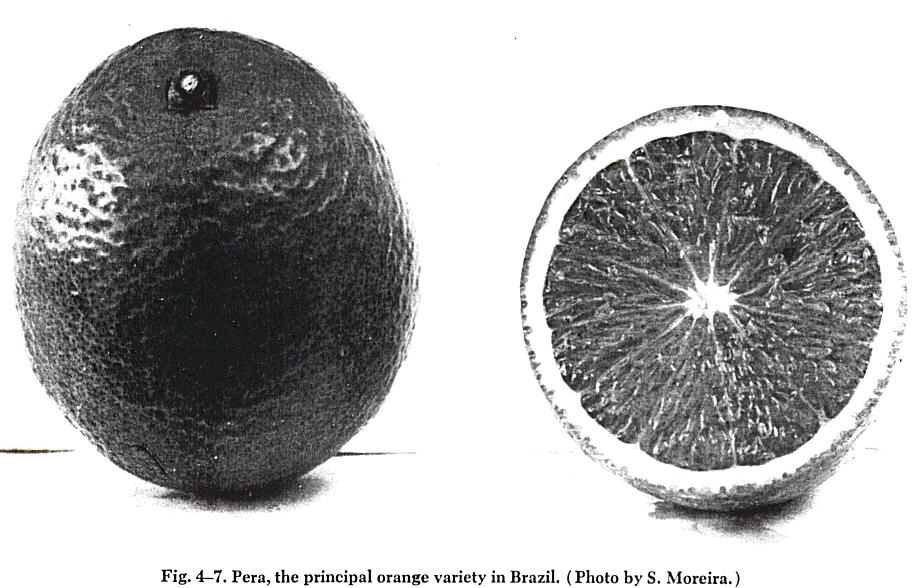
Pera (fig. 4-7)
Fruit medium-small,
ovoid to ellipsoid; seeds very few. Rind medium-thin; surface smooth
and finely pitted. Color light orange at maturity. Flesh
well-colored; firm, fine textured, juicy; flavor rich. Late in
maturity. Holds well on tree without deterioration in quality, and
stores and ships well.
Tree vigorous, upright;
foliage dense, with many leaves of which the petioles are unevenly winged; very
productive.
Moreira and Filha (1963) and other
Brazilian horticulturists have expressed the opinion that the Pera variety is
probably the same as Lamb Summer of Florida. If so, it originated as
a seedling in Volusia County sometime prior to 1897, when it was first
described and named for the owner. It never attained much importance
in Florida. Several clones are recognized of this variety in
Brazil, including Perão, a light-bearing tree with fruit which is large and
resembles Shamouti. A. A. Salibe has called attention to the
resemblance between Pera and the Berna variety of Spain.2
Introduced into
Brazil at an early date, Pera has long been the principal variety as well as
the most important late export variety. It constitutes nearly
three-fourths of the commercial acreage in the region of Rio de Janeiro and
slightly more than a third of the commercial acreage in São Paulo
State.
Petite Jaffa
See under Maltaise Blonde.
Pineapple
Fruit medium-sized,
spherical to slightly obovate; basal area sometimes depressed and radially
furrowed; commonly with faint areolar ring; moderately
seedy. Well-colored (one of the best in Florida). Rind
medium-thick; surface finely pitted and slightly pebbled. Flesh
color light orange; tender, juicy; flavor rich though
sweet. Midseason in maturity. Does not hold on tree as
well as some, but excellent for processing.
Tree moderately vigorous, medium-large, thornless, and highly
productive. More sensitive to frost than
most.
The Pineapple originated as a seedling
on the place of J. B. Owens at Sparr, near Citra, Florida, and is said to have
come from seed planted soon after 1860 (Ziegler and Wolfe, 1961). It
was first propagated by P. P. Bishop at Citra about 1873 under the name of
Hickory and some ten years later was renamed Pineapple because of its delicate
fragrance. Its attractiveness, fine flavor, and good market
reception brought about some increase in use, but it was not until after the
1894-95 freeze, which necessitated extensive replanting, that its popularity
developed. It soon became the principal midseason variety and has
remained so ever since. It is a major variety in Florida and of
considerable though decreasing importance in Brazil and South
Africa. Of increasing popularity in Florida is the Queen variety,
which may have originated as a Pineapple seedling. Two virtually
seedless limb sports have been found—Seedless Pineapple, discovered in 1932 on
Merritt Island, Florida (U.S. Plant Patent 477), and more recently (1948) a
variety named Plaquemines, which originated as a limb sport in
Louisiana. Varieties that are considered to be derivatives in South
Africa include Belvedere, which is indistinguishable from Pineapple, and Gem
and Letaba, both of which are less seedy and earlier in maturity. A
seedling clone that exhibits resistance to the burrowing nematode in Florida has
recently been named Ridge Pineapple.
Pope (Pope Summer, Glen
Summer)
Pope is a variety so similar to
Valencia that they are indistinguishable, and its origin suggests that it
probably should be regarded as a selection of Valencia rather than a
variety. According to Ziegler and Wolfe (1961), it traces back to
an outstanding budded tree that was found by F. W. Pope about 1916 in a 40-acre
planting of the Pineapple variety near Lakeland, Florida. It was so
late in maturity and held the fruit so well without loss in quality that Pope
undertook its commercial propagation in 1935 and had the name trademarked in
1938. Since 1945 its propagation and promotion have been conducted
by Pope Summer Orange Nursery, Ltd., though the same variety is reported
(Ziegler and Wolfe, 1961) to be propagated by the Glen St. Mary Nurseries
Company under the name Glen Summer. It has been planted to a
considerable extent in the Indian River district of Florida.
Portugaise Blonde
See under Maltaise Blonde.
Precoce des Canaries
See under Cadenera.
Precoce de Valence
See under Cadenera.
Premier
Fruit medium-small, globose;
seeds relatively few. Rind medium-thick and surface moderately
coarse. Flesh very juicy and flavor good. Early midseason
in maturity.
Tree moderately vigorous, of
irregular, upright growth habit; medium-sized; very
productive.
Of unknown parentage, Premier is a
selection of the Joppa type introduced about 1935 by the late Professor H.
Clark Powell, of the University of Pretoria, from the Mazoe Citrus Estates,
Umtali, Southern Rhodesia. Montrose Premier is indistinguishable and
apparently represents a clonal selection. The so-called Orange
Premier is an entirely unrelated clone of the Jaffa type that is subject to the
budunion crease disease and should be discarded. Premier has proven
to be popular and is currently the most important midseason variety in the
Lowveld areas of Transvaal, South Africa. It also is grown
extensively in Southern Rhodesia.
Queen
The Queen was originally
named King, but later the name was changed to avoid confusion with the old King
mandarin variety. This is a midseason variety with fruit much like
the Pineapple orange. It is less pronounced reddish-orange in color,
higher in soluble solids and hence richer in flavor, somewhat less seedy, and
holds better on the tree.
The tree is more
vigorous than Pineapple, equally productive, and somewhat more resistant to
cold.
According to Ziegler and Wolfe (1961),
this variety originated as a seedling in an old orchard on Lake Hancock, near
Bartow, Florida, and came to notice prior to 1900 at which time budwood was
obtained by a Mr. Walters from a Mr. King, a son-in-law of the
owner. It was used to propagate trees for the Perrin and Thompson
Groves near Winter Haven, the owners of which gave it the name
King. Its commercialization was undertaken by the Lake Garfield
Nurseries of Bartow about 1915 under the present name. For some
decades it did not receive much attention, but its popularity has increased
appreciably in recent years.
Salustiana (Salus) (fig. 4-8)
Fruit medium-large,
subglobose to spherical; basal cavity shallow with faint radial furrows; apex
depressed; areolar ring small but well-marked in many cases; virtually
seedless. Unusually well-colored at maturity. Rind
medium-thick and surface moderately pebbled. Flesh melting, juicy;
flavor rich and sweet. Fruit said to hold especially well on tree
without much loss of quality. Early in maturity (earliest of the
Spanish varieties).
Tree vigorous, somewhat
upright, medium-large, and productive.
This
comparatively new Spanish variety is believed to have originated as a limb sport
on a comuna tree in the garden of a convent. It was called to
the attention of Don Salustiano Pallas of nearby Enova, Valencia, and
propagated and introduced by him about 1950 (Gonzalez-Sicilia,
1963). Because of its early maturity, seedlessness, and quality, it
is regarded as highly promising and has been planted to a considerable extent
in Spain in recent years and somewhat in Algeria and
Morocco.
According to Chapot and Huet (1963),
who have reported on the characteristics of this variety in North Africa, both
tree and fruit are indistinguishable from Cadenera, except that the latter is
somewhat flatter in form. Salustiana is much earlier in maturity,
however.
Sathgudi
Fruit medium to large,
globose; moderately seedy. Color greenish-yellow to pale orange at
maturity. Rind medium-thick, tough, leathery; surface finely pitted
and moderately pebbled; peels readily. Carpellary membranes thick
and tough; flesh orange-colored; juicy; flavor fair (sweet with some
acid). Midseason in maturity insofar as can be determined.
Tree vigorous and moderately
productive. Commonly
seed-propagated.
The origin of Sathgudi is
unknown, but probably relates to a village or community. However, one
of its local names in southeast India suggests that it may have come from
Batavia, Indonesia. For many years it has been the principal variety
in southern India.
Seleta (Selecta,
Siletta)
Fruit medium-sized, subglobose to
spherical; basal area sometimes with radiating furrows; apex rounded or
slightly flattened; areole usually distinct; seeds few. Rind
medium-thick; surface smooth to slightly pebbled; color light
orange. Tendency to color in advance of maturity, while still
acid. Flesh juicy; flavor somewhat acid until full maturity, when it
becomes sprightly and readily acceptable. Fruit does not hold well on
tree after maturity, dropping freely. Late midseason in maturity
though coloring early.
Tree moderately
vigorous, medium-sized, and regularly productive. A tendency to give
rise to budvariations has been noted in California (Webber, 1943, p.
516) and Australia.3
The origin of
Seleta is unknown, but it seems likely that it is an old Portuguese variety,
for in 1925 it was listed among those currently grown there (Bobone, 1938) and
the synonym employed, Lusitana, referred to the ancient Roman provincial name
for Portugal. Presumably taken to Brazil at an early date, it is the
variety from which the Bahia or Washington navel orange is supposed to have
originated (Dorsett, Shamel, and Popenoe, 1917), although to the writer this
seems improbable. According to Moreira and Filha (1963), it is
still of commercial importance in Brazil, where several clonal selections are
currently popular—Abacaxi, Amarela, Branca, Itaborai, and
Vermelha. It seems likely that this variety is the Siletta of
Australia as the Sydney Gazette of April 22, 1824 (Bowman, 1955) lists
Celeta and Bahia oranges among recently introduced citrus
varieties. It early achieved commercial importance in Australia,
which continued until about 1920. Since that time it has been
infrequently planted and only for juice
purposes.
Two clones have long been recognized
in Australia—White Siletta, which corresponds to the description given here,
and Red Siletta, so-named because of its deeper color. The Red
Siletta is presumably of local though unknown origin. The
first-mentioned clone is that which achieved principal
importance. The fruit of the latter is coarser in rind texture and
somewhat lower in quality; the tree is more vigorous and larger.
Shamouti (Chamouti, Palestine Jaffa,
Jaffa, Jaffaoui, Iaffaoui). (fig. 4-9)
Fruit medium-large to
large, oval to ellipsoid; basal end slightly flattened or depressed with narrow
and low collar or shoulder, commonly with short radial furrows; apical end
evenly rounded; areolar ring usually present but faint. Seedless or
nearly so and well-colored under favorable conditions. Rind thick,
tough, and leathery; surface finely pitted but relatively smooth; inconspicuous
oil glands. Flesh color light orange; firm, tender, juicy; fragrant
and pleasantly sweet-flavored. Fruit peels and segments separate
readily. Ships and stores unusually well, but does not process
well. Midseason in maturity.
Tree
moderately vigorous, distinctive in appearance, upright in growth habit, with
thick, thornless branchlets; leaves large and broad, with petioles which are
small and narrowly winged. OnPalestine sweet lime rootstock,
tree is somewhat dwarfed, probably because of xyloporosis infection, but
isregular and highly productive, whereas tree islarger on sour
orange but less productive because of pronounced
alternation.
While Shamouti, of which there
are various other spellings, is the preferred name for this distinctive and
highly important variety, it is so well and favorably known in Europe under the
name Jaffa that it is now impracticable, as well as undesirable, to undertake
to change this usage. There is another, quite different variety of
the same name and parentage, however, frequently called Florida Jaffa to
distinguish between them (see Jaffa).
Like the navel oranges
in general, the Shamouti tree is sensitive to heat and aridity during the bloom
and hence restricted in range of climatic adaptation. Thus, in very
hot, arid regions production is low and the fruits are undesirably large and
coarse. Shamouti is clearly not adapted to hot desert or
semitropical climates. For reasons that are not clear, probably
relating to both climate and rootstock, the commercial culture of this variety
is restricted to climatically favored portions of the eastern end of the
Mediterranean basin.
According to Oppenheim
(1927, 1929), Shamouti originated some time prior to 1844 in an orchard near
Jaffa, Palestine (now Israel), presumably as a limb sport in a tree of the
local or beledi variety (see also under Jaffa). Its qualities were so outstanding that within
a few decades it became the leading variety in Palestine and has maintained
this position ever since. It spread to nearby countries and attained
importance, notably in Lebanon, Turkey, and Cyprus. It was early
exported to Europe, principally England, where it soon established a
reputation for its size, quality, and seedlessness. Its distinctive
shape provided a natural trademark. Currently, Shamouti is by far
the principal variety of the Near East and one of the major varieties of the
world. In addition to the countries already mentioned, it is the
leading variety in Syria and is grown to some extent in Greece and
Egypt. The 1965 production of this variety was estimated at not less
than 20 million boxes.
Although efforts were
made early to establish this highly reputed variety in both California and
Florida, the seed introduced apparently came from fruits of the seedy parent
variety rather than the almost seedless Shamouti and gave rise to the Florida
Jaffa and Joppa varieties (see Jaffa and Joppa). This fact was not realized for many years, and
it was not until about 1920 that the true Palestine Jaffa (Shamouti) was
introduced. Thus far, it has not compared favorably in quality and
productivity with other varieties.
The
evidence indicates that the Shamouti clone is highly unstable and prone to the
occurrence of limb sports. Thus, Oppenheim (1927, 1929) and Chapot
(1964c) report numerous instances of Shamouti trees containing branches
that produce round, seedy fruits typical of beledi, and a few cases have
been reported of beledi trees with Shamouti-like limb
sports. Chapot (1954, 1955b) reports the existence of four
varieties in Lebanon, the names of which clearly suggest the likelihood of
Shamouti origin. They are Shamouti or Iaffaoui Beledi, a seedy
Shamouti; Shamouti or Iaffaoui Maouardi, a seedless blood Shamouti; Maouardi
Beledi, a seedy, blood Shamouti; and Shamouti or Iaffaoui Moghrabi or Meski, an
acidless, seedy Shamouti. Other varieties which markedly resemble
Shamouti and are known to have originated from it include Kinariti or Kinnereth
(Early Shamouti) and the pink-fleshed Sarah of Israel and Shamouti Masry
(Egyptian Shamouti or Khalily White). (See Shamouti Masry, below.)
Finally, it should be noted that Maltaise Blonde of North Africa, sometimes
called Petite Jaffa, and Barile of Italy closely resemble Shamouti though their
fruit is somewhat smaller (see Maltaise Blonde).
Shamouti Masry (Khalily White, Egyptian
Shamouti)
Fruit medium-large, ellipsoid to
oval; seeds few or none. Color orange to deep
orange. Rind medium-thick; surface finely pitted and relatively
smooth; peels readily. Flesh well-colored; juicy; flavor rich and
sweet. Midseason in maturity. Indistinguishable from
Shamouti.
Tree moderately vigorous; leaves
large; Shamouti-like in appearance;
productive.
This variety is said to have
originated in the orchard of Moustafa Khalili in Kalioubiyah Province, Egypt;
whether it occurred as a seedling or limb sport is not reported. It
is preferred to Shamouti because the tree is more productive and the fruit
somewhat smaller and of finer texture. From descriptions it is
evident that this variety and Maltaise Blonde or Petite Jaffa of North Africa
are very much alike.
Tomango
See under Pigmented
Oranges.
Valence san Pepins
See under Cadenera.
Valencia (Valencia Late, Hart Late,
Hart's Tardiff) (fig. 4-10)
Fruit medium-large,
oblong to spherical; areole ring faint or lacking; seeds few or
none. Well-colored at maturity, but regreens thereafter under
certain conditions. Rind medium-thick, tough, and leathery; surface
smooth to faintly pebbled. Juice abundant and flavor good but
commonly somewhat acid. Fruit holds exceptionally well on tree with
little deterioration in quality and ships and stores well.Excellent for
processing. Latest maturing of all commercial
varieties.
Tree vigorous, somewhat upright,
large and prolific, but with alternate-bearing tendency. Very wide
range of adaptation.
This variety should not
be confused with the Spanish Valencia Temprana and various seedling
clones grown in the region of Valencia, Spain.
The total heat requirement for maturity of
the Valencia orange is so high that only in the hottest regions is it satisfied
prior to the succeeding bloom. In the United States, this usually
occurs in Florida, the Lower Rio Grande Valley of Texas, and the low elevation
desert areas of Arizona and California, where legal maturity is normally
attained in January or February, though the fruit may be stored on the trees
for several months thereafter, extending into or through the succeeding period
of bloom. In regions of lower total heat, however, maturity is later
and overlaps the bloom, sometimes by several months. As a
consequence, in most regions where this variety is grown the trees normally
carry two crops—the old, which is ripe or reasonably close to maturity, and the
new, at any stage of bloom to half-grown or thereabout. In regions
of mild winters and moderately low total heat during the growing season, such
as the coastal belt of southern California, Valencia becomes a summer-ripening
fruit, but with crops that alternate appreciably in amount and somewhat in
fruit size. Because the fruit stores remarkably well on the trees
without much dropping and little loss in quality, it is practicable in this
cool, equable region to extend the harvesting season through the summer into
fall and to ship tree-ripened Valencia oranges as late as October or early
November—17 or 18 months from the time of
bloom.
Presumably associated with its very
high total heat requirement and the relatively high acid content of the fruit is
the fact that the Valencia orange exhibits the widest range of climatic
adaptation of any orange variety of commercial importance. It is
suitable for the heat-deficient, mild, subtropical climate of coastal southern
California, the hot, low elevation desert regions of California and Arizona,
the humid, semitropical climate of Florida, and tropical climates in
general.
As might be expected, Valencia is
therefore much the most important variety of the common sweet orange group and
seems likely to remain so. It is of major importance in both Florida
and California and currently accounts for about half the total orange
production of the United States. It is also of major importance in
South Africa, Australia, and Mexico and of considerable importance in Israel,
Algeria, Morocco, and Brazil. In the 1965-66 season, production was
48.9 million boxes (90-1b) in Florida and 19.3 million boxes (75-1b) in
California and Arizona. Including production elsewhere, a
conservative estimate of the current world production of this variety would
appear to be not less than 100 million 70-pound box equivalents. In
Florida, approximately 80 per cent of the crop is processed for juice products,
whereas in California about two-thirds is shipped
fresh.
The common assumption that this
variety is of Spanish origin is not supported by the evidence. While
varieties of similar appearance exist in the Valencia region of Spain and
elsewhere, none is characterized by the lateness of maturity of
Valencia. Berna, which approaches it in late maturity, is altogether
different in other respects. Valencia Temprana, the only Spanish
variety with the name Valencia, is an early ripening fruit of smaller size and
flatter form that is no longer propagated (Gonzalez-Sicilia, 1963, pp. 198 and
201). Moreover, Gonzalez-Sicilia states (1963, p. 211) that the
Valencia variety originated in the United States and was introduced into Spain
by the Estación Naranjera de Levante at Burjasot, near
Valencia.
The English nurseryman, Thomas
Rivers of Sawbridgeworth, imported this variety from the Azores Islands and
catalogued it in 1865 under the name Excelsior (Coit, 1915). About
1870, he provided trees to S. B. Parsons, a Long Island Nurseryman, and in 1876
he sent trees to A. B. Chapman of San Gabriel, California. In the
meantime, Parsons sold trees to E. H. Hart of Federal Point, Florida, where in
1877 the variety received the name Hart's Tardiff. According to
Webber (1943, p. 523), the trees received by Chapman were unlabeled and included
several varieties, one of which proved to be late maturing and was
provisionally called Rivers Late. A few years later Chapman changed
the name to Valencia Late at the suggestion of a Spanish visitor who
pronounced it similar to a late-maturing variety in the region of
Valencia. It was not until several decades later that comparisons
in California established the fact that these two indistinguishable varieties
were identical and much later that this fact received recognition in
Florida.
While this variety can be traced back
to the Azores, it seems unlikely that it originated there and probable that it
came from Portugal. That likelihood has been greatly strengthened by
the recent discovery there of an old variety that is indistinguishable from
Valencia, which has been named Don João (Galvão, 1943; Chapot,
1963c).
Byron O. Clark (1916) appears
to have been the nurseryman most responsible for the popularization of the
Valencia orange inCalifornia. The first commercial orchard was
established near Placentia about 1880 when R. H. Gilman converted a young
planting of five acres to the new variety by top-budding. The first
carload of Valencia oranges shipped to eastern markets, however, is reported to
have been sent in 1877 by J. R. Dobbins of San
Gabriel.
Other varieties that are
indistinguishable from Valencia include Lue Gim Gong and Pope of Florida, Natal
of Brazil, Calderon of Argentina, and Harward of New Zealand. Two of
these—Lue Gim Gong and Harward—are known to have originated as Valencia
seedlings and doubtless represent nucellar selections of that
variety.
As would be expected in a clonal
variety of such extensive propagation and wide distribution, bud variation of
Valencia has given rise to a number of mutant varieties, among which are
Armstrong and Perry of California, Muden of South Africa, and Seedless Valencia
of Australia. Ksiri, a seedless mutation, has recently been
reported in Morocco (Merle, Chapot and Huet,
1964).
For some decades past, clonal
selections have been widely used in both Australia and California and
presumably to some extent elsewhere. Those currently most popular in
Australia are reported to be Berri, Lord Howe, and Norton or
Chaffee. These and St. Ives, a selection used in coastal New South
Wales, all trace back to outstanding trees propagated from introductions made
by the Chaffey Brothers of California in the early 1890's for use in their
nursery operations at Mildura, Victoria. Another selection is
Chapman, which came direct from California. Levitt reports that when
grown side by side at the Narara Horticultural Research Station, New South
Wales, these Australian clonal selections have been indistinguishable and
without significant differences in performance or behavior.4 Under the arid conditions of the lower
Murray River Valley, however, they hold their color and juice qualities later
into the summer and fall than other
selections.
The principal five old budline
clonal selections in California have been Azusa, Randall, Hardison, San Marino,
and Sespe. The latter three closely trace back to the original tree
at San Gabriel and are not more than two or three bud generations removed from
it. Azusa is undoubtedly not far removed from the original tree, but
the parent tree is unknown. Randall is known to have been introduced
from Florida in 1903 as Hart's Tardiff, the name given to this variety there
in 1877. Distinctive differences between these California clonal
selections are not discernible.
In recent
years, most of the trees planted in California have been of nucellar budlines,
which are virus-free, more vigorous, and commonly more
productive. Currently the most popular of these are Cutter, Frost,
and Olinda. The latter two are indistinguishable, but Cutter appears
to be somewhat more vigorous, presumably because of its more recent
origin. Campbell is also popular and outstandingly
vigorous. In the opinion of the writer, however, the parent clone
differs from Valencia and constitutes a separate variety.
Verna
See under Berna.
Vicieda (Viciedo)
Fruit
medium-small, short-oval; base with shallow radial furrows; occasional areolar
ring; moderately seedy. Color light orange. Rind
medium-thin and finely pebbled. Flesh color pale; texture somewhat
fibrous; not very juicy; well flavored. Early midseason in
maturity.
Tree medium-large and moderately
productive, but with marked tendency to alternate
bearing.
This old Spanish variety, which is
also grown to some extent in Morocco and Algeria, is declining in importance in
favor of superior varieties.
An unnamed
improved selection of Vicieda is recognized (Gonzalez-Sicilia, 1963) in which
the basal radial furrows are lacking, the rind is thinner, smoother, and better
colored, the flesh juicier, and the seed content lower. Indeed,
there is reason for the conclusion that Vicieda consists of a group of clones,
some of which are much better than others.
Minor Common Orange Varieties.—Common
orange varieties of lesser commercial importance or more local interest than
those discussed in the preceding subsection are presented below.
Arancio Barile
See under Barile.
Armstrong (Armstrong Seedless
Valencia, Mohn)
Presumably a bud variation of
Valencia, Armstrong is a Californian variety indistinguishable from the parent
except that the fruit is virtually seedless (very occasionally a
seed). The parent budded tree was found about 1928 in the orchard of
Pearl C. Mohn at Anaheim, California. The new variety was patented
in 1935 (Patent No. 124) and was introduced by the Armstrong Nurseries of
Ontario in 1939. It has not achieved much importance, presumably
because the parent variety is so nearly seedless (none to five or six
seeds).
Aziza
This Moroccan variety is a
beledi selection or unknown origin that was formerly of local importance
and has now been replaced largely with better varieties. The fruit
matures in midseason and is nearly seedless, medium-small, and oblong to oval,
with a medium-thick, tightly adherent rind. The flesh is tender,
melting, and of good flavor. The tree is moderately vigorous,
somewhat upright, and possesses an alternate bearing tendency.
Bailidge
The tree of the Bailidge
variety is vigorous and productive, yielding an attractive, medium-large, very
few-seeded, midseason-ripening fruit. As in the case of Clanor, this
South African variety also traces back to old, layered, seedling orange trees,
in this instance three adjoining and indistinguishable trees on the property of
Bailey and Cumberlidge near Rustenburg in western Transvaal. The
date of its selection and the person responsible are unknown. Late
to come into bearing and mediocre in quality. Bailidge is no longer
popular except in the eastern Cape Province region.
Barile (Arancio
Barile)
This old Italian variety is of unknown
origin and was never important except in the Adrano district, where it has been
little planted for many years. Barile is a few-seeded, medium-sized,
late midseason fruit that is distinctive in form in that it is oblong-oval with
a furrowed neck or collar. The rind is of medium thickness,
moderately pebbled, and bright orange in color. The flesh is firm
and of agreeable flavor. Of medium vigor and size, the tree is not
very productive. Chapot reports that this variety markedly resembles
the Shamouti of Israel and is closely related, if not identical.5
Best (Best Seedless)
Best is one of
a number of varieties of local origin or selection that are considered
promising in New Zealand. Such varieties currently comprise about 20
per cent of the sweet orange acreage in that country. Best is a
virtually seedless fruit of early midseason maturity and is characterized by
the frequent presence of a navel, juicy flesh, and rich flavor. The
tree is vigorous and productive. The variety originated as a
rootstock seedling of unknown parentage on the property of a Mr. Best at
Avondale, Auckland.
Bibile (Bibile Seedless)
A variety
with seedless fruit of good rind texture and quality, Bibile originated as a
seedling in the Bibile district of Ceylon. It was found by A. V.
Richards, government horticulturist, and named and introduced in 1949
(Richards, 1949).
Blanche de Teneriffe
See under Tenerife.
Boone (Boone's Early,
Giddings)
A very early ripening,
light-colored, moderately seedy fruit of medium size and good flavor, Boone was
popular in the early decades of the Florida industry but was soon superseded by
Parson and Hamlin. According to Webber (1943), the fruit is highly
variable, poorly colored, and drops badly following maturity. The
variety is said to have originated as a seedling selected by a Mr. Giddings
near Webster and was first propagated by David Collins of that locality under
the name Giddings. It was promoted under its present name in 1889 by
C. A. Boone of Orlando, but has not been planted for many years.
Branca
See under Prata.
Burton (Helen Burton)
This South
African variety produces a virtually seedless, high quality, medium-sized fruit
of midseason maturity. The tree is vigorous, upright-growing, large,
densely foliated, and productive. Burton originated as a seedling of
Cape Seedling parentage in a small planting originally owned by Mrs. Helen
Burton at Clanwilliam, western Cape Province. The selection was made
in 1954 by G. Joubert, field officer at Citrusdal for the South African
Cooperative Citrus Exchange. This new variety is considered
promising and a few young plantings currently exist in western Cape
Province.
Butler
Fruit medium-large, oblong to
ellipsoid; color light orange; moderately seedy. Flesh juicy and well
flavored. Early midseason in
maturity.
Tree vigorous, large, and
productive.
This Arizona variety apparently
originated from seedlings imported from Florida about 1895 and was found about
1915 in the orchard of Robert Butler near Phoenix. It was first
propagated about 1925 and is currently the most popular early season variety in
central Arizona.
Cadena Punchosa
A moderately seedy,
midseason Spanish variety that much resembles Cadenera, Cadena Punchosa is
inferior in that the fruit is much seedier. In addition,
Gonzalez-Sicilia (1963) reports that the juice content is lower, the flavor
less rich, and the season of maturity a little later. Chapot reports
that in Morocco these differences are not evident. Cadena Punchosa
has largely been replaced with less seedy varieties and is no longer
planted.6
Calderon
This late-ripening
Argentinian variety so closely resembles Valencia that the two are virtually
indistinguishable. The fruit is medium-sized, well-colored, and has
few seeds. The tree is vigorous, large, round-topped, and
productive. A comparatively new variety, Calderon is reported to
have originated as a chance seedling that came to notice in a seedling orchard
near Resistencia, Chaco Province. It is rapidly increasing in
popularity and during recent years has been planted extensively in Misiones
Province and to some extent in the Concordia district of Entre Ríos Province.
Campbell
This Californian variety
is commonly and, in the opinion of the writer, erroneously called Campbell
Valencia. The fruit is indistinguishable from Valencia, but the tree
exhibits certain consistent, discernible differences in vigor and behavior in
comparison with Valencia. In trials of the two parent clones and of
nucellar clonal budlines of comparable age, the trees of Campbell have
consistently been more vigorous, thornier, larger, broader-topped, and slower
to come into bearing than Valencia. The fruit has also been slightly
lower in juice content than Valencia in the coastal region and has exhibited a
greater tendency to regreen in the interior districts (Lombard,
1663). Moreover, in a trial at Santa Paula, Campbell is reported to
have shown a higher, though small, percentage of fruits that were creased or of
a chimeric nature. These differences, however, might possibly relate
to infection by the stubborn virus.
The
parent tree came to light about 1942 in the Early Campbell orchard near Santa
Ana, which was planted in 1871 (Bitters, Batchelor, and Foote,
1956). Almost certainly it was a seedling, for budded trees were
little used at that time, which was five years before the introduction of the
Valencia variety in California. The possibility that the orchard
could later have been topbudded to Valencia is remote, for trees propagated from
roots of this tree some years ago have shown no differences whatever from those
propagated from the top. And, finally, there are the differences
noted in the trials.
During recent decades
Campbell has been planted considerably in California. More
recently, the Campbell nucellar budline has achieved
popularity. This seedling is indistinguishable from Campbell, but is
more vigorous, thornier, and considered to be of nucellar origin. It
was derived some time prior to 1942 by H. S. Fawcett at the Citrus Research
Center, Riverside, California. It should probably be called
Fawcett Campbell.
Capuchina (Capucin)
This Spanish
variety produces a medium-small, oblong to oval fruit of low seed content, very
sweet flavor, and midseason maturity. Capuchina is still of local
importance, primarily in the Orihuela district of Alicante Province, but it is
no longer planted.
Casa Grande (Oasis)
Casa Grande is an
early ripening, highly productive Arizona variety, the fruit of which is
medium-small and moderately seedy. The tree is vigorous, upright,
somewhat thorny, and yields heavily.
The
variety originated as a dooryard seedling in Casa Grande, attracted attention
about 1925, and was first propagated by C. J. Wood, who made a commercial
planting in the Salt River Valley in 1930. A few small plantings
have been made in recent years, but this variety seems unlikely to become
important.
Conner (Conner's Seedless)
The
Conner is a medium-small, nearly seedless, midseason fruit. This
variety, which is of exceptional tree vigor, originated as a seedling in the
old orchard planted about 1879 near Glenwood, Florida, from which the Hamlin
variety came to light. Webber (1943) considers the Carlton variety
identical to Conner. Conner was popular for some decades and old
orchards still remain.
Croc (Croc
25)
This South African variety has a very
early ripening, moderately seedy fruit of good flavor, and is of interest
primarily because it originated as a limbsport in a Washington navel
orange tree. Though seedier, it bears considerable resemblance to
the Marrs variety of Texas, which is of similar origin. Croc came
to light comparatively recently in one of the orchards of the Crocodile Valley
Citrus Estates near Nelspruit, eastern Transvaal, where the only commercial
planting occurs.
Cutter Valencia (Cutter Nucellar
Valencia)
This California nucellar seedling
was derived about 1935 by H. S. Fawcett of the Citrus Research Center,
Riverside, from an outstanding old Valencia tree in the J. C. Cutter orchard at
Riverside. This seedling budline was released in 1957 and is
currently popular. Cutter is exceptionally vigorous and thorny and
somewhat slow to come into bearing.
Dacre
Dacre is a local midseason
variety in New Zealand. The fruit is medium to medium-small, low in
seed content, juicy, and of good flavor. The tree is vigorous and
productive.
The variety originated as a
seedling of unknown parentage on the property of a Mr. Dacre in the
Bay-of-Islands district of northern New Zealand.
Delicious (Partin
Delicious)
An early maturing fruit with
considerable resemblance to Parson, Delicious is smoother in rind texture,
deeper in flesh color, and contains fewer seeds. The fruit also
holds better on the tree without dropping or loss in quality. The
tree is vigorous, unusually upright, and productive. According to
Ziegler and Wolfe (1961), this Florida variety traces back to a seedling of
unknown origin that came to the attention of Clay S. Partin about 1900 and has
been propagated ever since for use in the Partin family
holdings. It was introduced commercially in 1958 by the Lilian S.
Lee Nurseries of St. Cloud. It is considered to be
promising.
Delta
This South African variety
produces a seedless fruit of high quality that resembles the Valencia but
matures somewhat earlier. The tree is vigorous and
productive. Delta originated as a dooryard seedling. It
is thought to be of Valencia parentage and was found in 1952 by A. Smith,
Government Entomologist, at Rustenburg, western Transvaal. It is
considered to be promising and has already been planted to some
extent.
Diller
Fruit small to medium, oblong
to slightly ellipsoid; seeds comparatively few. Color bright
orange. Rind medium-thick and moderately pebbled. Flesh
well-colored, juicy; flavor good. Early in
maturity.
Tree moderately vigorous; short,
thick, upright-growing branchlets and leaves; productive under desert
conditions. Said to be above average in cold
tolerance.
This Arizona variety originated as
a seedling of Florida origin in the orchard of Daniel Diller near Phoenix and
was selected in 1910 and introduced about 1920. It soon became
popular as an early variety in the Salt River Valley, where the 1965 planting
was said to be about 1,000 acres.
Diva
The fruit of this late-ripening
Brazilian variety is medium-sized, firm but juicy, of good flavor, and contains
very few seeds. It is said to ship and keep well. The
tree is of medium vigor and size, upright in growth, and only moderately
productive. Of unknown origin and limited importance, Diva is
considered to be promising.
Don João
This is a very
late-ripening Portuguese variety that came to light in 1943 in the Don João
quinta (orchard) near Beja (Galvão, 1943). It is so similar to
Valencia that Eng. Bento Nascimento, director of an agricultural research
station at Tavira in the important Algarve citrus region, lists it in a recent
communication as a synonym for Valencia Late.
Don João traces back to two very old trees, the sole remaining survivors in
1943 of a larger planting. The fruit of these trees was very late in
maturing and held well on the trees through summer without loss of
quality. The writer recently visited this orchard and found only one
tree remaining. The tree is thought to be not less than eighty years
old and may be older, although it has been neglected for many years, severely
pruned, and does not look that age.
The writer
found young, bearing Don João trees alongside Valencia at both the Tavira and
Setúbal citrus research stations to be indistinguishable. He
considers the possibility good that they are the same, since contrary to
popular belief the evidence indicates that Valencia is likewise of Portuguese
origin or introduction (see Valencia). Don João has been much planted in Portugal
in recent years and on a small scale in Morocco (Chapot,
1963e).
Du Roi
Du Roi produces a
medium-small, moderately seedy fruit and came into prominence in the early
period of the Florida citrus industry, primarily because of its medium-late
maturity. It was soon replaced by Valencia,
however. Widely distributed to other countries, it achieved
commercial importance principally in South Africa where old orchards still
remain, though it has not been planted for some
decades.
The origin and history of Du Roi are
obscure, but according to Webber (1943) it was probably introduced into Florida
from the Mediterranean basin by the Thomas Rivers Nursery of Sawbridgeworth,
England.
Early Shamouti
See under Kinarti.
Enterprise (Enterprise Seedless)
Enterprise produces a medium-small, commercially seedless, early ripening
fruit. The variety was prominent in the early period of the Florida
industry. It is still sparingly planted in Brazil, but has largely
been replaced by Hamlin.
Enterprise originated
as a seedling in an orchard at Glenwood, Florida, near De Land. It
was recognized as promising about 1880 and named for the nearby town of
Enterprise. In arid climates, the fruit is too small to compete with
other and better varieties.
Escalon
This Mexican variety
produces a seedy, oblong fruit of midseason maturity that has a smooth rind and
good color and flavor. Escalon is believed to have originated as a
seedling selection in Jalisco State, where it is currently the most popular
variety.
Folha Murcha
This is a late-ripening
Brazilian variety with fruit that markedly resembles the
Valencia.
The tree is moderately vigorous,
upright in growth, with stout branchlets and large dark green leaves that give
it some resemblance to Shamouti. The leaves, however, are rolled and
appear to be wilted, from which the name (withered leaf) is
derived. Folha Murcha is very productive. Of unknown
origin and presumably a bud variation, this unusual variety is currently of
minor importance but is considered promising.
Frost Valencia (Frost Nucellar
Valencia)
Frost Valencia is a nucellar
seedling derived about 1915 by H. B. Frost of the Citrus Research Center,
Riverside, and released in 1952. Exceptionally vigorous and
productive, it is the oldest of the California nucellar budline selections and
currently the most popular.
Fukuhara
This Japanese variety
produces a moderately late-maturing, occasionally navelled fruit of medium size,
deep color, high juice content, and rich, sprightly flavor (sugar and acid both
high), with few seeds. The tree is vigorous, productive, and more
cold-tolerant than other late ripening varieties.
Fukuhara was found by S. Fukuhara in Chiba
Prefecture in 1922, but it was not until six years later that K. Noro called
attention to its desirable features. While its parentage is unknown,
it is believed to be a bud variation of the Joppa variety. It is
grown to some extent on Kyushu Island and in Wakayama Prefecture of Honshu
Island, where it is recommended as a late-maturing variety.
Fuya Menuda (Hoja Pequeña, Oranger des
Baleares, Oranger de Soller)
An interesting
Spanish variety, apparently originating in the Balearic Islands, Fuya Menuda is
highly ornamental because all parts of the plant—tree, leaves, and fruit—are
markedly reduced in size. It constitutes the only truly dwarf sweet
orange variety known to the writer.
Giddings
See under Boone.
Harward Late (Harward Valencia)
This
New Zealand variety is a seedling of Valencia with fruit that is
indistinguishable from its parent. The tree is vigorous, large, and
productive, and since its overall performance is thought to be superior it
seems likely to replace Valencia in New
Zealand.
Harward Late originated at Tauranga
and probably represents a clonal budline of nucellar seedling
origin. The name Harward Valencia would therefore seem more
appropriate.
Hoja Pequeña
See under Fuya Menuda.
Johnstone Valencia
This South
African clonal selection is an outstanding Valencia tree on the place of Mrs.
J. Johnstone at Zuurplaats, near Rustenburg, western
Transvaal. Reported to be the most popular South African selection
currently in use, it scored highest in the Citrus and Subtropical Fruit
Research Institute trial held at Alkmaar (Marloth, Basson, and Bredell,
1964).
Jordan
This Arizona variety
resembles Butler but the fruit is less seedy. It was discovered
about 1925 in the orchard of Mrs. S. E. Jordan near Phoenix and was introduced
about 1930. Of unknown parentage, it is thought to be either a
seedling or bud variation of Butler and is finding favor as a substitute for
it.
Kinarti (Kinnereth, Early
Shamouti)
The Kinarti of Israel produces a
Shamouti-like but smaller, smoother-skinned, and earlier-ripening
fruit. The variety was found a few years ago as a limb sport of
Shamouti in a small orchard in Kinnereth Colony near Lake
Tiberias. Although of good quality, it bears poorly and has not
achieved commercial importance.
Kinnereth
See Kinarti
above.
Ksiri
This Moroccan variety is
considered to be a bud mutation of Valencia (Merle, Chapot, and Huet, 1964),
but the fruit is smaller and much flatter (subglobose to broadly oblate), the
rind is smoother and more tightly adherent with a tendency toward persistence
of the style, and seeds are completely lacking. The flesh is juicier
and both sugars and acids are somewhat higher. The maturity season
is fully as late as Valencia, possibly somewhat later. The fruit
holds well on the tree, which is less upright and vigorous than Valencia but
with larger, broader, and more round-pointed
leaves.
Ksiri is a comparatively new variety
that was found as a single tree in a young, bearing Valencia orchard in the
region of Mechra Bel Ksiri.
Lamb (Lamb's Summer)
Lamb is a very
late-maturing Florida variety. The fruit is medium-small, ovoid to
ellipsoid, contains very few seeds, and holds well on the tree with little loss
in quality. According to Webber (1943), this old variety originated
as a seedling in the nursery of a Mr. Lamb in Volusia County and was named by a
neighbor, E. O. Painter, who recognized its distinctive
characteristics. It did not attain much importance and has not been
planted for many years.
It is of interest to
note, however, that Moreira and Filha (1963) and other Brazilian specialists
have recently expressed the opinion that Pera, currently the principal variety
there, is probably the same as Lamb.
Late Shamouti
This late-ripening,
Shamouti-like variety originated in Israel as a bud sport of
Shamouti. Its history is not available to the
writer. Because of its late maturity (approximately the same as
Valencia), it is considered to be promising and is now under commercial trial
in Israel.
Letaba (Letaba Early)
The South
African Letaba variety produces a richly flavored, moderately seedy (as compared
with Pineapple), medium-large fruit of early midseason maturity. It
is included here primarily because of its commercial importance in the
extensive plantings of the Letaba Estates in northeastern Transvaal and because
it is superior to Pineapple in important respects. Its origin is
unknown, but a resemblance to Pineapple suggests that it is a selection of that
variety.
Lue Gim Gong
This so-called Florida
variety in all respects is indistinguishable from Valencia. In all
probability, it represents a nucellar clonal budline of that variety and hence
should be called Lue Gim Gong
Valencia.
According to Ziegler and Wolfe
(1961), at the time of its introduction in 1912 it was claimed to be a hybrid
of Valencia and Mediterranean Sweet, made at De Land in 1886 by a Chinese
gardener of that name. It was said to mature later than Valencia and
hold better on the tree, neither of which claims have proven to be
true. It is still planted to a limited extent in Florida,
however.
Mazizi
See under Yousef Solimon.
Mediterranean Sweet (Sanford's or Florida Mediterranean
Sweet)
This variety has medium-large,
well-colored fruit of low seed content and late midseason
maturity. It was widely planted in Florida in the early period of the
citrus industry and some old orchards still exist. According to
Webber (1943), the variety was introduced by H. S. Sanford from Mediterranean
Europe about 1875. Although the seasons of maturity are similar, it
is altogether different from the Garey's or California Mediterranean Sweet,
which appears to be the distinctive old Maltaise Ovale variety of the Mediterranean basin.
Midknight (Midnight Valencia)
Midknight is a virtually seedless, medium-large, somewhat oblong fruit of
excellent quality and medium-late maturity. Marloth and Basson
(1955) regard this South African variety as an early Valencia selection and it
is commonly called Midknight Valencia. Since it ripens earlier than
Valencia and does not fruit in clusters to the same degree, it is probably best
considered a variety. The tree is moderately vigorous and
upright-growing, with large, broad leaves, but not as productive as standard
Valencia.
It originated on the place of A. P.
Knight at Summerville, Addo, eastern Cape Province, as a selection from a
rather variable lot of budded trees ordered from Westfalia Estates (northern
Transvaal) in 1927. Unfortunately, more than one clone seems to have
been propagated under the same name, for two are now recognized—that
characterized above and another of which the fruit is round and the tree less
vigorous and more spreading. Neither clone is currently of much
importance.
Mohn
See under Armstrong.
Moss
This South African variety is a
Cape Seedling selection made several decades ago by H. E. Moss of Grahamstown,
eastern Cape Province. The fruit somewhat resembles Valencia but is
seedier and ripens earlier. The parent tree is reported to have
been about a century old at the time of its selection. It has not
been planted much and is no longer recommended.
Muden
Muden produces a medium-small,
comparatively few-seeded, round fruit of midseason maturity. The tree
comes into bearing very early and is regularly and heavily
productive. The fruit does not hold well on the tree, however, and
fruit size diminishes appreciably as the tree ages. This South
African variety originated as a limb sport of Valencia in an orchard of the
Golden Valley Citrus Estate at Muden, Natal Province. Muden was
found and first propagated in 1945. It was rather extensively
planted at Muden and in eastern Cape Province for a time but has been little
propagated in recent years.
Oasis
See under Casa Grande.
Olinda Valencia
This California
selection is a chance seedling, presumably of Valencia, found by H. J. Webber
and L. D. Batchelor of the Citrus Research Center, Riverside, in the dooryard
of O. Smith at Olinda in 1939 and released in 1957. It is
indistinguishable from Frost Valencia and hence is considered to be of nucellar
origin. Olinda is currently popular in California.
Omana Jaffa
Omana Jaffa is a local
selection of Jaffa that is currently popular in New Zealand as a late midseason
variety.
Oom Louis
This South African variety
is a medium-sized, comparatively few-seeded, globose to oblong, very juicy fruit
of midseason maturity. The tree is vigorous, early bearing, and
productive. Fruit quality is excellent on Empress mandarin
rootstock but poor on rough lemon. Oom Louis originated as a chance
seedling of Cape Seedling parentage on the property of the South African
Railways near Hectorspruit station, eastern Transvaal, where it was selected by
L. P. deVilliers of Nelspruit in 1944. It has been planted
commercially to some extent in eastern Transvaal.
Oranger des Baleares
See under Fuya
Menuda.
Oranger de Soller
See under Fuya Menuda.
Ovaletto di Calatafimi
This is a
long-oval, late-maturing, usually seedless fruit of medium size and good
quality. The variety came to notice in the Calatafimi district near
Tropani, Sicily, sometime between 1910 and 1920. It is considered to
be a derivative, probably a bud mutation, of the Calabrese Ovale variety (Fatta
Del Bosco, 1963).
Pajarita (Pajarito)
The Pajarita of
Spain is a moderately seedy, medium-small, comparatively thick-rinded fruit of
relatively low juice content, mediocre quality, and midseason
maturity. It is an old variety that has long been replaced with
better varieties.
Paperrind (St. Michael, Paper Rind
St. Michael, San Miquel)
The fruit of this
midseason California variety is small-sized, moderately seedy, juicy, and
well-flavored. The rind is very thin, leathery, and
smooth. The tree is vigorous, upright, and
productive.
Said to have originated on the
Island of St. Michael, Azores Islands, presumably as a seedling, this variety
was named and introduced about 1870 by T. A. Garey, pioneer citrus nurseryman
of Los Angeles. Along with Garey's Mediterranean Sweet, which ripens
earlier, it soon attained importance as a midseason variety filling the gap
between the early Washington navel and the late Valencia oranges. As
the California industry expanded with overlapping production of the latter two
superior varieties, the popularity of Paperrind and Mediterranean Sweet
declined and both have now virtually disappeared. Although widely
distributed to other countries, Paperrind seems to have achieved importance
elsewhere only in Mexico, where it is known as San Miquel.
Partin Delicious
See under Delicious.
Paterson (Paterson River)
The
Paterson is an Australian selection of Parramatta Seedling that originated on
the Paterson River near Maitland, New South Wales. Characterized by
uniformity in shape and quality, this variety became popular following World War
I, but has largely been replaced by the Washington navel. Commercial
plantings have not been made for several decades, although some old orchards
still remain.
Peret (Berna Peret, Vernia Peret,
Pereta)
A comparatively new, late-maturing
seedless variety, the fruit of Peret of Spain is indistinguishable from Berna,
but according to Gonzalez-Sicilia (1963) colors earlier and more intensely and
is juicier and sweeter. These differences have not been confirmed in
limited comparisons in Morocco.7 The tree is said to be more vigorous,
larger, and more regularly productive than Berna but somewhat less
cold-resistant.
This variety is reported to
have been found in an old seedling orchard in the Vergel district of Alicante
province about 1911, but it was not propagated and promoted until much more
recently. It is currently planted to some extent in northern
Alicante and southern Valencia provinces.
Perry
The Perry of California is a
limb sport of Valencia with fruit which is deeper in color (reddish-orange) and
matures somewhat later. It originated in the Perry orchard at
Fillmore and was discovered by Howard Lorbeer of that community about
1956. It appears to be promising and is currently under
trial.
Plaquemines
This Louisiana variety
is a seedless budsport of Pineapple. The two varieties are
indistinguishable in appearance, but the fruit of Plaquemines averages slightly
smaller, the rind is a little thicker, and maturity is somewhat
later.
The Plaquemines variety is one of
twenty-three limb variations found in Pineapple trees at the Magnolia Orange
Grove near Port Sulphur, Plaquemines Parish, and put under study in
1948. Propagated soon thereafter and fruited for some years, it was
released by the Louisiana Agricultural Experiment Station in 1960 (Hawthorne
et al., 1960).
Prata
(Branca)
Prata produces a medium-large,
spherical, highly seedy fruit of good flavor. The distinctive
feature of this variety and reason for its inclusion here lies in its pale
yellow color. It is an old variety of very limited importance in
Spain and Portugal, found elsewhere only in collections.
Robinhood (Robin Hood)
This South
African variety produces a medium-sized, oblong to slightly oblique, virtually
seedless, very juicy fruit of excellent quality and midseason
maturity. The tree is vigorous and productive. Robinhood
traces back to a budded parent parent tree of the Jaffa type on the farm of a
Mr. Pursglove in the Karino area of eastern Transvaal, which he recognized as
superior and decided to propagate several decades ago. Because of
budunion "crease," it should be grown on rootstocks other than rough
lemon. A few commercial plantings exist in the Lowveld portion of
the region of its origin.
St. Michael
See under Paperrind.
San Miquel
See under Paperrind.
Seedless Valencia
This Australian
variety is a bud variation of Valencia that differs from it in that the fruit
is more oblong or oval in form, less seedy (occasionally one or two seeds), and
matures earlier (late midseason). The tree is vigorous and upright
with large leaves that tend to be bunched, giving it a distinctive appearance,
and is strongly alternate-bearing.
Seedless
Valencia is said to have been discovered in the orchard of W. Eathers at North
Richmond, New South Wales, between 1920 and 1925. Limited commercial
production occurs in Gosford and other districts near Sydney, but this variety
is unlikely to increase much in importance because of its alternate crop habit.
Siletta
See under Seleta.
Tenerife (Blanche de Teneriffe) (fig.
4-11).
The Tenerife variety of Spain
produces a medium-sized, moderately seedy, midseason fruit of good quality that
is pale yellow in color rather than orange. An old variety that
appears to have originated in the Canary Islands, it early spread to other
countries. In several countries, Tenerife has received favorable
reports, but nowhere has it become commercially
important. Currently, it is considered to have promise in
Egypt.
Torregrosa
A moderately seedy,
midseason fruit that resembles Cadena Punchosa, the Spanish Torregrosa is
inferior in that it is somewhat smaller, the rind is much thicker, the juice
content is lower, and the flavor more acid. It was long ago replaced
with better varieties.
Trovita
This California variety is believed to be a Washington navel orange
seedling. The fruit is early maturing, medium-small, few-seeded,
juicy, and pleasantly flavored. The tree is vigorous,
upright-growing, and productive, but with a tendency to alternate
bearing.
Trovita originated as a seedling
from a fallen fruit, presumably of Washington navel, at the Citrus Research
Center, Riverside, California, in 1916 and was released in 1935. It
was selected in 1928 and described and named by H. B. Frost, the name being
Esperanto for "found." In comparison with the parent variety, the fruit is
smaller, juicier, and of milder flavor. The tree is more productive
under desert conditions. Trovita has achieved little importance in
California, but is said to be promising as an early juice variety in the Negev
region of Israel and elsewhere.
Valencia Temprana
This Spanish
variety produces a virtually seedless, small-sized, juicy fruit of good flavor
that is early midseason in maturity. It was long ago replaced with
better varieties and is included here because it is the only Spanish variety of
that name and obviously altogether different from the California-named Valencia
variety of worldwide importance.
Westin
The fruit of this Brazilian
midseason variety is medium-small, virtually seedless, especially well-colored
(deep orange), juicy, and richly flavored (relatively high
acidity). The shipping quality is reported to be
good. The tree is vigorous, spreading, large, and very
productive.
Formerly known as
Clementina, to avoid confusion with the well-known Clementine mandarin,
it was recently renamed in honor of Professor Philippe Westin Cabral de
Vasconcellos and is considered to be among the most promising midseason
varieties for Brazil.
Yousef Solimon
(Mazizi)
This Egyptian variety produces fruit
similar to the Egyptian baladi, but it is less seedy, the rind is thinner
and of smoother surface texture, the flesh is juicier and richly sweet with
less acid, and the fruit is earlier in maturity (early
midseason). The tree is moderately vigorous, medium-large, and
upright-growing, with somewhat sparse foliage that consists of long, narrow
leaves. Yousef Solimon is an irregular and poor
bearer.
This variety was found in a baladi
seedling orchard in Upper Egypt owned by Yousef Solimon and is popular in
the local markets because of its rather distinctive flavor.
Zegzel
This Moroccan variety is a
midseason, seedling clone. The fruit is medium-sized, subglobose to
round, well-colored, and seedy, with roughly pebbled, easily peeled rind of
medium thickness and juicy flesh of good flavor. The fruit holds
well on the tree, with little loss in quality though with some puffing of the
rind. The tree is vigorous, highly productive, upright-growing and
large, with dense foliage consisting of large
leaves.
An old beledi selection that
originated in the Zegzel Valley of eastern Morocco, Zegzel formerly was of
considerable importance and exported to Europe. The variety is now
only of local popularity and no longer propagated. It is of interest
to note that Zegzel has been grown almost entirely as seedling
trees.
Sugar or Acidless Oranges
The sugar or acidless oranges are a small
group of very low acid varieties that corresponds to the sweet lemons,
limettas, and limes because of their lack of acidity, their insipidly sweet
flavor, and the presence on the seeds of a cream-colored chalazal spot, which
is darker on the more acid forms of citrus and chestnut-brown for the common
sweet oranges (Chapot and Praloran, 1955).
They are variously referred to as the douceâtre or douce
(France), sucreña (Spain), Maltese or dolce (Italy),
meski (North Africa and the Near East), moghrabi (Near East),
lokkum or Tounsi (Turkey), succari (Egypt), and lima
(Brazil) oranges. With the exceptions given above, they are
indistinguishable from the common sweet orange and several have marked
resemblances to certain varieties of that group.8 There is at least one acidless navel
orange variety, however—Bouroubaine Meski of Tunisia, and a pink-fleshed
acidless variety, Vainiglia Sanguigno of Italy. It has recently been
shown, however, that this latter variety is not a true blood orange since the
principal pigment involved is the carotenoid lycopene rather than an
anthocyanin (Huet and Chapot, 1964). The Mosambi variety of India
has sometimes been regarded as a member of the sugar orange group, but the
dark brown color of the chalazal spot indicates
otherwise.
Several independent origins are
suggested for the sugar orange since at least three varieties so closely
resemble varieties of the sweet orange as to strongly suggest a close
relationship. Thus, Shamouti Meski appears to be an acidless form of
the famous Shamouti variety of the Near East, Maltaise Meski a non-acid form of
the Maltaise Blonde of unknown origin, and there can scarcely be doubt that
Bourouhaine Meski is a derivative from Bourouhaine of
Tunisia.
Because of the extremely low acidity
of the flesh, sugar oranges attain edibility as soon as the juice content is
moderately well developed and hence are the earliest to reach the local
markets. Moreover, their peculiar flavor is relished in most
Arabic-speaking countries and to some extent in Spain and Portugal and their
former colonies. As a consequence, their culture has remained
profitable, although they are obviously not suitable for export to major
population centers of Europe or the United States. In the
Mediterranean area, Spain and Egypt are the countries where their culture is
most important, and in the Western Hemisphere they are popular in Brazil and
Mexico. This type of orange may eventually prove to be valuable for
breeding purposes (Soost and Cameron, 1961).
Major Sugar Orange Varieties.—The
varietal situation for both major and minor sugar orange varieties is most
uncertain, yet it is clear there are a number of varieties, only a few of which
are sufficiently distinctive to be identifiable with certainty. To
judge from the writer's personal knowledge and descriptions in the literature,
the variety most widely grown and hence most important occurs under many local
names which in reality are synonyms. It is therefore his opinion
that some of the characterizations given below almost certainly relate to the
same horticultural variety.
Canamiel
See under Sucreña.
Dolce
See under Vainiglia.
Grano de Oro
See under Sucreña.
Imperial
See under Sucreña.
Lima
Fruit medium-small, spherical
to subglobose; seeds comparatively few. Rind medium-thick; surface
slightly rugose; color light orange. Flesh color light yellow;
tender and juicy; flavor insipid because of lack of acid. Very early
in maturity.
Tree vigorous, large with dense
foliage, and highly productive.
Lima is said
to be the most important of the three non-acid orange varieties grown in
Brazil, where this fruit is so highly appreciated that it currently constitutes
about 10 per cent of the plantings. It is accorded particular
dietary values for adults and is reported to be especially popular with
children.
Maltese
See under Vainiglia.
Mosambi
See under Mosambi.
Real
See under Sucreña.
Succari
(Sukkari)
Fruit small to medium-sized,
somewhat oblate to globose; seedy. Rind medium-thick and surface
relatively smooth. Good color at maturity. Flesh color
pale and juice abundant, but almost devoid of acid. Sugar-acid
ratio of 90-100:1 at maturity. Matures early
(October-December).
Tree vigorous, upright,
and productive.
Of unknown origin, Succari has
long been popular in Egypt and is of considerable commercial
importance.
Sucreña (Imperial Grano de Oro, Real,
Canamiel) (fig. 4-12)
Fruit medium-small,
variable in form, but prevailingly subglobose to spherical; moderately seedy,
chalazal spot cream-colored. Rind medium-thick and moderately
pebbled. Well-colored at full maturity. Flesh color good
at full maturity at which stage juice content is moderately
high. Flavor insipid owing to lack of acidity. Of
comparatively short season, it is commonly harvested prior to full maturity,
at which stage color is pale and juice content and quality
poor. Earliest of all oranges.
Tree vigorous, somewhat upright, medium-large, and
productive.
This variety is grown in Spain
under a number of names, which reflects the fact that it has considerable local
use though minor economic importance. The fruit is said to be
distasteful to most palates but much appreciated by those accustomed to it or
intolerant of acid. The vitamin C content is reported to be not
appreciably lower than in other oranges.
Sukkari
See under Succari.
Vainiglia (Vaniglia, Maltese,
Dolce)
Fruit medium-small to medium,
subglobose to spherical; small apical depression; seedy. Rind
medium-thick and finely to moderately pebbled. Well-colored at
maturity. Juicy and sweet flavored but lacking in acid and with
slight bitterness, though eating quality generally improves with
age. Very early in maturity.
Tree
vigorous, medium-sized, and very productive.
In Italy, this variety is very old and is thought to be of local
origin. Because of its insipidly sweet and faintly bitter taste,
the demand for Vainiglia is said to be very limited and entirely
local.
Of special horticultural interest is
the presumption that it gave rise to the unique, pink-fleshed, non-acid
Vainiglia Sanguigno variety, which is not a true blood
orange.
The similarities reflected in the
characterizations of the four varieties discussed in this subsection are such
as to make it highly likely that they represent a single clone.
Minor Sugar Orange Varieties.—The
following seven sugar orange varieties appear to be the best known among those
of local importance.
Bourouhaine
Meski
This is a Tunisian variety which
Chapot and Huet (1964) state is an acidless form of the distinctive Bourouhaine
navel orange variety, believed to be native to that country.
De Nice
(Orange de Nice)
This sugar orange, a
variety of the French Riviera, is so similar to the Succari of Egypt and Meski
of Tunisia as to be indistinguishable to the writer.
Iaffaoui Moghrabi
See under Shamouti Meski.
Meski
According to Chapot and Huet
(1964), Meski is a Moroccan variety. The writer found it
indistinguishable from the De Nice of France, Succari of Egypt, Mogbrabi of
Lebanon, and the common Meski of Tunisia.
Maltaise Meski
This is a non-acid
Tunisian variety that Chapot and Huet (1964) state is otherwise
indistinguishable from the highly distinctive Maltaise Blonde (Petite Jaffa)
variety.
Orange de Nice
See under De Nice.
Piralima
This Brazilian variety is
much like the Lima but the fruit is reported to be somewhat flatter in form,
the rind surface smoother and paler in color, the seed content a little lower,
and the tree somewhat more productive. Of considerable importance
and second to the Lima in Brazil, Piralima is a selection of Lima made in the
Piracicaba area by Professor P. Westin Cabral de Vasconcellos.
Serrana
The Serrana of Brazil is a
smaller, oval-shaped, and less juicy fruit than Piralima, with a thin, very
smooth rind.
It is reported to be an unstable
clone, presumably chimeric in nature, that occasionally gives rise to limb
sports which produce fruits of quite different
characteristics. Considered to be of local origin, the Serrana is of
limited importance.
Shamouti Meski or Shamouti
Moghrabi (Iaffaoui Moghrabi)
Chapot (1954)
reports that this Lebanese variety is indistinguishable from the famous
Shamouti (Palestine Jaffa) except that it is seedier and almost
tasteless.
Pigmented Oranges
The pigmented oranges are the blood oranges of
the Mediterranean basin (sanguina of Spain, sanguine of
French-speaking countries, and sanguigna and sanguinella of
Italy). They differ in appearance from the common sweet oranges only
because under certain conditions the fruit usually exhibits pink or red
coloration in the flesh and juice and on the rind. The blood
oranges, in general, are characterized by a somewhat distinctive flavor that is
much appreciated by connoisseurs and causes certain varieties to be regarded as
among the most delicious of oranges. The coloration of the blood
oranges is associated with the development of anthocyanin pigments, whereas the
pink and red coloration in the pigmented grapefruits is caused principally by
the carotenoid pigment lycopene. These pigments tend to deteriorate
during processing and impart a muddy color to the
juice.
Most blood orange varieties appear to
have originated in the Mediterranean basin, probably first in Sicily or Malta
where they have been known for several centuries. Although grown to
some extent in many of the Mediterranean countries, their commercial culture
is confined principally to Italy, Spain, Algeria, Morocco, and
Tunisia. They enjoy high favor in European markets in general and
are especially popular in central and northern Europe. The lack of
dependability of blood coloration development in most varieties, however, is
currently an important handicap and, together with technical difficulties in
processing the juice, constitutes the principal deterrent to expansion of their
culture. Neither the producer nor the marketing agency can
guarantee to provide the consumer with a uniform product with respect to either
internal or external pigmentation, which is obviously requisite to
standardization.
The conditions responsible
for the development of the blood coloration are not well understood and may
differ somewhat for the flesh and rind. It is clear that a certain
amount of heat is a requisite, for intense coloration does not occur in the
cool equable coastal region of southern California. Color development
is much less regular and intense in humid climates, such as Florida, than in
arid climates such as the inland valleys of California where the diurnal
fluctuations in temperature are much greater. Cold storage
materially intensifies flesh coloration. Whereas moderate insolation
seems to favor color development on the rind, intense sunlight appears to
prevent or destroy it. As a consequence, rind coloration is usually
best on less exposed or partially shaded fruit. In general,
therefore, blood coloration in the flesh is most certain and intense in hot,
dry, interior districts of the subtropics and rind coloration is best on
non-exposed fruit. That nutritional or other factors may be
involved, however, is suggested by the observation that pigmentation is
sometimes more intense on the fruit produced by trees on a particular rootstock
and on trees of other kinds of citrus converted to blood oranges by
topgrafting.
Under comparable conditions,
however, some varieties are more dependable in the development of the blood
coloration than others and exhibit more intense pigmentation. Those
varieties in which blood coloration is most regularly and strongly expressed
are commercially preferable and constitute the deep blood group (sanguine
of French-speaking countries). The conclusion that the deep
blood varieties form a natural group has been materially strengthened recently
by the studies of Chapot (1963e). Chapot reports that the
three varieties most certain of blood coloration under a wide variety of
conditions and most intense in pigmentation under favorable conditions—Spanish
Sanguinelli, Tarocco, and Moro—exhibit purplish-red coloration of the chalazal
spot. In contrast, the other blood varieties available for
comparison showed chalazal spot coloration not significantly different from the
normal chestnut-brown of non-blood oranges. The less dependable and
usually less intensely pigmented varieties comprise the light blood group
(sanguinello of Italy, demi-sanguine in French) and are much more
numerous and highly variable in behavior.
Blood oranges have originated in three, widely separated areas of the
Mediterranean basin, giving rise to three regional groups, in two of which
parental relationship is either known or indicated. As described and
characterized by Chapot (1963e), these groups are as
follows:
The Ordinary Blood
Oranges.—This is the oldest group, almost certainly of Sicilian origin, the
fruits of which are similar to the common sweet orange with the exception of the
blood pigmentation. It includes the very old Sanguinello Comune and
Maltaise Sanguine varieties, many other light blood oranges, and the much
younger Moro and Tarocco deep blood varieties.
2. The Doblefina Varieties.—Thisgroup originated in Spain with the
Doblefina (Doble Fina) variety, the parentage of which is
unknown, and all members are derivatives from it and exhibit many of its highly
distinctive characteristics. It consists of the relatively old
parent variety Doblefina, Entrefina, the fairly new Doublefine Ameliorée
(Washington Sanguine), and the very new deep blood Spanish Sanguinelli
varieties.
3. The Shamouti or Palestine
Jaffa Blood Oranges.—This group, smallest of the three, originated in
Lebanon or Syria. Each member is identical with its parent variety
with the exception of the degree of blood pigmentation. It consists
of Shamouti Maouardi, a light blood Shamouti, and Maouardi Beladi (Damawi), a
light blood form of the beladi orange, which gave rise to Shamouti.
Mention should
perhaps be made also of two pink-fleshed orange varieties in which the
coloration is caused by the carotenoid pigment lycopene instead of an
anthocyanin. Huet and Chapot (1964) have recently reported this to
be the case in the old Vainiglia Sanguigno variety of Italy, and Monselise and
Halevy (1961) have found a similar situation in the new Sarah variety of Israel,
which originated as a budsport of Shamouti.
While specific statistics are not available, Burke (1961) reported that blood
oranges comprised 42 per cent of the Spanish orange production in
1961. Competent observers have estimated that this percentage is
higher in Italy. Allowing for the production in Algeria, Morocco,
and Tunisia, a conservative estimate of the 1965 commercial production of
pigmented oranges appeared to be not less than 30 million boxes (70-lb
equivalents), and probably more. Moreover, from the trends of recent
years, production may be expected to increase significantly in both Spain and
Italy. Because of the pigmentation of the juice, the blood oranges
are not well adapted to processing and must therefore be marketed
fresh.
Some more or less general practices,
unique to the production of blood oranges, may be noted. In some
districts in North Africa, differential harvesting reportedly is employed to
separate the pigmented fruits from the non-pigmented. The most
practicable means of such harvesting is said to consist of picking the north and
south sides of the trees separately. A highly restricted practice
which is said to be used beneficially by some growers in West Pakistan
consists of shading the lower portion of the trees by means of a tall,
rapid-growing covercrop such as sesbania (Sesbania
exaltata). This is reported to appreciably increase the
percentage of pigmented fruits.
Major Pigmented Orange Varieties.—The
principal pigmented orange varieties of the world are presented
below.
Belladonna Sanguigno
See under Moro.
Blood Oval
See under Doblefina.
Bloodred (Blood Red Malta)
Bloodred
is a seedy, light blood orange of very good flavor, but without distinctive
characteristics, that is widely grown in the Punjab region of India and West
Pakistan and is much prized there and in northern India. The
development of blood coloration is highly variable and uncertain and is best in
the submontane districts, where the fruit attains good color and excellent
flavor.
The origin of this variety is unknown
but almost certainly it came from the Mediterranean basin.
Calabrese Sanguigno
See under Tarocco Liscio.
Doblefina (Oval Sangre, Sanguina
Oval, Rojo Oval, Sanguine Ovale, Morlotte, Blood Oval) (fig. 4-13)
Fruit medium-small
to small, oval to oblong; virtually seedless. Yellowish orange at
maturity, more or less densely blushed with rose-colored
flecks. Rind medium-thick, firm and leathery; surface very smooth and
fine-textured; tightly adherent (difficult to peel). Flesh firm and
moderately juicy, with pink flecks scattered more or less throughout;
distinctive fragrance and mild, pleasant flavor. Fruit hangs poorly
on tree and drops badly, but ships and stores unusually well. Late
midseason in maturity.
Tree small and somewhat
lacking in vigor, spreading and open in growth habit; foliage sparser and
lighter green than most. An early and heavy
bearer.
Aside from its short season, lack of
juiciness, and other faults, the Doblefina variety is highly variable and
uncertain with respect to development and intensity of the blood coloration,
which is often deficient or lacking. When well developed, however,
the fruit is attractive.
Of unknown Spanish
origin, Doblefina was for many decades the principal blood orange variety in
Spain and was favorably known in European markets. It has been
losing ground for some years, however, to other varieties of better color and
richer flavor, particularly its derivative, Spanish Sanguinelli. It
is of interest to note that three blood orange varieties—Entrefina, Doublefine
Ameliorée, and Spanish Sanguinelli—have originated as budsports from
Doblefina.
Doublefine Ameliorée (Grosse Sanguine, Washington
Sanguine, Washington Sangre, Pedro Veyrat) (fig. 4-14)
Fruit medium-large,
oval to oblong, often asymmetric; commonly with persistent style or small
shallow-embedded navel; seeds few and rudimentary or none. Under
favorable conditions external blood coloration good (better than
Doblefina). Rind medium-thick, moderately smooth, and not as tightly
adherent as in Doblefina. Flesh moderately juicy, but blood
coloration commonly poor or lacking. Flavor good. Holds
well on tree (very much better than Doblefina) and stores and ships as well or
better. Late midseason in maturity.
Tree lacking in vigor, small, very precocious, and
productive.
This relatively new variety is
said to have originated as a lima sport of Doblefina that was found by
Balthazar Ferrer at Sagunto, Spain. It has remained a minor variety
in Spain, but is currently the leading blood orange variety in Algeria and
Morocco. The blood coloration is variable and uncertain and lacking
in the Atlantic coastal districts of Morocco.
Entrefina
(Inglesa)
Fruit small, globose to very
slightly oval; seeds very few. Color similar to Doblefina, but even
less certain in development of blood coloration. Rind surface less
smooth than Doblefina, but flesh somewhat juicier and fruit holds better on the
tree. Late midseason in maturity.
Tree said to be more vigorous, larger, and more productive than Doblefina and
less subject to dropping of the fruit.
Entrefina is generally considered to be a subvariety or selection of Doblefina,
with which it is often confused. Because of its smaller size and
less attractive appearance, this variety commands lower prices than Doblefina
and has lost materially in importance.
Grosse Sanguine
See under Doublefine Ameliorée.
Inglesa
See under Entrefina.
Maltaise Sanguine (Portugaise)
Fruit
medium-sized, oblong to globose; seeds few to none. External blood
coloration well developed under favorable conditions. Rind
medium-thick, moderately pebbled, somewhat soft, and peels
easily. Flesh tender, melting, and very juicy, with good blood
coloration under favorable conditions. Flavor and aroma
excellent. Late midseason in maturity. Holds on tree only
moderately well and stores and ships poorly.
Tree moderately vigorous, medium-large, and not very
productive. Some tendency to
alternation.
Portugaise is the name employed
in Algeria where this variety is commercially most important, but in Tunisia it
is the old and highly reputed Maltaise Sanguine variety. Almost
certainly a number of clones are involved which are indistinguishable in
general, yet exhibit minor differences in growth habit and fruit
form. In Tunisian usage, Portugaise is considered to be somewhat
more upright in growth habit and with fruit of a slightly more pronounced oval
form. There is a close resemblance between Maltaise Sanguine and
the Sanguinella Moscata variety of Italy.
There is general agreement as to the excellent eating quality and fragrance of
this variety. However, it is highly variable and uncertain with
respect to blood coloration development. Frequently external red
pigmentation is not accompanied by internal coloration and in some growing
areas both are lacking.
The origin of this
undoubtedly very old variety is unknown, but possibly it may have been the
island of Malta. The Maltese Blood variety introduced into Florida
from the Mediterranean many years ago seems likely to be a clone of this
variety as does the Bloodred Malta of West Pakistan and Punjab,
India. The Egyptian variety Baladi Blood, which is said to have been
imported from Malta about 1830, almost certainly is Maltaise
Sanguine.
Morlotte
See under Doblefina.
Moro (Belladonna Sanguigno) (fig. 4-15)
Fruit medium to
medium-large, subglobose, round or obovoid; base somewhat furrowed; apex
commonly flattened; areole faint or lacking; seeds few or none, but with
chalazal spot purplish-red. Rind medium-thick, moderately adherent,
and somewhat pebbled. Orange-colored at maturity with light pink
blush or red streaks at advanced maturity. Flesh deeply pigmented
(almost violet-red); juicy; flavor pleasant. Very early in maturity
(earliest of the commercial blood oranges), but holds well on the tree and
stores and ships well. A distinctive aroma develops with advanced
maturity, but flavor deteriorates if held too long in storage and becomes
objectionable to some.
Tree of medium vigor
and size, spreading and round-topped; very productive fruit (generally in
clusters of three or more).
Moro is
distinctive in that pigmentation develops early and strongly in the flesh,
ranging from medium to intense, whereas rind pigmentation may be lacking or at
best only moderately developed. Thus, the Moro does not develop
external pigmentation in the coastal area of southern California, where
conditions are unfavorable to development of blood coloration, but almost
always exhibits far more internal coloration than any other
variety. This variety undoubtedly belongs to the deep blood
group.
Of comparatively recent Sicilian
origin and thought to have developed from the Sanguinello Moscato variety, Moro
did not attain the popularity of Tarocco for several decades. More
recently, it has been planted to a considerable extent in Sicily, where it now
enjoys equal favor.
Murtera
Fruit medium-small,
spherical to slightly oval; areolar ring in many cases; seeds
few. Color orange at maturity with light red blush. Rind
medium-thin with finely pebbled surface. Flesh juicy but generally
lacking in red coloration. Flavor rich and sweet. Hangs
well on the tree, better than either Doblefina or Entrefina, and ships
well. Late midseason in
maturity.
Tree vigorous, medium-large, very
productive, and hardy; foliage dense and dark-green in contrast with
Doblefina.
The principal fault of this Spanish
variety is the poor blood coloration of both rind and flesh, particularly the
latter. As a consequence, Murtera's popularity has declined in
favor of such better colored varieties as Spanish Sanguinelli.
Oval Sangre
See under Doblefina.
Pedro Veyrat
See under Doublefine Ameliorée.
Portugaise
See under Maltaise Sanguine.
Ruby (Ruby Blood)
Fruit
medium-sized, globose to slightly oblong; faint areolar circular furrow or
ridge; seeds relatively few. Well-colored, withreddish flush
under favorable conditions. Rind medium-thick, finely pitted, and
lightly pebbled. Flesh tender and juicy; flavor
rich. Flesh color orange, streaked (rather than flecked) with red
under favorable conditions. Midseason in
maturity.
Tree moderately vigorous, compact,
medium-large, and productive.
The Ruby variety
was introduced from the Mediterranean (country unknown) to Florida about 1880
and brought to California not long thereafter. From its appearance
and behavior, it may prove to be an old Italian variety. In both
Florida and California, Ruby is highly uncertain and variable with respect to
development of blood coloration. For this reason, it has not become
popular and remains merely a novelty. In California's coastal
region, it never develops red pigmentation. Ruby is at its best,
with marked variability, however, in hot interior districts. In
such districts, the quality is excellent and part of the crop colors
beautifully.
Several unnamed clones or
selections are known to exist which differ in blood coloration development and
other minor respects.
Rojo Oval
See under Doblefina.
Sanguigna Oval
See under Doblefina.
Sanguigno Semplice
Fruit
medium-sized, globose; base slightly flattened; moderately seedy;
yellowish-orange, and red-tinted at maturity (more so than Sanguinello
Comune). Rind medium-thick, moderately tough and adherent, and
moderately to strongly pebbled. Flesh juicy, pleasantly flavored,
and streaked with red (much less intensely pigmented than the
rind). Midseason in maturity, but holds well on the
tree.
Tree similar to Sanguinello Comune in
nearly all respects.
Of unknown Sicilian
origin and no longer planted, Sanguigno Semplice is believed to be the oldest
blood orange variety in Italy.
Sanguinella Negra
See under Spanish Sanguinelli.
Sanguinelli
See under Spanish Sanguinelli.
Sanguinello Comune
Fruit
medium-sized, obovoid to oblong; base strongly furrowed and sometimes with
small and very short neck; seeds few or none. Orange-colored at
maturity, washed with red. Rind medium-thick, moderately tough and
adherent, and moderately to strongly pebbled. Flesh rather deeply
red pigmented at maturity (more so and earlier than rind); juicy; pleasantly
flavored. Midseason in maturity. Stores and ships
moderately well.
Tree of medium vigor and
size; productive.
An old Italian variety of
unknown origin, Sanguinello Comune has long been one of the most important
blood oranges of Sicily.
From the literature
it is not clear whether it is a true horticultural variety or a group of
similar and presumably closely related clones. It appears not to be
a synonym of Sanguinello Moscato, however, though there are strong resemblances
and they are doubtless closely related.
Sanguinello Moscato (fig. 4-16)
Fruit medium-large,
subglobose, round, or oblong; neck strongly furrowed (more pronounced than
Sanguinello Comune); few or no seeds. Orange-colored with the apical
portion strongly red-blushed. Rind medium-thick, somewhat pebbled,
and moderately adherent. Flesh very juicy; very well flavored;
aromatic; usually well blood-colored. Midseason in maturity and
holds well on tree and ships well.
Tree
vigorous, large, symmetrical in form; very productive with most of the crop
borne inside, where it is protected against climatic vicissitudes and
uniformity in pigmentation is favored.
According to Casella (1935a), this is a subvariety of Sanguinello Comune
which is superior in certain respects that long ago caused it to become the
principal variety in the Mount Etna region of Sicily. Its superiority
has given it a reputation in the export trade as the Paterno
orange.
The facts are not known concerning the
origin of this old Sicilian variety but it is one or the most important and
probably the most highly reputed blood orange.
Spanish Sanguinelli
(Sanguinelli, Sanguinella Negra) (fig. 4-17)
Fruit said to be
similar to Doblefina, but larger, seedier, and often asymmetrical; persistent
style; blood coloration of both rind and flesh much more intense and
constant. External red pigmentation rarely equalled by other blood
oranges and excelled by none, making the fruit most
attractive. Reported to hold on tree longer than Doblefina and to
store and ship fully as well or better. Late midseason in
maturity. Intensity of external pigmentation and purplish-red color
of the chalazal spot (Chapot, 1963e) place this variety in the deep blood
group.
Tree small to medium, spineless;
foliage light green; productive.
Spanish
Sanguinelli is the preferred name to distinguish this new variety from the
Italian light blood group (singular sanguinella, plural
sanguinelli).
The variety originated as
a limb sport of Doblefina which came to light about 1950. Its market
reception has been excellent and it seems destined to replace the parent
variety and most other Spanish blood oranges.
Tarocco (Tarocco dal Muso, Tarocco di Francofonte) (fig. 4-18)
Fruit medium-large
to large, variable in form from broadly obovate to globose; commonly with
broad, pronounced, and furrowed basal collar; few or no seeds, the chalazal
spots of which are purplish-red. Yellowish-orange, blushed with red
at full maturity. Rind medium to medium-thick, moderately tightly
adherent, and finely to moderately pebbled. Flesh somewhat firm but
juicy, usually well pigmented; flavor rich and sprightly. Midseason
in maturity (somewhat later than Moro and Ovaletto). Loses quality
if left on tree much past maturity and drops badly, but ships and stores
well.
Tree moderately vigorous, medium in size
and irregular in form; foliage rather open, consisting of highly variable
leaves, mainly oval-elliptical and sharp-pointed. Sensitive to wind
and neglect; only moderately productive.
The
name of this comparatively new Italian variety, the English equivalent of which
is the peg-top toy, is said to have come from the pronounced basal collar that
is characteristic of fruits of the original clone. Scarcely three
decades after its discovery, however, Casella (1935a) distinguished
three types or clones, of which that known as Tarocchino is now considered to
be the variety Ovaletto Sanguigno (Chapot, 1963e).
Tarocco Liscio (Calabrese
Sanguigno, Tarocco Ovale)
Fruit medium-large
to large, variable in form from oval to obovate; commonly with broad neck in
place of collar; sometimes with small navel; seeds few or none. Rind
medium-thick, somewhat more tightly adherent than Tarocco, and smooth to very
finely pitted. Internal characteristics and other features similar
to Tarocco proper.
Tree apparently somewhat
less vigorous than Tarocco and more sensitive to wind and
heat.
That the two clones of Tarocco and
Tarocco Liscio may exist as a chimeric mixture is suggested by Chapot
(1963e), who reports that in Morocco fruits of both types often occur on
the same tree. The clone introduced into California several decades
ago appears to be of the liscio type.
Of unknown origin, but believed to have developed from Sanguinello Moscato,
Tarocco was found by Dinaro Gesualdo in an orchard in the Carbone area of the
Piedegaggi di Carlentini district of Siracusa Province, Sicily, shortly after
the turn of the present century (Casella, 1935a). Presumably
because of its high quality, attractive appearance, and certainty of red
pigmentation, it spread rapidly to other areas and is now widely planted in
Sicily, generally distributed throughout Italy, and grown to some extent in
Spain and Morocco.
Tarocco is reported to
have exhibited internal pigmentation wherever grown in the Mediterranean basin
and usually some external coloration. Its behavior in California
corresponds with these reports, since some degree of internal coloration
usually develops even in the relatively cool southern coastal
region. This behavior, coupled with the purplish-red coloration of
the chalazal spot, indicates that Tarocco belongs to the deep blood orange
group (Chapot, 1963e).
Tomango
Fruit medium-small
to medium, oblong to oval; occasionally with small navel; seeds few or
none. Rind medium-thin, comparatively smooth; color yellowish-orange
at maturity. Flesh tender and melting, very juicy; flavor
excellent. Midseason in maturity.
Tree slow-growing, medium-small, and straggly upright in habit; leaves large,
broadly lanceolate, and suggestive of the Jaffa variety. Somewhat
slow to come into bearing but productive.
In
South Africa, where the Tomango variety received its name and has considerable
and increasing importance, it is not grown as a blood orange, since external
pigmentation rarely if ever develops and internal coloration occurs only in
seasons of unusually cold winters, when it is confined to small red flecks in
the flesh. Tomango is obviously a light blood variety that is grown
under conditions unfavorable for the development of the blood
pigmentation.
The origin of this variety is
unknown but it has been traced back to the Watkinson Nurseries of Nelspruit,
eastern Transvaal, from whom a tree was obtained by H. L. Hall of Mataffin
(same state) in 1906. It seems likely that it is one of the
Mediterranean light blood varieties.
Tomango
is one of the four midseason varieties recommended for commercial planting in
South Africa (Marloth and Basson, 1955).
Washington Sangre
See under Doublefine Ameliorée.
Washington Sanguine
See under Doublefine Ameliorée.
Minor Pigmented Orange
Varieties.—Pigmented orange varieties of regional significance or minor
commercial value are presented below.
Chemi
The Chemi is an old Tunisian
variety of local importance only. The fruit is oblong and almost
pyriform, because of a prominent, broad, elevated collar. Both fruit
and collar are sometimes slightly ridged. External pigmentation is
light or lacking, but internal blood coloration is commonly deep and approaches
that of Moro but is less constant. Chapot (1963e) remarks
that although the name of Chemi translates as "Syrian" this variety is not now
known in the Near East.
Damawi
See under Maourdi.
Demmi
Demmi (meaning blood) is
currently the Libyan variety most popular for export. The fruit is
medium to medium small, slightly oblong-oval, and has a low seed
content. The rind is thin and tough and the flesh is firm but juicy
and richly flavored. Demmi is early midseason in maturity at which
stage both flesh and rind are deep pink. The fruit holds well on the
tree, retains its quality, and stores and ships
well.
The tree is moderately vigorous and
productive and more resistant to such unfavorable conditions as desert winds
than other varieties. Of unknown but apparently local origin,
several clones of Demmi are recognized of which the one described here is
preferred. One clone, which should be avoided, apparently contains
an infection that causes marked dwarfing associated with woody knots on the
trunk and larger branches.
Doppio Sanguigno Signorelli
This
Italian variety produces an early midseason-ripening and coloring fruit that is
almost seedless and of high quality. The principal fault of Doppio
Sanguigno Signorelli is low productivity.
The
writer has not been able to ascertain the current status of this and minor
Italian vanities in this subsection which were described by Casella
(1935a). The fruit of Doppio Sanguigno Signorelli is similar
in appearance to Sanguigno Doppio. It is larger, however, and commonly
has a small navel. The rind is thicker, somewhat more roughly pebbled
with some bloom, and more intensely red-colored at full
maturity. The flesh is also well-colored, juicy, and the flavor
sweet and aromatic.
The tree is somewhat
lacking in vigor, with numerous pendulous branchlets, and of low
productivity.
Chapot (1963e) believes
that this variety probably originated as a bud variation of Sanguigno
Doppio.
Iaffaoui Maourdi or
Mawardi (Shamouti Maouardi)
This Lebanese
variety is a light blood clone of the well-known Shamouti or Palestine Jaffa and
indistinguishable from it except that under favorable conditions the rind is
attractively rose-tinted and the flesh moderately
blood-colored. Chapot (1954) considers the variety to be of local
origin.
Maltaise Boukhobsa
This variety is a
Tunisian selection of Maltaise Sanguine which is indistinguishable except that
the fruit is much earlier in maturity and keeps better, and the leaves are
narrower. Chapot (1954) reports that this very new variety is the
earliest to mature of all blood oranges.
Maouardi or Mawardi Beladi
(Damawi)
This light blood Lebanese variety
of the beladi type is also of local importance in Egypt under the name
Khalili Ahmer or Red (Egyptian Blood). Chapot (1954) considers
Maouardi to be of local Lebanese origin.
Ovaletto Sanguigno
Ovaletto
Sanguigno produces a very early ripening, lightly pigmented, nearly seedless,
pleasantly flavored fruit. It is a highly productive variety and the
principal fault is poor and uncertain fruit
pigmentation.
The fruit is quite variable
but usually medium to medium-large and oval to oblong with slightly flattened
ends. The rind is medium fine-grained, moderately thick, and
slightly red-tinged at maturity. The red-streaked flesh is of a
pleasant flavor. The fruit, which stores and ships well, matures
shortly after Moro (the earliest blood orange) and drops badly if held long on
the tree.
The tree is vigorous, large, and
regularly productive, more so than most other
varieties.
According to Casella
(1935a), this variety came to light about the same time as Tarocco and in
the same area. Chapot (1963e) believes that Tarocchino,
described by Casella as a derivative of Tarocco, is identical with Ovaletto
Sanguigno.
Saasli
Saasli is a virtually
seedless, light blood Lebanese variety of unknown origin. The fruit
is oval in form, with a smooth, thin rind. The flesh is melting,
juicy, and of good flavor. Under favorable conditions, the rind is
highly pigmented but the flesh poorly colored. The tree is vigorous
but not very productive. Saasli is of minor and local importance
only in Lebanon, and Chapot (1954) considers it of local origin.
Sanguigno Doppio (Doppio
Sanguigno)
Sanguigno Doppio, an Italian
variety, produces a midseason, seedy fruit of rough external texture and
mediocre quality. The variety has not been planted for decades, but
still has importance in some of the older orchards and
districts.
The fruit is medium-small to
medium in size, subglobose to spherical, flattened at both ends, and with a
pronounced and furrowed basal cavity. The rind is medium-thick, very
roughly pebbled, red-splashed and striped at maturity, and puffs badly when
overripe. The flesh is poorly pigmented but pleasantly
flavored. The fruit loses quality rapidly if stored on the tree and
does not store or ship well.
This variety is
considered to be one of the oldest blood oranges, but has never spread much
beyond the area where it is presumed to have originated.
Sanguigno Zuccherino
This Italian
variety produces an early, midseason, few-seeded fruit that is of low quality
and keeps and ships poorly. Sanguigno Zuccherino has not been
planted for decades, but still retains local importance in a few of the older
districts of Italy.
The fruit is
medium-small, subglobose to round, deeply grooved at the base and has a small
apical basin. The rind is medium in thickness, soft and not strongly
adherent, moderately pebbled, and pink-blushed at maturity. The
flesh is moderately pigmented, very juicy and sweet, and low in
acidity. The fruit is too flat in taste for most
palates.
Shamouti Maourdi
See under Iaffaoui Maourdi.
Vaccaro
The Italian Vaccaro variety
produces an attractive, midseason, few-seeded fruit of good
quality. This variety, which has distinctive tree characteristics,
is of limited importance in the Paterno area.
The fruit is of medium size, subglobose to spherical, shallow-furrowed at the
base, and slightly flattened at the apex with a faint areolar
ring. The rind is medium-thin, leathery, and tightly
adherent. It has a smooth, glossy surface and is moderately splashed
with pink. The flesh is red-streaked, moderately juicy, and of
agreeable flavor. Seeds are few and small. The fruit
holds well on the tree.
The tree is somewhat
lacking in vigor and has a distinctive growth habit in that the main branches
are horizontal rather than upright and the branchlets are slender, weak, and
pendulous.
Navel Oranges
The most distinctive feature of the navel
oranges, in which they differ from all others, is anatomical in nature and
consists of the presence of the navel—a small and rudimentary secondary fruit
embedded in the apex of the primary fruit. While the tendency to
produce fruits with small navels is exhibited by a number of the mandarins and
some other orange varieties, it is highly variable from season to
season. Only in the navel oranges does this phenomenon occur
regularly. Seedlessness also is characteristic of navel oranges,
resulting from the fact that functional pollen is lacking and viable ovules are
rare.
Closely related to the navels is the
seedy double orange (see Tunisian Bourouhaine), in which the secondary fruit is much larger, more
deeply embedded, and usually devoid of rind.
Other distinctive characteristics of most navel oranges include a crispness of
flesh texture, ease of peeling and separation of the segments, and richness of
flavor, which under favorable climatic conditions combine to make navel oranges
among the finest of dessert fruits. These characteristics, added to
the deep orange color navels usually develop, cause them to command a premium in
most markets.
With minor exceptions only,
navel orange trees are less vigorous and more sensitive to unfavorable
conditions of environment or neglect than most other oranges. This
is reflected in greater dwarfing on certain rootstocks, lower average
production in many areas, and a much narrower range of climatic
adaptation. Navel oranges are poorly adapted to the humid tropics,
semitropics, or intense desert heat.
The navel
orange was known in the Mediterranean basin several centuries ago, where it was
described and figured by Ferrari (fig. 4-19), whose famous monograph on the citrus fruits was
published in the seventeenth century in Rome (Ferrari, 1646). Risso
and Poiteau (1818-22) described a Portuguese navel orange
variety. Gonzalez-Sicilia (1963) states that local varieties of
this fruit have long been known in Spain and refers to the preñado (pregnant)
variety described by Giner Alino in 1893. More recently, a
conspectus of citrus varieties in Portugal (Bobone, 1938) lists and describes
two navel oranges—Baia (Bahia of Brazil) and Comprida. It seems
clear, therefore, that navel orange varieties have long existed in Spain and
Portugal and the likelihood seems good that the Portuguese introduced this
fruit into Brazil where almost certainly the Bahia variety, which has come to
be known as Washington, originated (Dorsett, Shamel, and Popenoe,
1917).
Although importations of navel orange
clones from Brazil were made to Australia as early as 1824 (Bowman, 1955) and
to Florida in 1835 (Webber, 1943, p. 531), that which became known as
Washington was received by the U.S. Department of Agriculture in 1870,
propagated in Washington, D.C. under glass, and sent to California and Florida
three years later. The remarkable success of the introduction made
in Riverside, California, led to its rapid commercialization and spread to
other countries.
Navel orange clones in
general, and notably the Washington variety, appear to be unstable and
especially prone to give rise to somatic mutations. Indeed, with the
possible exception of the so-called Australian variety and its derivatives, all the navel varieties
treated in this subsection are known or believed to have originated from
Washington, nearly all as bud or limb sports. Moreover, this variety
has given rise to several non-navel clones, among which are the Croc, Marrs, and Trovita varieties.
Primarily
because of the Washington and Bahianinha varieties, the navel oranges are of
great commercial importance, ranking second only to the common sweet
oranges. Conservatively estimated, their annual production in 1965
was in the range of 45 to 50 million 70-pound box equivalents. The
principal navel orange producing countries are the United States (California),
Brazil, Spain, South Africa, Australia, Morocco, and
Algeria.
The navel oranges are utilized
primarily in the fresh form for eating out-of-hand, in fruit salads, as a
dessert fruit, or as fresh juice. Bitterness often develops when the
juice is stored and is poorly adapted to processing.
Major Navel Orange
Varieties.—Theten navel orange varieties of greatest commercial
significance are described below.
Atwood (Atwood Early)
The fruit and
tree of the Atwood navel orange variety are virtually indistinguishable from
the parent variety, Washington. The fruit colors slightly earlier
and the rind surface appears to be somewhat smoother, however. While
earlier maturity is suggested by its coloring behavior, the fruit stores on the
tree especially well without appreciable loss of quality. During
the early part of the season, however, its quality is not quite as good as
that of the parent variety.
According to Opitz
(1962), Atwood originated as a limb sport in the orchard of Frank Atwood near
Lemon Cove, California, and was first noticed about 1935. It is
considered to be promising in central California and has been planted to some
extent there in recent years.
Australian
Strictly
speaking, this is a group of somewhat similar but inferior navel orange clones
at least one of which was introduced from Australia into California prior to
the successful establishment there of the Washington navel variety; such an
introduction seems also to have occurred in South Africa. Australian
is therefore to be regarded as the name of a group or type rather than a
variety.
In general, the fruits are smaller
than Washington, flatter in form, and sometimes broadly pointed at the
apex. The navel is smaller and more deeply embedded, and the rind is
thicker and rougher. The flesh is softer in texture and commonly
juicier than the Washington, and the season of maturity is considerably later,
the flavor remaining tart until late in the
season.
The trees are more vigorous, hardy,
larger, and upright-spreading, rather than drooping as with the
Washington. Some clones are productive but with an alternate-bearing
tendency; most, however, are erratic and unsatisfactory in production and
commercially worthless.
The origin of this
type of navel orange is obscure, but it is known to have gone from Brazil to
Australia, from whence it was probably taken to California and South
Africa. It may have originated in Brazil, as did the Washington
variety, but it seems more likely to have been taken to Brazil from Portugal
where a navel orange variety has long existed (Risso and Poiteau,
1818-22). Although perhaps remote, the possibility clearly exists
that this old Portuguese variety may have given rise to
Washington.
Because of its earlier
introduction into California and South Africa and its propagation for some years
thereafter, both countries experienced the problem of eliminating
Australian-type clones from use in their orchards. In California
this was long ago accomplished through care in budwood selection and
topgrafting orchard trees. While no longer propagated in South
Africa, there still remain old orchards of selected Australian-type clones, the
principal two of which are reported to be Company and Pretoria (Marloth and Basson, 1959).
Bahia
See under Washington.
Baiana
See under Washington.
Baianinha Piracicaba (Bahianinha) (fig. 4-20)
The two-word name
Baianinha Piracicaba is preferable to distinguish this important variety from
two smaller-fruited Brazilian selections, Ivers and
Thomazzelli.
The fruit is reported to differ
from Washington navel principally as follows: (1) it averages considerably
smaller in size; (2) the shape is slightly more oval; (3) it has a smaller and
closed navel; and (4) the rind is thinner. The tree is said to be
productive but smaller and less vigorous than the Washington
variety.
In California, where this variety has
been under observation for only a few years, the differences between this
variety and Washington appear to be somewhat less than those reported in
Brazil.
The presumption is that
thisvariety originated as a bud mutation from the Washington or Bahia
navel orange. Webber (1943) has presented evidence, however, that
it may not have originated in Brazil, as commonly supposed, since it appeared
in a planting of navel orange trees made at Piracicaba, São Paulo State, about
1907-08 with budded trees imported from the United States, presumably
Florida. That this variety is somewhat unstable and has subsequently
given rise to other clones is clear from the literature and the existence of
the two smaller-fruited selections mentioned above.
Primarily because of its desirable size for
export markets, Bahianinha Piracicaba soon became popular in Brazil and within
a few years attained the status of the major early export
variety. It is said to constitute about a third of the commercial
orange acreage of Brazil and is grown principally in São Paulo
State.
Cram
See under Washington.
Dalmau
See under Navelina.
Eddy
See under Washington.
Fisher
See under Washington.
Frost Washington
Frost Washington
is the first, and currently much the most important, nucellar budline of the
Washington navel. It was originated by H. B. Frost, the geneticist
and breeder, at the University of California Citrus Research Center, Riverside,
from a controlled cross made in 1916. It was not released until
1952, however. Since that time its popularity has increased until
it is now more widely planted in California, Arizona, and Morocco than any
other clonal selection of Washington.
In this
connection, mention should be made of the now well-established fact that Frost
already has given rise through bud variation to a new and much less desirable
clone, characterized by a more acid fruit of later maturity. In
comparison to the Frost Washington, the fruit size and navel opening average
smaller, the rind texture is coarser, and the flesh is more tender (Soost et
al., 1961).
Gillette
Fruit large, spherical;
navel well developed but not prominent;
seedless. Well-colored. Rind thick and moderately
pebbled. Flesh color, texture, and flavor similar to
Washington. Very early in maturity (about ten days earlier than
Washington) and holds well on the tree.
Tree
vigorous and distinctive in appearance; leaves large, thick, cupped, and
somewhat grapefruit-like, clustered toward the tips of erect
branchlets. Fruit said to be less subject to sunburn and splitting
than Washington. Moderately
productive.
In comparison with the Washington
variety, the fruit of the Gillette is slightly larger and more
spherical. The rind is also somewhat thicker. The tree is
distinctively different in appearance.
The
origin of Gillette is unknown, but it is presumed to be a limb sport that was
accidentally propagated about 1935 by the Gregg Nursery of Anaheim,
California. It came to light in 1945 when four scattered trees were
found in an orchard owned by the Gillette Brothers at Hemet, California, which
had been planted in 1936 by the Gregg Nursery. Although not promoted
by any nursery company, plantings of this variety now occur in all the more
interior navel orange sections of California.
Leng (fig. 4-21)
Fruit medium-small
to medium in size, globose; navel uniformly small though well developed;
seedless. Color bright orange. Rind medium-thin to medium
and finely pebbled. Flesh well-colored; texture medium; juicy;
flavor only fair. Very early in maturity (a week or ten days earlier
than Washington), but fruit holds well on tree without loss of
quality.
Tree indistinguishable from
Washington but fruit more susceptible to splitting and sometimes undesirably
small. A regular but moderate
bearer.
In comparison with Washington, fruit
of the Leng variety reaches maturity slightly earlier, has a smoother, thinner
rind, and is smaller, juicier, and poorer in
flavor.
This Australian variety originated
as a limb sport of Washington in the orchard of A. D. Leng at Irymple, near
Mildura, New South Wales, and first came to notice in 1935. It is
currently popular in the Murray River districts of New South Wales and Victoria
and in South Australia.
Navelina
(Dalmau)
Fruit medium to medium-large,
spherical to obovoid; basal end commonly strongly furrowed; navel small and not
prominent, but opening not closed; seedless. Color reddish-orange at
maturity. Rind medium-thin and smooth (approaching
Thomson). Flesh color deep; texture medium; rather juicy; flavor
sweet (less sprightly than Washington). Very early in maturity
(fully as early as Thomson and perhaps a little earlier).
Tree lacking in vigor, semi-dwarfed, and
small (like Robertson); characteristic small dark green leaves give a
distinctive appearance. Productive.
In comparison with Washington, the fruit of
the Navelina variety averages a little smaller and has a much less prominent
navel, the rind is smoother and deeper colored, and maturity is much
earlier. The flavor is not as rich and sprightly. The
tree is notably less vigorous and smaller.
Gonzalez-Sicilia (1963) reports that this variety was received about 1933 from
the Citrus Research Center, Riverside, California, under the name Early Navel
(R5, T8, CES 574).9 The records at the Citrus Research
Center show that the variety was accessioned about 1910 under the name Smith's
Early Navel and was thought to be a budsport of local origin. Under
the Spanish name Navelina, presumably referring to the small tree, this variety
is now available from several nurseries in Spain. It is grown in
Portugal under the name of Dalmau and is under trial in a number of other
Mediterranean countries. Currently, the principal center of
commercial production is reported to be the Sagunto-Castellón district, north
of Valencia, Spain.
Chapot reports that two
clones are recognized in Morocco. That described above is called
Dalmau (name of a Spanish nurseryman). Another, similar in all
respects except that the color of both fruit and leaves is less intense, goes
by the name Navelina.10
Oberholzer (Oberholzer Palmer)
Fruit
similar to Washington, but smaller and with less conspicuous
navel. Early in maturity and holds well on
tree.
Tree more vigorous than Washington;
upright-spreading; outstandingly productive.
This new South African variety should not be confused with the Palmer
Washington, a clonal selection that has been propagated to a small extent, or
with the Ryan, sometimes incorrectly called the Palmer Nucellar. The
variety is recorded as Accession No. 503 of the Citrus and Subtropical Fruit
Research Institute of Nelspruit, eastern Transvaal, South
Africa.
The possibility would seem to exist
that this variety may have originated as a variation in a nucellar budline, for
it came to light about 1950 as one of four trees sent to Nelspruit by P. C. J.
Oberholzer of the University of Pretoria, who had propagated them with budwood
taken from a group of ten trees whose bud parent was reported to be a Washington
navel seedling of unknown origin.
Oberholzer
appears to be promising and has already been planted to a considerable extent
in South Africa, where it is said to be the navel variety currently most in
demand.
Original
See under Washington.
Parent
See under Washington.
Riverside
See under Washington.
Robertson
Fruit virtually
indistinguishable from Washington except for medium-large size, slightly lower
quality, and earlier maturity, which is usually ten days to two
weeks. While maturing about the same time as Thomson, quality is
better and fruit is retained much longer on tree. Because fruit is
often borne in tight clusters, its shape is sometimes slightly distorted and
exhibits flat contact surfaces.
Tree lacking
in vigor (more so than Thomson), small (markedly dwarfed on sour orange
rootstock), heat-resistant, precocious, and very
prolific.
The heat resistance and associated
high-yielding behavior of the Robertson navel orange appear to relate to the
fact that, although it blossoms at about the same time as other varieties the
young fruits develop more rapidly and pass through the fruit-setting phase
earlier. The fruits thus escape the severe dropping associated with
the heat and dryness normally characteristic of the later fruit-setting period
of other varieties (Coit and Hodgson, 1919).
Robertson originated as a limb sport in an old Washington navel tree in an
orchard near Redlands, California, where it was found by Roy Robertson in
1925. It was patented (U.S. Plant Patent No. 126) by Armstrong
Nurseries of Ontario, California, and introducer to the trade in
1936. Although planted and topworked to some extent, it has not
become commercially important in California or Arizona, nor apparently
elsewhere. However, because of its small tree size and early and
high productivity, it is popular as a dooryard or container-grown patio tree.
Tibbets
See under Washington.
Thomson (Thomson Improved) (fig. 4-22)
Fruit medium-large,
globose to slightly obovate or ellipsoid; occasionally with collar and commonly
with two or three relatively deep and long radial basal furrows; apex usually
protruded or broadly nippled or with large open navel; seedless. Less
well-colored than Washington. Rind medium-thin and surface smooth
and glossy though finely pitted. Flesh well-colored with
firmtexture; medium juice content; flavor good. Holds on the
tree poorly with rapid loss in quality. Very early in maturity (10
days or more in advance of Washington).
Tree
less vigorous and more compact than Washington and commonly semi-dwarfed; also
less cold- and heat-resistant. Clone unstable, very likely chimeric
in constitution, and exhibits tendency toward
reversion.
The Thomson variety originated as
a limb sport of Washington in Duarte, California, and was named and introduced
by the owner, A. C. Thomson, about 1891. Because of the earliness
and attractive appearance of the fruit, it was extensively planted for some
years and introduced to other navel orange-producing countries such as Algeria,
Morocco, Chile, and Australia. Within a few years, however, its
faults became so evident that planting was discontinued and most of the
California acreage was converted or removed. So far as can be
determined, this has been its history elsewhere, with the possible exception
of Chile. Except for earliness of maturity, it is inferior to the
parent variety in all respects.
Dungan
Thomson is the only selection of Thomson currently propagated in
California. The tree or trees employed are in an old and
outstanding orchard of this variety at Exeter, the present owner of which is
Jack Dungan of that locality. Dungan Thomson has come into
prominence recently because of renewed interest in the planting of very early
maturing varieties in the San Joaquin Valley.
Warren
See under Washington
below.
Washington (Bahia, Riverside,
Baia, Baiana) (fig. 4-23)
Fruit large,
spherical to obovoid or ellipsoid; base sometimes slightly collared; apex often
slightly protruded or broadly nippled; navel medium to large and sometimes
protruding navel; seedless. Especially well-colored (deep
orange). Rind medium-thick, somewhat tender; surface coarsely pitted
and moderately pebbled. Flesh color deep; texture firm; moderately
juicy; flavor rich. Fruit holds on tree and stores and ships
relatively well, but processes poorly. Early in
maturity.
Tree round-topped, somewhat
drooping, and medium in size and vigor. Sensitive to heat and aridity
during bloom and fruit-setting, and hence restricted in range of climatic
adaptation. Anthers cream-colored, for they are devoid of
pollen.
The origin of the Washington or Bahia
variety is not known but, after a study at first hand, Dorsett, Shamel, and
Popenoe (1917) of the U.S. Department of Agriculture concluded that it was
probably a limb sport that was found in a tree of the Selecta variety near
Bahia, Brazil, and first propagated some time between 1810 and
1820. In the opinion of the writer, it is more likely that the parent
variety was the Portuguese navel (Umbigo) orange described by Risso and
Poiteau (1818-22) and that it originated somewhat
earlier.
The marked superiority of the new
variety was noted by travelers and visitors and led to its introduction into
Australia in 1824 and Florida in 1835. It is known that trees were
sent from Australia to California as early as 1870 (Coit, 1915, p.
16). The introduction that led to adoption of the name Washington
and to its commercialization in California and most other countries where it is
now grown, however, occurred in 1870 when twelve budded trees were received from
Bahia by William 0. Saunders, superintendent of gardens and grounds for the
U.S. Department of Agriculture in Washington. These were planted in
a greenhouse and immediately propagated for distribution. Several
years later trees were sent to a number of persons in California and
Florida. Among those who received trees were L. C. Tibbets of
Riverside, Alexander Craw of San Diego, and Edwin Kimball of Hayward
(Butterfield, 1963, p. 34).
It was the Tibbets planting, however, that resulted in the name
Washington being attached to this variety and brought it into
prominence. It is believed that Tibbets received and planted three
trees in his dooryard, located near the present junction of Central and Palm
Avenues, two of which survived and became sources of budwood a few years
later. In 1903, one of these was transplanted to a location in
front of the Glenwood Hotel (now the Mission Inn) where it survived only a few
years. At about the same time, the other tree became the property of
the City of Riverside and was removed to its present location at the head of
Magnolia Avenue, where it still exists, although in a condition of decline from
which it seems unlikely to recover.
Planted
in March, 1874 (Mills, 1943), the Tibbets trees came into bearing early and the
fruit soon attracted local attention. Exhibited at a citrus fair in
Riverside on January 22, 1879, by the Southern California Horticultural Society,
it was awarded first prize over other navel oranges, all of which were from
stock previously imported from Australia. The Washington was so
superior that enterprising nurserymen and growers propagated it extensively and
within a decade or two it became the leading variety, a position it held for
many years. Thomas W. Cover, a local nurseryman and grower, who also
exhibited it at the above-mentioned fair, is credited with having first
propagated the Washington variety. From California it early spread
to other parts of the citricultural world and soon became a major variety, now
second only to Valencia.
As to whom credit
is due for calling the Bahia navel orange to Mr. Saunder's attention and
providing the budded trees received by him in 1870, the facts are somewhat
uncertain. Coit (1915, p. 17) states that a woman missionary
stationed at Bahia was responsible, but Webber (1943, p. 531) credits F. I. C.
Schneider, whom be states was the first Presbyterian missionary sent to
Bahia. It seems likely that both statements are correct and that the
transaction involved both Mrs. Schneider and her husband, for in later
correspondence Mr. Saunders stated that his correspondent was a woman.
Although early introduced and planted
extensively in Florida, this variety has proven to have only limited commercial
value there. It tends to produce poorly and the fruit is generally
large, coarse-textured, and of poor quality. It is clearly not well
adapted to hot, semitropical climates. There are several other navel
varieties or local origin, however, that do much better in Florida and have
been planted commercially in recent years, among which are Summerfield, Glen, and Dream. So far as can be ascertained these are all
seedling or mutant clones of obscure.
Presumably having originated as a limb sport, Washington has exhibited a
remarkable degree of somatic instability, giving rise by bud mutation to
numerous clonal varieties and many chimeras. That earliest recognized
in California is Australian, which may have originated in Australia but more
likely in Brazil. It is more vigorous but commercially nearly
worthless. Some of the earlier introductions into Florida seem
likely to have been mutant clones. The principal varieties known to
have originated in California as limb sports include Thomson, Carter,
Robertson, Atwood and Gillette. Of little or no importance are
Navelencia, Nugget, Buckeye, Riverside Early, Surprise, Yellow, and
Summernavel. Several have been reported from South Africa and
Australia.
There are also a number of named
clonal selections and at least one nucellar clonal budline currently under
propagation.
Although a number of outstanding
trees have been selected and registered for use in propagation, three have been
of principal interest in recent years, namely Eddy, Parent (Original, Tibbets),
and Warren. Eddy was named for the owner of a superior orchard in
Arlington, California, the clone of which traces back to an outstanding tree at
East Highlands. Warren goes back to an outstanding tree near
Glendora, California, that was selected by C. M. Warren, long-time prominent
citrus nurseryman. Parent, as the name and synonyms indicate, is the
last remaining tree of the Tibbets introduction from Washington, D.C., and
hence the original clone to which this variety traces in
California. Unfortunately, for some years past it has been declining
in vigor and in 1967 seemed unlikely to survive much longer. Other
selections that have been used somewhat include Cram and Fisher.
Minor Navel Orange Varieties.—Navel
orange varieties of limited commercial importance or declining popularity are
presented below.
Baddaford
See under Flannagan.
Bellamy
Fruit large, shape varying
from oblate to obovate; navel small or lacking, rind of medium thickness and
texture. Well-colored, juicy, and of good
flavor.
Tree vigorous, upright, moderately
thorny, and productive.
The Bellamy variety of
Australia originated as a chance seedling, presumably of the Washington navel,
at Ourimbah, New South Wales, and was first planted commercially by a Mr.
Bellamy of that community in about 1930. It is recommended only for
conditions not sufficiently favorable for Washington and seems not likely to
achieve much importance.
Bourouhaine (Orange Double,
Orange du Bey)
Fruit medium-sized,
oblate to subglobose; apex flattened or slight depressed and large; externally
inconspicuous and deeply embedded navel which usually is completely without
vestiges of peel and hence in cross-section gives the appearance of a double
fruit. Seedy when cross-pollination available, but seedless when not
as viable pollen is not produced. Juicy and flavor
good. Early in maturity but does not hold well on the
tree.
This is an old and highly distinctive
variety in Tunisia that is considered to be of local origin. It is
believed to have given rise to the similar but acidless Bourouhaine Meski variety.
Buckeye (Golden
Buckeye)
Fruit oblong to ellipsoid; apex
nipple-like, containing a closed navel; rind very smooth, thin, and
leathery. Yellowish-orange colored, with occasional narrow orange
streaks or ribs. Matures considerably earlier than
Washington.
Tree slow-growing, small, and
weak.
Buckeye is reported to have originated
in California as a limb sport of Washington. It was introduced in
1903 by the R. M. Teague Nurseries of San Dimas. This weak-growing
and chimeric variety has never attained much commercial
importance.
Carter
Both the tree and fruit of
this California variety are so similar to Washington that they are
indistinguishable. Grown under the same conditions, however, the
rind of Carter appears to be somewhat smoother and thinner, the flesh texture a
little less firm and juicier, and the flavor somewhat sweeter (less
tart). Carter is also slightly earlier in
maturity.
Presumed to be a bud variation of
unknown origin, a number of old trees of this variety were noted about 1925 in
the A. N. Carter orchard at Sierra Madre, California. The variety
was introduced by the Armstrong Nurseries of Ontario, California in 1928 and
recommended for home planting. It is still in demand in California
and has been planted to some extent elsewhere.
Company
Fruit medium-small
to medium, subglobose to oblate; basal end deeply furrowed; apical end drawn
out to a broad point in which a prominent navel is embedded. Flesh
melting, juicy; flavor good, but acid until late in the
season. Midseason in maturity (much later than Washington).
Tree vigorous, large, and productive, but
with tendency to alternate bearing.
The
Company variety is a South African selection of the so-called Australian navel
made in one of the orchards of the Webster Estates at White River in
1913. While this variety has not been planted for many years, old
orchards of it still exist in the White River area.
Dream
Fruit medium-sized, subglobose to spherical; navel medium to medium-large; rind
smooth, well-colored, and of medium thickness. Flesh texture
moderately soft; flavor rich and sweet (less acid than most
navels). Early in maturity and in Florida holds on tree better than
most navels without loss of internal quality.
This Florida variety was found in 1939 by D. J. Nicholson of Orlando as a
budded tree in an old orchard of mixed varieties near Sanford. It
was named, patented (U.S. Plant Patent No. 625), and released in
1944.
Dungan
See under Thomson.
Flannagan
(Baddaford)
This South African selection
is from an individual tree in the Flannagan orchard at Baddaford, Fort
Beaufort, eastern Cape Province, planted about 1903, that was much used in the
early period of the industry. There is reason for believing that it
was propagated from a Bahia navel tree imported from Brazil and presented to
Mr. Flannagan in 1905 by C. P. Lounsbury, government
entomologist. Flannagan is typical of Washington navel in all
respects except that the twig growth is perhaps a little finer and
thinner.
A few commercial orchards still
exist in the Rustenburg area but new plantings have not been made for many
years.
Glen (Glen
Improved)
Glen is similar to the Washington
navel but reported to bear more heavily and consistently under similar
conditions in Florida.
Found as a group of
trees of similar behavior in a Washington navel orchard of a W. C. Roe of
Winter Haven, Florida, this variety is thought to have originated as an
unrecognized limb sport. The possibility would seem to exist,
however, that it represents a clonal selection. It was named and
introduced in 1934 by the Glen St. Mary Nurseries of Glen St. Mary,
Florida.
Golden Buckeye
See under Buckeye.
Greathead
This South African clonal
selection was made from one of five trees in the 16-year-old Washington navel
orchard of P. Greathead near Nelspruit, eastern Cape Province, that were
provided by the U.S. Department of Agriculture in 1919. The tree
selected is said to have been received under the label Shamel. It is
typical of Washington navel in all respects and has been widely used in South
Africa.
Navelate (Navel
Tardia)
Fruit similar to Washington but
somewhat paler in color; navel less prominent and more commonly closed; rind
thinner and more leathery; flesh less firm and juicier; flavor less
sprightly. Matures two to three weeks later than Washington and
holds on tree considerably better and later without loss of
quality.
Tree somewhat more vigorous and
productive.
According to Gonzalez-Sicilia,
this Spanish variety originated as a limb sport in a Washington navel orchard
planted in 1930 in the Vinaroz district of Castellón de la Plana
Province. It was discovered in 1948 by D. Adrian Gil, nurseryman of
Alcanar, Taragona Province, who propagated it in 1952 and released it in
1957. In view of its many desirable features, Navelate is considered
to be highly promising.11 Cliapot, however, questions its value
and reports that in Morocco the fruit is less juicy than Washington and is not
signficantly later in maturity.12
Navelencia
Fruit paler in color than
Washington; rind much smoother (similar to Thomson), and slightly tougher;
navel somewhat prominent but usually closed. Maturity slightly
earlier than Washington, but later than Thomson. Flesh texture firm,
but juicier than Thomson; flavor as good or better. Fruit holds
better on tree than Thomson.
Tree less
vigorous than Washington.
This variety
originated in the orchard of A. C. Thomson at Duarte, California, and was
introduced in 1903 by the R. M. Teague Nurseries of San
Dimas. Although popular for a while, Navelencia has not been planted
for many years.
Navel Tardia
See under Navelate.
Newhall
Fruit slightly smaller than
Washington, oblong to ellipsoid; color reddish-orange (deeper than Washington);
flavor excellent; maturity earlier than
Washington.
Tree somewhat less vigorous than
Washington and leaves slightly darker green.
This new California variety is said to have originated as a limb sport in the
Duarte area that was propagated by Paul Hackney of the Newhall Land and Water
Company of Piru and came to prominence in their variety
collection. Because of its attractive appearance and early
maturity, Newhall is currently under trial in several districts of California.
Nugget (Golden Nugget)
Fruit
medium-large, oblong; naval medium small but open; rind relatively smooth and
pale yellowish-orange; flesh crisp and moderately juicy; pronounced tendency to
splitting. Early in maturity.
Tree
weak-growing, small, and drooping.
A limb
sport discovered by J. P. Engelhart of Glendora and introduced by the San Dimas
Nursery Company in 1893, this Californian variety never attained commercial
importance.
Orange Double
See under Bourouhaine.
Orange du Bey
See under Bourouhaine.
Pretoria
Fruit medium-small
to medium, subglobose to almost oblate, navel small and
inconspicuous. Flesh juicy, melting, and acid in flavor until late
in the season. Early midseason in maturity (much later than
Washington).
Tree vigorous, large, and
productive, but with tendency to alternate
bearing.
Pretoria is a South African selection
of the so-called Australian navel type made in 1933 from a distinctive
high-yielding tree in the orchard of a Mr. Van Skalkwyk in the Pretoria
District.
Riverside (Riverside Early)
Both the
tree and fruit of this Californian variety are very similar to the Washington
navel but the rind surface is a little smoother and the percentage of closed
navels is higher. The season of maturity is about the same and
possibly slightly earlier for Riverside.
The
origin of this variety is obscure, but it is known that it was sent from
California to F. W. Savage at Eustis, Florida, in 1895. It has never
achieved commercial importance in either state. In a small trial in
the Imperial Valley of California some years ago, however, its yield was
superior to that of other navel orange varieties including Washington, which
suggests June drop resistance.
Rustenburg
Fruit similar to
Washington navel, but more globose; rind thinner, firmer, and smoother; navel
less conspicuous. Slightly later maturity and of good
quality.
Tree not distinctive and bears
well.
This South African variety originated in
a group of five variant trees in the orchard of A. P. M. Robinson, Heks Kranz,
Rustenburg, and is doubtless a budsport of local origin. It was
first propagated in 1944 and still has limited commercial importance in the
Rustenburg area.
Summerfield
Fruit similar
to Washington navel but somewhat smaller, with smaller navel. Flavor
sweet but not rich because of low acidity which results in early
maturity.
Tree reported to be regularly
productive in Florida.
The origin of this
Florida variety has been traced to a "selected tree or trees" found in 1928 by
W. J. Lyles in an old orchard, locally called the Wild Grove near
Weirsdale. The variety was released by the Summerfield Nursery
Company, Weirsdale, about 1931. It is currently the navel orange
variety most widely planted in Florida.
Summernavel
(Workman)
Fruit similar to Washington, but
rind thicker and rougher in texture; colors and matures considerably
later. Holds on tree especially well with little loss in internal
quality.
Tree more vigorous, low and
spreading; leaves larger than Washington; twig bark distinctively
russet-brown.
A budsport discovered about 1934
in the orchard of J. A. Workman at Riverside, California, this variety was
named, patented (U.S. Plant Patent No. 347), and introduced by the Armstrong
Nurseries of Ontario in 1942. Summernavel is recommended for home
planting and has not achieved commercial importance.
Surprise
Fruit very similar to
Washington, but averages slightly smaller; rind somewhat smoother; navel for
most part closed. Slightly later in
maturity.
Tree perhaps slightly less vigorous
than Washington.
This comparatively old
variety of unknown Californian origin was named and introduced by E. S. Hubbard
of Federal Point, Florida, who discovered it in a lot of King mandarin trees
propagated from budwood obtained from California after the Florida freeze of
1894-95. While it fruited much better than Washington, it was never
extensively planted in Florida and is virtually unknown in
California. In the opinion of the writer, the possibility exists
that Surprise and Riverside are the same.
Suzuki
Fruit similar to Washington
navel in size; navel smaller; rind thinner, smoother, and somewhat deeper color;
flavor less acid. Slightly earlier in maturity but stores well.
Tree a prolific bearer.
This Japanese variety was first noted about
1935 as a limb sport in a 20-year-old tree in the orchard of M. Suzuki, in
Shizuoka Prefecture, and was released for propagation in 1949 and registered in
1963. Because it is prolific, very early maturing, and of excellent
quality, Suzuki is considered to be very
promising.
Suzuki is one of a number of
mutant varieties that Washington navel has given rise to in
Japan. This variety, Tange, and Ukumori are considered the most
promising, although navel plantings are currently of minor importance in Japan
(approximately 1,750 acres in 1961).13
Tange
Fruit similar to Washington,
but somewhat smaller; navel much smaller. Flavor as good or better,
maturity season about the same, and keeping quality somewhat
better.
Tree notably vigorous; flowers very
large; leaves broad and thick, with strongly winged petioles; prolific.
This Japanese variety was found in 1946 as a
limb sport in the 25-year-old orchard of H. Tange, in Hiroshima Prefecture, and
registered in 1961. Tange is considered to be one of the most
promising navel varieties in Japan.
Texas
Both the tree and fruit of
this variety are similar to the Washington navel, but the fruit of Texas is
somewhat smaller, seedier, and exhibits a higher percentage of open
navels. When grown in California, the Texas variety has proven less
fruitful.
Texas was introduced into the
United States from Brazil by the U.S. Department of Agriculture in 1916
(Dorset, Shamel, and Popenoe, 1917) and first propagated in 1924 at the Weslaco
Substation of the Texas Agricultural Experiment Station. Early
trials there suggested the possibility of greater productivity than Washington
and a superiority in fruit quality. Similar comparisons at the
Citrus Research Center in Riverside, California, and at Indio, California,
failed to confirm such results as did later trials in Texas.
Ukumori
Fruit similar to Washington
but larger (sometimes much larger); rind thicker and rougher; surface texture
coarse; flavor less attractive.
Tree similar
to Washington, but more vigorous and
productive.
This Japanese variety originated
as a limb sport found in 1938 in the orchard of M. Ukumori, in Ehime
Prefecture, and was registered in 1950. Because of its fruitfulness
and large size, it has been planted to some extent in Japan, but the inferior
quality of the fruit seems likely to lead to its replacement with better
varieties.
Watt (Watt's Early)
Similar to
Washington but fruit smaller; navel less conspicuous; colors and ripens
earlier. Fruit quality excellent.
Tree lacking in vigor, small and compact, but precocious and
productive.
This South African variety
originated as a limb sport in a Washington navel tree on the property of a Mr.
Glegg at Kirkwood, eastern Cape Province, and was noted and propagated by a man
named Watt about 1945. It is currently of little importance and
little propagated.
Workmen
See under Summernavel.
Fruits Resembling the Sweet Orange
Although some fruits commonly assumed to be natural tangors (mandarin-orange
hybrids) exhibit various characters of the sweet orange—adherent rind, solid
axis, white cotyledons, and form of the petiole wings—and there are also some
that are subglobose in shape and bland in flavor, the writer is unacquainted
with any of which the composite picture more resembles the sweet orange than
the mandarin and would hence justify their inclusion in a sweet-orange-like
group. This is also true of all synthetic tangors known to
him.
While the Temple, Murcott, and King
varieties are usually called oranges in Florida, and the new hybrid Page variety
was introduced as an orange, King is regarded in this treatment as a member of
the Citrus nobilis mandarin group, Temple is provisionally classed as a natural tangor and the
others are included in the Citrus reticulata mandarin group.
SOUR OR BITTER ORANGES (CITRUS AURANTIUM
L.)
Like most of the other citrus fruits
of commercial importance, the sour, bitter or Seville orange is considered to
have originated in the region of northeastern India and adjoining portions of
China and Burma. Spreading northward to Japan and westward through
India to the Mediterranean basin, it finally reached Europe sometime around
the Christian era. The sour orange was among the first citrus to be
taken to the New World. In such climatically favorable portions of
the New World as Florida and Paraguay it escaped from cultivation and became
feral. It is the naranja agria or amarga of Spain,
melangolo or arancio amaro of Italy, bigarade or orange
amére of France, khuskhash of Israel, khatta of West Pakistan
and parts of India, and daidai of
Japan.
While the sour and sweet oranges have close resemblances there
are important differences which clearly justify their separation into different
species. The sour orange leaf is somewhat darker in color and more
taper-pointed and the petiole is longer and more broadly winged. The
fruit is usually flatter and more deeply colored and the rind thicker and more
loosely adherent. The rind surface is generally rougher and is
minutely pitted with sunken oil glands. The core is normally hollow
and the flavor sour with pronounced bitterness in both carpellary membranes and
albedo. Most distinctive and easily recognizable differences relate
to the odor of the oils in the leaves and rind. In the sour orange
the leaf oil is agreeable and distinctive, whereas in the sweet orange it is
merely pleasant. Sour orange rind oil is strong and somewhat
disagreeable in contrast with the sweet and pleasant odor of sweet orange rind
oil. Moreover, the chalazal spot is purple-tinted in the sour
orange, reddish-brown in the sweet oranges in general, red in the deeply
pigmented blood oranges, and cream-colored in the sugar or acidless oranges
(Chapot and Praloran, 1955).
In comparison
with the sweet orange, the sour orange tree is more upright and thorny and much
more resistant to such unfavorable environmental conditions as frost, excess
soil moisture, and neglect. However, the sourorange does not
attain as large size as the sweet orange. It is also much more
resistant to the widespread gummosis (mal di gomma)
disease. In addition, it is susceptible to verrucosis (scab) and
markedly intolerant to the tristeza virus when used as a rootstock, while the
sweet orange is highly resistant to both
diseases.
The fruit is too sour and bitter to
be acceptable to most palates, although it can be used to make a distinctive
and refreshing drink. Its principal use, however, is in the
preparation of a distinctive marmalade, much in demand and appreciated in Europe
and especially so in Great Britain, for which sweet orange marmalade is not an
acceptable substitute. To meet this demand, sour oranges are grown
to a limited extent in most of the Mediterranean countries. The
principal producing area, however, centers around Seville in southern Spain,
where commercial plantings are currently reported at approximately 4,000
acres. Great Britain comprises the principal sour orange
market. Other products obtained or made from the fruits include rind
oil and the liqueurs curaçao and Cointreau.
Oil of petit grain is distilled from the leaves and young shoots and oil of
neroli from the flowers. For these products, however, which are
much used in perfumery, special varieties selected primarily for flower
production constitute the principal source of production. A
byproduct of this process is orange flower-water, also used in perfumery, for
flavoring cakes, and for medicinal purposes.
The importance of the sour orange in the citricultural world, however, arises
from its use as a rootstock. Because of its marked resistance to the
soil-inhabiting fungi principally involved in the gummosis and foot rot
(mal di gomma)diseases, a century or more ago it became the
leading rootstock. While its use as a rootstock has declined greatly
in recent years because of marked intolerance to the tristeza virus disease,
and it now seems destined to be abandoned for that purpose, sour orange remains
a major rootstock in the Mediterranean basin and some other
areas.
Because of the attractive appearance of
both tree and fruit and their hardiness and resistance to unfavorable
conditions in general, the sour oranges are also useful as
ornamentals.
Three natural groups are
distinguishable in the sour oranges, namely the common bitter orange,
bittersweet orange, and the variant bitter oranges.
Common Bitter or Sour Orange
This is the ordinary bitter orange (fig. 4-24) so extensively employed as a rootstock and grown in
Spain and elsewhere as a marmalade fruit.
The
principal marmalade variety in Spain (Gonzalez-Sicilia, 1963) is Sevillano
(Agrio de Espana, Real), whichis said to consist of a group of selected
clones characterized by victor, comparative freedom from thorns, and
productivity.
In California, comparison of
rootstock clones from many parts of the citricultural world with some of local
origin has revealed a considerable range of variation in both tree and fruit
characters but none has proved to be outstandingly superior though several have
been named.
Bittersweet Orange
The bittersweet orange group, which contains
at least two varieties, may be regarded as a subgroup of the common bitter
orange, from which it differs mainly in lower acidity and better
flavor.
Formerly thought to be a hybrid of the
sweet and sour oranges, the weight of evidence suggests that the bittersweet
orange originated as a mutation from the latter. It appears to be
identical with thc fruit described by Risso and Poiteau (1818-22, p. 101) as the
sweet-fruited bitter orange of the Mediterranean basin. It seems
likely that the Spanish took this orange to both Florida and South America, for
it was early found in the former and occurs extensively in Paraguay where it
comprises an important source of oil of petit
grain.
Minor differences that characterize
most of the bittersweet oranges include somewhat denser and more compact habit
of growth, broader and less taper-pointed leaves, and paler-colored fruit of
slightly smaller size and smoother rind texture.
Two named varieties, both of which doubtless
consist of more than one clone, are Bittersweet of Florida and Paraguay
(Apepu). They are so similar as to be scarcely
distinguishable.
Variant Bitter Oranges
In contrast with the high degree of similarity
that characterizes the common and bittersweet sour oranges, the variant bitter
oranges exhibit a remarkable degree of diversity of forms and
characters. All are less vigorous than the common and bittersweet
oranges—some strikingly so—and, in general, they have broad, spreading tops,
few or no thorns, smaller and less wing-margined leaves, and smaller and
flatter fruits containing fewer seeds. A few exhibit teratological
characters of a brachytic nature. Variant bitter oranges are grown
principally for perfumery purposes and as ornamentals.
Perfumery Varieties
(Bouquetiers).—While extensive use is made in Italy and Paraguay (and to
some extent in Spain and North Africa) of the flowers of the common bitter
orange for production of oil of neroli and the byproduct orange flower-water,
special perfumery varieties grown solely or primarily for the flowers are
employed in the French Riviera, the traditional perfumery center of the
Mediterranean basin, and also in North Africa. For the most part
these varieties are characterized by small tree size, freedom from thorns, and
profuse flowering. The three varieties most widely grown appear to
be the following:
Bouquet (Bouquet de Fleurs) (fig. 4-25)
This heavy-flowering
variety constitutes an attractive ornamental in California, lending itself
especially well to use as a hedge plant. In California, it is
characterized by small tree size with a spreading top consisting of thornless
branchlets with short internodes (brachytic in nature) and dense clustered
foliage. The leaves are small, oval, and round or blunt-pointed
with short wingless petioles. The fruits are small, somewhat oblate,
moderately pebbled and well-colored, with medium-thick rind, solid axis, and
few seeds. Chapot (1964a) considers this to be the old most
Bigaradier Riche Dépouille of Risso and Poiteau (1818).
Bouquetier a Grandes Fleurs (Bouquetier à Peau
Epaisse)
This variety is much the most
important of the perfumery varieties (Chapot, 1946b) and is characterized
by very large, single flowers and large round fruits with very thick and hard
rinds. The tree is small and spineless and the leaves are
medium-sized, broad and blunt, or round-pointed. The fruit makes
excellent confections.
Bouquetier de Nice a Fleurs Doubles (Bouquetier de Nice à Fruits
Plats, Bouquetier de Nice)
This variety is the
Bigaradier à Fruit Fetifere of Risso and Poiteau
(1818-22). The tree is vigorous and upright-growing and the flowers
are double with a very large pistil, which usually gives rise to a flat fruit
of medium size that is also double, since it contains a well-developed
secondary fruit deeply embedded inside the primary fruit. The leaves
are very large and broad but slightly taper-pointed.
Ornamental Varieties.—Although the
perfumery varieties are also used as ornamentals, there are other variant or
aberrant forms of the bitter orange that are grown only as
ornamentals. Among these are the following:
Abers Narrow Leaf (fig. 4-26)
This is an extremely
narrow-leafed form, the tree of which is small and drooping in habit and the
fruit of which is typical for bitter orange with thc exception that the calyx
is fleshy. The presumption is that Abers Narrow Leaf originated in
Florida, where it received its name, though it may have been introduced
there. From the literature, it appears to be very similar to, if not
identical with, the Granito variety
(salicifolia)of Trabut as described in Algeria.
Kabusu (Kabusudaidai)
This variety
is reported to be virtually indistinguishable from Zadaidai except that the
calyx is normal and not large, fleshy, and distinctive.
Both Zadaidai and Kabusu are grown primarily
as ornamentals in Japan and the fruits are used for decorative purposes and in
the preparation of marmalade and vinegar.
Kikudaidai (Citrus canaliculata Y. Tanaka)
The Kikudaidai variety is an attractive,
somewhat dwarfed ornamental with fruits that have a solid core and are
medium-small, subglobose to oblate, yellowish-orange, and characteristically
deeply, longitudinally grooved. The origin of this ornamental is
unknown.
Panaché
See under Variegated
below.
Variegated (Panaché)
While
variegation is not uncommon in citrus fruits, clones are comparatively rare in
which it is exhibited in both foliage and fruits combined with good vigor and
attractive appearance. A bitter orange clone which meets these
requirements occurred about 1920 as a seedling in a nursery of the Citrus
Research Center, Riverside, California. Since Variegated reproduces
from seed to a remarkable degree, it is believed to have originated as a
nucellar chimera.
It is characterized by
vigor, though not as great as the seed parent, and the variegation is
manifested mainly in the fruits, a high percentage of which are beautifully
striped with yellow and deep orange. It has been propagated under
the name Variegated Sour.
That one or
more clones of similar appearance are known in the French Riviera is clear from
literature references to the Bigaradier Panaché.
Willowleaf
As the name indicates,
this is a willow-leafed form of ornamental. The tree is moderately
dwarfed, of highly symmetrical round-topped form, with dense compact foliage
consisting of small, narrow, sharp-pointed, yellowish-green
leaves. The fruits are small, round to pyriform, yellowish-orange
and with only juiceless flesh.
Only one clone
of Willowleaf has been noted in California and its origin and history are
unknown (Bitters, 1957), although it is believed to have been introduced under
the botanical variety name salicifolia. It is markedly
different from Abers which has sometimes called Willowleaf.
Zadaidai (fig. 4-27)
The Zadaidai is a
well-known variety in Japan. The tree is somewhat lacking in vigor,
usually dwarfed, round-topped, and nearly thornless, but otherwise similar to
the common bitter orange except that the leaves are slightly smaller, with
petioles more narrowly winged. The fruit differs only in the fact
that the calyx is unusually large, well developed, and very thick and fleshy, a
character occasionally found in other citrus fruits.
Fruits Resembling the Sour Orange.—In
parts of the Orient, notably Japan, there are citrusfruits commonly
referred to as species which appear to be natural hybrids of sour orange
parentage. Those of commercial importance that resemble the sour
orange for the most part also exhibit mandarin characters. The
principal fruits among these are the following:
Kitchli (Vadlapudi and Guntur Sour Orange) [Citrus maderaspatana
Tan.] (fig. 4-28)
Fruit medium-sized,
depressed globose to broadly obovoid; sometimes slightly necked; color
yellowish-orange; seedy; rind rough, somewhat warty, and of medium thickness
and adherence. Core semi-hollow at maturity. Flesh pale
orange-colored; flavor pleasant at full maturity, with slightly bitter
aftertaste and musky aroma. Prior to maturity flesh sharply
acid. Cotyledons light green.
An
old Indian fruit of unknown origin, the Kitchli somewhat resembles the
bittersweet orange though it is smaller, flatter, and rougher in surface
texture. It is of commercial importance in South India, principally
in the Guntur district, where it is grown on a somewhat extensive
scale. Several clones are recognized, but only that of mildest
flavor is propagated commercially.
Nanshôdaidai [C. taiwanica Tan. &
Shimada]
Fruit medium-large, obovate; broadly
necked and narrowly collared; seedy. Rind medium-thick but easily
peeled; somewhat pebbled; prominent sunken oil glands; color
lemon-yellow. Sections 10 to 12 and axis open. Flesh color
dull yellow; juicy; acid flavor with bitter aftertaste. Seeds large,
slimy, with wrinkled seed coat, and polyembryonic.
Tree vigorous, upright-spreading, and very
thorny. Foliage consists of medium-large, somewhat slender, light
green, sharp-pointed, strongly winged leaves, the oil of which is suggestive of
bitter orange.
Thought to have originated in
the Nanshô district of Taiwan (Formosa), where it has no economic importance,
the Nanshôdaidai is included here because of its promise as a substitute for
sour orange rootstock in California.
Naruto (Narutomikan) [C. medioglobosa
Tan.]
Fruit medium-sized, subglobose to
slightly oblong; orange-colored; seedy; rind smooth but rather thick; easily
removed rind and open core. Flesh color yellowish-orange; tender and
juicy; flavor good. Very late in maturity.
A very old Japanese fruit of unknown origin,
the Naruto is still grown but no longer propagated. It is confined
to Awaji Island of Hyogo Prefecture.
Sanbô (Sanbôkan) [C. sulcata
Takahashi]
Fruit medium-sized and obovoid;
collar or neck prominent; rind medium-thick, yellow, coarsely pebbled, somewhat
bumpy, and easily removed, with tendency to re-green. Flesh
moderately juicy and flavor good. Late
maturity.
Sanbô is an old Japanese fruit of
unknown origin, first described in 1848, that is still popular and grown mainly
in Wakayama Prefecture.
Myrtle-leaf Orange (Citrus myrtifolia Rafinesque)
Because it somewhat resembles the sour orange,
the myrtle-leaf orange (chinotto of Italy, chinois of France) is
commonly considered to be a botanical variety of C. aurantium
L. Indeed, the presumption is that the myrtle-leaf orange
originated as a mutation from the sour orange. The differences are
sufficiently great and the degree of variation exhibited so wide, however, as to
appear to justify separate species standing.
The several forms of the myrtle-leaf orange are all characterized by
lowvigor, slow growth, and small trees with brachytic thornless
branchlets, the internodes of which are so short that the leaves are crowded
and the growth habit more or less dense and compact. The leaves are
very small, dark green, and usually but not always
lanceolate-pointed. The fruits are small, oblate to round, with
more or less rough rind surface and orange to deep orange in
color. The seed content is highly variable and ranges from few or
no seeds to many.
The myrtle-leaf orange has
been known for some centuries in the Mediterranean and, as its Italian and
French names imply, was presumably introduced from China. It is grown
primarily as an ornamental though the fruits of certain forms have long been
prized and used for candying or "crystallizing" whole. Its
commercial culture appears to be confined largely to the province of Liguria,
Italy. Elsewhere it is an attractive and useful
ornamental.
At least four forms or varieties
of myrtle-leaf orange are recognized and there are doubtless several clones of
each. Three of these forms have leaves which resemble those of the
myrtle; the leaves of the fourth are more like those of the
boxwood. The varieties are as follows:
Boxwood Leaf Chinotto (Chinois à Fouilles de
Buis)
This form or variety is less dwarfed
than any of the other chinottos and is characterized by somewhat larger,
oval-shaped and round-pointed leaves that resemble the boxwood rather than the
myrtle. The tree is round-topped and symmetrical with dense,
dark-green foliage and is highly ornamental. The only clone grown in
California is unfruitful and it is not known whether fruitful clones exist in
the Mediterranean.
Crispifolia Chinotto (Crinkle-Leaf
Chinotto)
This variety, known only in the
Mediterranean basin, is reported to be less dwarfed and more upright in growth
than any of the other myrtle-leafed forms and is said to be characterized by
crinkled or twisted leaves.
Large Chinotto (fig. 4-29)
This variety
resembles the small chinotto (see below), but the plant is less dwarfed and
larger and the growth habit less compact. The leaves are broader and
somewhat larger and the flowers less showy. The large chinotto is
highly productive and the fruits are also larger and hang well on the plant,
making it ornamental the year round. The fruit is well adapted to
preserving or candying. Seedless clones have been
reported.
Small or Dwarf Chinotto (fig. 4-30)
This is the smallest
of the myrtle-leaf oranges. The plant is a highly dwarfed thornless
tree or shrub with very small, clustered, myrtle-like leaves and a compact,
symmetrical, round to broadly conical form. It blossoms profusely
but varies greatly in fruitfulness. Some clones bear very little but
others are highly productive. The fruit hangs until picked so the
appearance is that of everbearing.
Bergamot (Citrus bergamia Risso)
While the distinctive fruit of the bergamot
(bergamotto of Italy, bergamote of France) is sometimes referred
to as an orange, its resemblances to the oranges are so remote or lacking that
it seems best to employ the European usage. Both the origin of the
name and its significance are obscure. It appears to be a hybrid of
the sour orange, however, for which reason it has commonly been regarded as a
botanical variety of C. aurantium L. Since the differences
are numerous and marked and a wide degree of variation is exhibited, separate
species standing seems to be justified.
The
tree is moderately vigorous, upright to spreading in habit, virtually
thornless, and with new shoot growth not pink- or purple-tinted. At
full maturity it is medium-small to medium in size. The leaves are
large and somewhat like the lemon in color, form, and emargination, although
the blades are sharper-pointed and the petioles are longer and more broadly
winged.
The flower buds and flowers are
medium-large and pure white and there is but one bloom. The
lemon-yellow-colored fruits are small to medium-large, oblate, round obovate or
broadly pyriform, frequently possess a small navel, and usually have a
persistent style. The rind is medium-thin with a smooth to
moderately rough surface, commonly ridged, and adherent. The
segments are numerous and the core solid. The flesh is moderately
firm, pale greenish-yellow, and highly acid with a faint bitter
aftertaste. The highly monoembryonic seeds, comparatively few and
sometimes none, often are not well developed. The cotyledons are
white or faintly green.
A distinctive
characteristic of both foliage and fruits is the strongly pungent and agreeably
aromatic oil, which is similar to that of the sour orange leaf, though the rind
oil of the latter is different.
The bergamot
has been known in the Mediterranean for several centuries, the distinctive and
desirable characteristics of its oil having been recognized as early as
1750. Two kinds were described by Volckamer (1708-14, p. 155) and
five by Risso and Poiteau (1818-22). Presumably it originated as a
seedling in southern Italy. While there is general agreement that the
sour orange has one parent, the other parent is a matter of
conjecture. It has usually been assumed that it was the lemon, but
Chapot (1962b) has presented rather convincing evidence in support of
the conclusion that some kind of acid lime was the other parent. In
this connection, it may be of interest to note that the distinctive aroma of
bergamot oil occurs also in the limettas (C. limetta Risso) of
the Mediterranean basin, which are sometimes incorrectly referred to as
bergamots.
For reasons that are not clear, the
commercial culture of this fruit, which is grown primarily for the rind oil, is
virtually confined to the province of Calabria in southern Italy, where the
most recent statistics indicate a total planting of approximately 7,500
acres. While the tree grows and bears well in Sicily and in
portions of North Africa and elsewhere, reportedly the oil is highly variable,
inferior in quality, and therefore
unprofitable.
Bergamot oil is commercially
important because it constitutes the base of cologne water (eau de cologne),
perhaps the most widely used toilet water, and also has other perfumery
uses. According to Chapot (1962b), this cologne water was
developed in Cologne in 1676 by an Italian emigrant, Paolo Feminis, and
commercialized by his son-in-law, Gian Maria Farina. Its manufacture
dates back to 1709. Bergamot petit grain oil is another product, of
minor importance, distilled from the leaves and young growth. An
important byproduct of the highly acid juice in the oil extraction process is
citrate of lime or citric acid.
Varieties. —Several forms or varieties
of bergamot are recognized, among which are the common Bergamot, Melarosa,
Torulosa, and Piccola.
The common bergamot
(bergamotto of Italy) appears to consist of two clones which are often
confused with each other and, in fact, frequently overlap in characteristics:
Femminello (note also the lemon variety of the same name) and
Castagnaro. The two clones are listed separately with other
varieties below and their principal differences are as noted by Chapot
(1962b).
Castagnaro (fig. 4-31)
The tree is more
vigorous and upright and attains larger size than the Femminello but is
somewhat less fruitful. The fruit is prevailingly round and
sometimes slightly ribbed, but frequently exhibits a short neck and obovate
form. The rind surface is commonly rougher and the oil is usually
somewhat less aromatic than Femminello.
Femminello
The tree is somewhat less
vigorous and smaller than Castagnaro but earlier and more regular in
bearing. Thefruit is spherical or nearly so, the rind smooth,
and the oil somewhat more aromatic and hence
preferred.
Femminello is considered to be the
best bergamot variety and Chapot (1962b) concludes that it represents a
superior selection of Castagnaro.
Femminello
and Castagnaro are the two markedly preferred varieties of bergamot and
constitute virtually all of the commercial production.
Melarosa
The Melarosa variety is
distinguished by theform of the fruit, which is flat to decidedly oblate
and sometimes has a small, apical mammilla. It is of minor and local
importance only.
Petite
See under Piccola
below.
Piccola (Petite)
This form was
described by Risso and Poiteau (1818-22) and while mentioned in subsequent
literature is unknown to the writer or to Chapot (1962b). If
Piccola were a true bergamot, it seems to have disappeared. More
probable, however, is thelikelihood that it represents a variant seedling
clone or that the name was erroneously used for one of the dwarf perfumery
varieties of the sour orange, such as Bouquet.
Torulosa (Striata)
This variety is
also characterized by the fruit, which is somewhat larger than Melarosa and
broadly pyriform or obovoid. Its most distinctive feature, however,
consists in the numerous, small, longitudinal and darker-colored ridges in the
rind which give it a striated or striped appearance. The peel also
averages thinner than in the other bergamots.
Torulosa has no commercial importance.
THE
MANDARlNS
Principal in importance in
the Orient are the mandarins, a large, distinctive, and highly varied group
that includes some of the finest and most highly reputed citrus
fruits. Closer in resemblance to the oranges than to any of the
other groups, these fruits are commonly referred to as mandarin or loose-skin
oranges—a usage which is both unfortunate and confusing in view of the
numerous, highly distinctive differences between the two groups. In
the United States, where the name tangerine first came into common usage,
mandarin and tangerine are used more or less interchangeably to designate the
whole group. Since mandarin is the older and much more widely
employed name, its use is clearly preferable. Presumably because of
the orange-red color of the Dancy variety, which originated in Florida
and was introduced in the markets as the Dancy tangerine, horticulturists have
tended to restrict the use of the term tangerine to the mandarins of similar
deep color. However, this is a usage of convenience only and the
tangerines do not comprise a group of natural significance. The
mandarin is the mikan of Japan, the suntara or sangtra
(numerous modifications) of India, the mandarino of Italy and Spain,
and the mandarine of French-speaking
countries.
While the range of variation in
characters exhibited by the mandarin group is much greater than in the oranges
or pummelos and grapefruits and the existence of a number of species is
indicated, the distinctive features of the group as a whole are as follows:
Fruit very small to medium (prevailingly
smaller than the oranges), oblate to highly compressed form; rind and fruit
sections loosely adherent (more so than any of the oranges); open core (much
more so than any of the oranges); flavor and aroma commonly distinctive; seeds
with greenish cotyledons (minor exceptions).
Tree very cold-resistant (more so than any of the oranges) but fruit not;
distinctive leaf petioles (wings line-margined with few exceptions); blade
notch-pointed and with main vein prominent above as well as below; spines small
and few or lacking; flowers single or in unbranched inflorescences and
prevailingly small (minor exceptions).
That
the mandarin probably originated in northeastern India is strongly suggested by
the existence in the forests of Assam of a primitive form, Citrus indica
Tan., the so-called Indian wild mandarin, together with numerous mandarin
hybrids and other and more highly developed forms not found
elsewhere. It seems clear, however, that the King and Kunenbo
mandarins must have originated in Indo-China and it is virtually certain that
the satsuma mandarin had its origin in Japan. South China must also
be the region of origin of some of the numerous mandarins. Finally,
there is considerable reason for concluding that the Mediterranean mandarin, as
the name indicates, originated under cultivation in Europe, presumably in
Italy.
According to Webber (1943), the first
mention of the mandarin in Europe relates to the introduction into England by
Sir Abraham Hume in 1805 of two mandarins from Canton, China, one of which was
described and illustrated in 1817 in the Botanical Register and the
other in 1824 in Andrews Botanical Repository. Ziegler and
Wolfe (1961) have concluded that one of these introductions was the highly
reputed ponkan. That the mandarin had reached the
Mediterranean basin somewhat earlier seems likely, however, for Risso and
Poiteau (1818-22) mention a "mandarin orange" which had been known there "for
some years" and Chapot (1962c) assigns the date of origin of the
Mediterranean mandarin as between 1810 and 1815. From the fact that
in 1830 the village of Monroe on the St. Johns River in Florida changed its
name to Mandarin, Ziegler and Wolfe (1961) concluded that this fruit must have
been introduced into the United States about 1825. The fates of
that introduction and of another known to have been made in 1838 are
obscure. The first known successful introduction is said to have
been made by the Italian consul at New Orleans between 1840 and 1850 and
consisted of the Mediterranean mandarin, which came to be known as Willowleaf in
this country (sometimes erroneously called
China).
In general, mandarin trees are the
most cold-resistant of the citrus fruits of commercial importance, although
some of the hybrids, notably the Temple variety of Florida, are striking
exceptions. So far as is presently known, the satsuma mandarins are
the hardiest and the King and kunenbo group the tenderest. Primarily
because of the small size and thin rind of the fruit, however, the mandarins
are more subject to cold damage than the oranges or
grapefruit. Likewise, the mandarins are among the most
heat-resistant of citrus fruits, comparing favorably with the grapefruit,
although exposed fruits may become sunburned. The mandarins,
therefore, have a wider range of climatic adaptation than any other citrus
group. They also exhibit a wider range in total heat requirement and
hence season of maturity. Thus, under comparable conditions, the
earliest satsuma mandarins attain horticultural maturity earlier in the fall
than any of the oranges or grapefruits, and the King mandarin and some others
ripen the following spring or early summer fully as late or later than the
latest oranges or grapefruit. It should be noted, however, that the
development of good flavor seems to require a period of relatively hot weather
during the latter part of the growing season. Some of the mandarins,
notably the Dancy variety, appear to have a lower chilling requirement for good
color development than do the oranges in general, since they color better in
semitropical and tropical climates. Under similar conditions,
however, satsuma mandarins are especially slow in color development and
commonly attain horticultural maturity while still poorly
colored. For reasons that remain obscure, this fruit is climatically
better adapted than the oranges to the monsoon regions of the Orient, where
mandarin culture is highly important.
Environmental influences on mandarin fruit characteristics are especially
pronounced and important. Fruit size is markedly enhanced by beat
and high atmospheric humidity. Fruit form is materially and
unfavorably affected by low atmospheric humidity, which causes the axis to
lengthen and the shape to become rounder and less oblate. In
addition, the tendency to development of a neck, present in most mandarins, is
accentuated. As a consequence, the form may change from oblate to
pyriform. Such effects are most pronounced on some of the tangelos
and the differences between desert-grown and coastal fruits of the same variety
in California may be so marked as to be scarcely credible. Both
composition and flavor also are markedly influenced by climatic
factors. In hot, humid climates the fruit is juicier and milder in
flavor because of lower acid content. Moreover, the effects of
rootstocks on these and other characteristics of the fruit may be even more
pronounced and highly unfavorable. Thus, the rough lemon rootstock so
markedly affects the composition of certain mandarins that they are insipid in
flavor. In addition, it materially shortens the period they can be
held on the trees without loss of quality from granulation. These
effects seem to be accentuated on light-textured soils, and vice
versa. In this connection it should be remarked, however, that
certain rootstocks, notably trifoliate orange and sour orange, enhance the
quality of most mandarins and extend the period of its retention in the fruit
while still on the tree. Among varieties most sensitive to such
influences is Temple in Florida.
The
above-mentioned climatic tolerances, requirements, and influences serve to
explain why commercial mandarin culture in the United States has developed
primarily in Florida and elsewhere is restricted to the hottest portions of
California and Arizona, where it still may be regarded as somewhat
experimental,
The production problems and
practices most distinctive to commercial culture of the mandarins and their
hybrids—in particular the tangelos—appear to be concerned with bearing behavior
and fruit size. Some of the mandarins—notably the Mediterranean
mandarin and its hybrids, and Dancy also to some degree—exhibit a pronounced
tendency to alternate bearing in which the large crops consist of undesirably
small, unmarketable fruits. Not uncommonly, excessively large crops
result in little or no bloom the following season. Thus far,
attempts to regulate bearing behavior and control fruit size to some degree
have been comparatively unsuccessful, although fruit-thinning accomplished
byspring pruning in the heavy crop years has been reported to be helpful
and is sometimes practiced. Chemical fruit-thinning sprays have
shown promise, particularly on mandarins; they are thus far limited in
effectiveness because of difficulty in predicting the degree of thinning.
While most citrus fruits are strongly
parthenocarpic and require neither pollination nor seed formation for
fruitfulness, this is not the case with certain mandarins—particularly the
standard Clementine and the Orlando and Minneola tangelos. The
presence of seed is requisite to fruitfulness for those mandarins and can be
assured only by cross-pollination, since they are partially
self-incompatible. While limb girdling has been reported helpful
for the Clementine in Morocco, it would appear safest to interplant with
suitable pollinators.
Among the fruit-handling
problems encountered in mandarin culture are the comparative shortness of the
fresh-fruit season and the sensitivity of fruit to injury during handling
operations. With only a few exceptions, the "on-tree" life of ripe
mandarin fruits with retention of satisfactory quality is restricted to a few
weeks, after which the rind "puffs" and both juice and acidity diminish
rapidly. If fruit is picked at the right stage and kept in cold
storage, however, the marketing season may be extended by several
months. The availability of storage facilities, therefore, has
special importance in the handling of most mandarins and particularly such
early ripening kinds as the satsumas. Because of their thin,
comparatively soft, loose rinds the mandarins are the most delicate of citrus
fruits and even with the greatest care in all fruit-handling operations waste
losses are still often considerable.
As a
result, mandarins are comparatively high in production and marketing costs,
which are passed on in high prices to the consumer. Consequently, in
the United States and Europe the mandarin remains a luxury or specialty fruit
used largely for decorative purposes or in gift packages for holiday season
activities.
Accurate statistics on world
mandarin production are not available, but it is highly probable that this fruit
was second to the sweet orange in importance in 1965-66 with a production of
between 67 and 72 million (70-lb equivalent) boxes, which included 7 million
boxes of Temple and tangelos produced in Florida. Mandarin
production is most important in the Orient. Japan is by far the
leader—approximately 36 million boxes in 1965. Production is high
in India and China, but meaningful statistics are not
available. Florida ranks second to Japan with a 1965-66 production
of about 5.4 million boxes (70-lb equivalent) of so-called Temple oranges, 4.9
million boxes of tangerines, and 1.5 million boxes of tangelos—a total of
nearly 12 million. Spain, Italy, and Algeria normally produce
between 3 and 4 million boxes each, Morocco about 2.5 million, and Argentina,
Greece, and Egypt between 1 and 2 million each. Australia, South
Africa, Israel, and Lebanon produce a few hundred thousand boxes
each. The 1965-66 production in California was a proximately 800,000
boxes (75-1b) and will increase appreciably in the near future.
Mandarin processing is of minor importance
except in Japan and Florida. In 1964-65, about 15 per cent of the
satsuma mandarin crop in Japan was processed, the principal products being
canned fruit segments and juice. A significant portion of the
Florida production of Dancy tangerines is converted into canned
juice. Elsewhere the principal if not the only market outlet is
shipment as fresh fruit.
In comparison with
the oranges, the natural group they most resemble, the mandarins exhibit a
wider range of variation in such respects as size, fruit color, rind adherence,
flavor, and season of maturity. While most varieties of commercial
importance (the satsumas, Dancy, Nagpur, Mediterranean, and Clementine) are
medium-small to medium in size and a few are medium-large to large (King and
Ortanique), there are a number of very small-fruited mandarins (Cleopatra and
kinokuni) of horticultural value or interest as rootstocks or
ornamentals.
The color range exhibited is
very great—from the pale yellowish-orange of the Mediterranean mandarin and
some other varieties to the deep orange-red of some of the so-called tangerines
such as Dancy. In this connection, it should be noted that pigmented
mandarins, comparable to the blood oranges, apparently do not
exist. The so-called blood mandarin (mandarine
sanguine)of Morocco is merely a deep orange-red-colored variety,
the flesh of which is completely lacking in pink or red coloration.
With respect to degree of rind adherence,
some of the mandarins (Ellendale, Clementine, and the naartje of South
Africa) have rinds that are rather closely adherent—though readily peelable—and
remain so even after horticultural maturity in contrast with other varieties
(the satsumas, Dancy, and Mediterranean) in which the rind is loosely adherent
at maturity and continues to separate thereafter. The range of
variation in flavor and aroma is also great—from bland to rich and
fragrant. So far as the writer has been able to ascertain, however,
there are no acidless mandarins comparable to the sugar or acidless
oranges. On the other hand, Swingle (1943) reports there are several
small-fruited mandarins (sunkat of South China and others) that are
highly acid at maturity and never become edible. Finally, the length
of season during which mandarin varieties attain maturity is somewhat longer,
since some of the satsumas ripen earlier than any of the sweet oranges and the
King mandarin is fully as late or later than the Valencia orange.
With respect to seed content, the two groups
are similar in that there are seedy, slightly seedy, and seedless varieties in
both. However, there are many more orange varieties of low seed
content, since most mandarin varieties are comparatively seedy. An
interesting parallel may be noted in the fact that the satsuma mandarins and
navel oranges are both seedless and for the same reasons viable pollen is not
produced and functional ovules are exceedingly few. While navel
varieties of the mandarin are not known, the satsuma group exhibits a marked
tendency to develop small navel-like structures. Certain other
mandarins possess this tendency, but less markedly.
Natural Groups
Although obviously
closely related, the mandarins are clearly separable into several natural
groups. Their classification into three species by the American
authority Swingle (1943) seems untenable, especially in view of the fact that
the Japanese systematist Tanaka (1954) has recognized 36 species of
mandarins. Tanaka's classification, which clearly is the most
comprehensive treatment undertaken thus far, places the mandarins in the
following five taxonomic groups:
I. Section
Acrumen—Subsection Euacrumen.
Characterized by large flowers,
leaves, and fruits.
Three species:
nobilis, unshiu, and yatsushiro.
II. Section
Acrumen—Subsection Microacrumen—Group
Anisodora.
A distinctive
small-fruited, yellow-colored group from the Okinawa and Luchu
islands.
Three species: keraji, oto,
and tarogayo.
III. Section Acrumen—Subsection
Microacrumen—Group Citriodora—Subgroup
Megacarpa.
Characterized by
small flowers and leaves and medium to medium-large
fruits.
Fourteen species: reticulata,
deliciosa, tangerina, clementina, suhuiensis, subcompressa,
paratangerina, crenatifolia, benikoji, suavissima, tardiferax,
genshokan, platymamma, and
succosa.
IV. Section Acrumen—Subsection
Microacrumen—Group Citriodora—Subgroup
Microcarpa—Subsection
Augustifolia.
Characterized by small
flowers, small but narrow leaves, and small
fruits.
Ten species: tachibana,
kinokuni, sunki, reshni, indica, erythrosa, ponki, oleocarpa,
pseudo-sunki, and tardiva.
V. Section
Acrumen—Subsection Microacrumen—Group Citriodora—Subgroup
Microcarpa—Microgroup Latifolia.
Characterized by small flowers, small but broad leaves, and small
fruits.
Six species: depressa, amblycarpa,
leiocarpa, tumida, lycoperaeformis, and
hainanensis.
Of these thirty-six
species Swingle recognized only tachibana and indica, wild species
of Japan and India, respectively, and reticulata in which he placed all
others. While the validity of some of Tanaka's species may be
questioned, in the opinion of the writer some of them are soundly
based. Although the writer has seen
two-thirds of the species in question, his competence is limited to only a
quarter of them and, unfortunately, to only four of the fourteen of Group III,
which is characterized by small flowers and leaves but medium to medium-large
fruits and hence has contributed numerous varieties of economic
importance. As a consequence, but with hesitation and reluctance,
the writer has tentatively grouped all but one of them (deliciosa) with
reticulata.
In the presentation which
follows, the varieties of principal importance or promise are grouped,
therefore, into four species: unshiu, nobilis, deliciosa, and
reticulata.
Satsuma Mandarin (Citrus unshiu Marcovitch)
This mandarin is the famous and highly
important Unshû mikan (Unshiu)of
Japan. The name satsuma, by which it has become known in the
Occident, is credited to the wife of a United States minister to Japan, General
Van Valkenberg, who sent trees of it home in 1878. Satsuma is the
name of a former province, now Kagoshima Prefecture, on the southern tip of
Kyushu Island, where it is believed to have originated. This
mandarin may be described as follows:
Fruit
medium-small to medium, oblate to subglobose; sometimes slightly necked;
seedless. Orange-colored but commonly matures prior to development
of good color. Areole faint or indistinct and small; navel
frequently present. Rind thin, somewhat leathery; surface moderately
smooth and with large and prominent oil glands; easily separable. As
the fruit passes through maturity, rind surface becomes increasingly bumpy and
likewise its separation increases somewhat. Segments 10 to 12, with
tough carpellary membranes, loosely separable; axis hollow. Flesh
orange-colored; tender and melting; flavor rich but
subacid. Pulp-vesicles short and broad. Season of
maturity very early to medium early (includes the earliest-known mandarin
varieties). Fruit holds poorly on trees after maturity and must be
picked promptly, but stores well. The occasional seeds found have
light green cotyledons.
Tree slow-growing,
small to medium-small, usually spreading and drooping, nearly thornless;
foliage open. Leaves dark green, large, long, lanceolate, and
tapering at base and apex, the latter usually taper-pointed. Both
main and primary lateral veins prominent above as well as
below. Petiole slender, very long, and wing-margined. Tree
very hardy to cold and resistant to unfavorable
conditions.
The highly distinctive satsuma
mandarin is considered to have originated in Japan sometime prior to 1600 A.D.,
the approximate period of the earliest known reference to it. Since
it has never been found in China and its Japanese name Unshû is
considered to be a corruption of Wenchow, an ancient province of China, it
seems likely that it originated as a chance seedling from a fruit or form
imported from that country, probably from Wenchow
Province. According to Ziegler and Wolfe (1961), the first recorded
introduction into the United States (Florida) was by George R. Hall in
1876. The satsuma reached California not long thereafter and within
a few decades was established in collections in the Mediterranean basin and
elsewhere.
The satsuma mandarin tree is the
most cold-tolerant of citrus fruits of commercial importance, mature dormant
trees having survived minimum temperatures of 15º F to 18º F in northern
California and southern Alabama without serious injury. Moreover,
because of its apparent low total heat requirement, some varieties ripen
earlier than any of the oranges or other mandarins. However, warm
weather is required during the growing season for the development of
satisfactory quality. As a consequence, the satsuma is adapted to
regions of winters too cold for other citrus fruits and with growing seasons
sufficiently warm to produce fruit of early maturity and good
quality. For reasons that remain obscure, this mandarin has not
proven commercially successful in the milder and hotter portions of the
subtropics or in the tropics. Its range of climatic adaptation
for commercial culture is therefore narrow and restricted to the upper
and colder portions of the subtropical zones.
In the United States, climatic conditions suitable for satsuma mandarin culture
occur in parts of northwestern Florida, in a narrow strip extending along the
Gulf of Mexico across Alabama, Mississippi, and Louisiana into eastern Texas,
and in the thermal belt of the Sacramento-San Joaquin Valley basin of
California. Some decades ago, there existed in the Gulf Coast region
what appeared to be a thriving and promising young industry of some thousands of
acres. Primarily because of a series of unprecedented
vicissitudes—introduction of the citrus canker disease and necessity for its
eradication and recurrent devastating freezes—those plantings have virtually
disappeared. Replacements currently comprise only a fraction of the
original acreage. At about the same time, small plantings were made
in the Sacramento Valley of California which persisted for several decades but
ultimately were removed or largely replaced with other varieties, primarily
because of handling and marketing difficulties and possibly rootstock-scion
incompatibility problems involving virus diseases. In recent years,
however, there has been a revival of interest in this mandarin and about 1,500
acres have been planted, principally in the San Joaquin Valley.
In portions of southern Japan, climatic
conditions are favorable to the production of early ripening satsuma mandarins
of high quality and maximum size, which has permitted the development of the
world's largest and most important mandarin industry. The total
planting in Japan for 1963 was reported to be 215,000 acres with a production
of about 28 million 70-lb box equivalents. The areas of production
are widely distributed, involving the islands of Honshu, Shikoku, and Kyushu
and nineteen prefectures (chap. 2, table 2-69, p. 142 [text version, Revised
Ed.]). At the present time, satsuma mandarins comprise about 80 per
cent of the citrus acreage and account for approximately a third of the total
fruit tonnage harvested in Japan.
While this
fruit is grown primarily for fresh consumption, a significant and increasing
portion of the crop is canned as fruit segments or juice. Limited
quantities of fresh fruit have been exported to Canada, where they have
comprised the earliest new-crop citrus fruits to reach the
markets. Export of canned fruit segments has increased greatly in
recent years and this excellent product is now found in both American and
European markets.
The most unusual or
distinctive features of the Japanese industry are as follows: (1) much the
greater part of the orchards are close-planted and are situated on relatively
steep, bench-terraced slopes; (2) the rootstocks used are trifoliate orange
(Poncirus trifoliata [L.] Raf.) and Yuzu (C. junos
Siebold), mainly the former; (3) a common and recommended practice is
inarching trees on trifoliate rootstock at 12 to 15 years of age or even older
with Yuzu seedlings to offset dwarfing and prolong their productive
life; (4) the employment of regular and severe pruning; and (5) the
availability of extensive storage facilities which make possible notable
extension of the fresh-fruit marketing and processing
seasons.
At the dawn of modern horticulture in
Japan, five kinds, groups, or varieties of unshu mikans were recognized,
three of the names of which refer to localities or districts, one to season of
maturity of the fruit, and the other to antiquity of origin. These
horticultural groups are as follows:
1.
Wase (Early)—All early-ripening clones were placed in this group
irrespective of origin, known or otherwise. Indeed, all varieties of
Unshû are classified into two groups—Wase Unshû (earliest to ripen,
hence very early) and Unshû (ripening later, but still
early). More recently the latter has been subdivided into the
intermediate or midseason varieties—Nakate Unshû—and the late
ripening varieties—Futsu Unshû. Wase itself is
therefore not a horticultural variety but constitutes a group of very early
ripening varieties, each of which carries its own name. In general,
however, these varieties are distinctively different from the typical
Unshû.
2. Zairai (Native,
indigenous, or old)—This group is said to include what are considered to be the
oldest clones of unknown parentage or origin. Thus, Miyagawa,
currently the most important of the Wase varieties, is known to have
originated as a limb sport in a Zairai tree. Zairai
does not exist as a named variety, however, though Zairai clones as a
group are usually seedy and inferior in other respects. They are
reported to have originated mainly in Fukuoka Prefecture of Kyushu Island where
the Unshû was early taken from Satsuma
Province.
3. Owari (an old province on
Honshu Island, now Aichi Prefecture)—This group, much the most important,
represents an old clonal variety which early became popular and predominant in
Owari Province and may have originated there, although it is thought to have
come from Ikiriki of Nagasaki Prefecture. Because of its excellence,
it spread throughout the country and until approximately 1940 was virtually the
only variety planted commercially. Since World War II, however, the
plantings have been restricted largely to derivative varieties known to have
originated as bud mutations in Owari trees. Owari itself seems no
longer to be propagated as a clonal variety, though it still comprises the bulk
of the production. As a group it is characterized by good tree vigor
and productivity and flat fruit of good quality which, because of the firm
consistency of the flesh and tough carpellary membranes, is especially suitable
for canning.
4 and 5. Ikeda and
Ikiriki (town or village names in Osaka and Nagasaki Prefectures)—These
groups seem also to represent old varieties of local origin no longer
propagated, though old plantings still exist—of the former, on Shikoku Island
and in nearby Wakayama Prefecture on Honshu Island; of the latter, mainly in
Saga and Nagasaki Prefectures of Honshu
Island.
Ikeda is reported to be characterized
by small, subglobose, and virtually seedless fruit of mediocre quality and
relatively late maturity. The trees of Ikiriki are said to be small,
compact, and not very productive, but the fruit is reported to be seedless and
of excellent quality.
During the period of
1908-1911, approximately a million satsuma trees were imported and planted in
the United States. A few years later, a study of the varieties
included in the importations (Scott, 1918; Tanaka, 1918) disclosed that they
consisted mainly of the Owari type or variety, although three others—Wase,
Ikeda, and Zairai—were also identified and described. In view of
these facts, the authenticity of the Wase and Zairai clones in question is
doubtful at least and the clones of Owari and Ikeda should probably be regarded
as selections of those varieties. Fortunately, however, the Owari
identified and propagated in the United States appears to be true to type for
Silverhill, a seedling clone derived from it inFlorida and considered
to be of nucellar origin. It has been tested in Japan and is among
the clones currently recommended for planting there.
The satsuma mandarins must be regarded as a
highly unstable group, for as early as 1932 Tanaka (1932) reported numerous bud
variations of which some thirty were named and described. This list
has now been extended to a hundred or more, some of which appear to be identical
although of different origin. Of current importance or promise are
the varieties described below, nearly all of which are derivatives of
Owari.
Early (Wase) Varieties.—Since the
satsumas are characterized by early fruit maturity, the Wase varieties are very
early ripening—late September and October. As a group the trees are
said to be more or less lacking in vigor, slow growing, and
dwarfed. They have moderately dense foliage consisting of relatively
small leaves with slender, fairly line-marginated petioles. The Wase
varieties comprise about one-fifth of the total mandarin acreage in
Japan. The descriptions that follow are from M. Nishiura of the
Horticultural Research Station at Okitsu, Japan.14
Aoe (Aoe Wase)
Aoe is primarily of
historical interest. It is said to be the oldest known and hence,
perhaps, the original variety of this early ripening group. While no
longer propagated, it is still important in some of the older districts of
Japan.
Iseki (Iseki Wase)
Iseki is
currently confined to Koneshima Island in the sea of Japan, where it is
gradually being replaced by the larger-fruited Miyagawa variety. It
is considered to have outstanding eating quality.
Matsuyama (Matsuyama Wase)
Fruit
somewhat more oblate than Miyagawa, the leading Wase variety, but reported to
mature slightly earlier.
Tree also more
vigorous. Tested rather widely and considered to be highly promising.
Matsuyama originated as a limb sport in an
Owari tree on the property of U. Ukumori, at Matsuyama, Ehime
Prefecture. The variety was found about 1935 and registered in 1953.
Miho (Miho Wase)
Fruit somewhat more
oblate than Miyagawa, but higher in sugar, usually lower in acid; and earlier
in maturity.
Tree also more
vigorous. Markedly similar to Okitsu, but fruit from young trees has
been slower to color and in some location trees have been somewhat more
vigorous.
The Miho variety originated as a
sister nucellar seedling to Okitsu but seems to have the slight differences
mentioned above. It was registered in 1963.
Miyagawa (Miyagawa Wase) (fig. 4-32)
Fruit large (for
satsuma), moderately oblate, with thin and smooth
rind. Seedless. Juice abundant, sugars and acid
well-blended, and quality excellent. Matures very early and stores
well for Wase Unshû.
Tree more vigorous than
most old Wase clones and productive.
Miyagawa
originated as a limb sport in a Zairai tree in Fukuoka Prefecture and was named
and introduced by Dr. Tyôzaburô Tanaka in 1923. It is currently the
best known and much the most extensively grown of the Wase varieties.
Okitsu (Okitsu Wase) (fig. 4-33)
Fruit somewhat more
oblate than Miyagawa, but averages higher in sugar content and matures a week
or so earlier. Trees also more vigorous.
Okitsu originated as a nucellar seedling of
Miyagawa from a controlled pollination with Poncirus trifoliata made by
Doctors M. Kajiura and T. Iwasaki at the Horticultural Research Station,
Okitsu, in 1940. It was distributed for trial in 1953, registered in
1963, and appears to be highly promising.
Late (Unshu) Varieties.—The late satsuma
varieties ripen in November-December and hence are early to medium-early in
their maturity season.
Hayashi (Hayashi Unshû)
Fruit
medium-large; sugars and acid relatively high; keeping quality exceptionally
good; otherwise like Sugiyama, the principal variety. Medium-early in
maturity (December).
Tree very vigorous (for
satsuma), productive, and more upright than
Sugiyama.
Hayashi originated as a bud
variation of Owari on the property of B. Hayashi in Wakayama Prefecture and was
found about 1920 and introduced in 1925. It is grown primarily as a
shipping variety and stores well.
Ishikawa (Ishikawa Unshû) (fig. 4-34)
Fruit very large
(one of the largest); rind finely pitted; sugar and acid both high; keeping
quality very good. Maturity season late for satsumas
(mid-December). Otherwise like most
othervarieties.
Tree vigorous (for
satsuma), with large, long, somewhat-drooping branches; leaves larger than most
other varieties.
The Ishikawa variety
originated as a bud mutation of Owari in the orchard of K. Ishikawa in Shizuoka
Prefecture. It was noted about 1934 and registered in
1950. This variety is grown primarily because the fruit is late to
mature and stores well.
Nankan No. 4
Fruit large; sugars
high and acid low; early in maturity (November). Otherwise not
distinctive. Tree vigorous and productive.
Nankan No. 4 originated as a bud variation of Owari on the property of S.
Yakushiji in Ehime Prefecture and was introduced about 1925. It is
an early shipping variety in some prefectures.
Owari (Owari Satsuma)
Fruit medium
in size, medium-oblate to subglobose; sometimes slightly necked;
seedless. Orange-colored but commonly matures in advance of good
coloration. Rind thin and leathery; surface smooth to slightly
rough; easily separable. As maturity passes, the neck, if present,
increases in size, the rind roughens, and its looseness increases, becoming
baggy. Segments 10 to 12, with tough carpellary membranes; loosely
separable; axis hollow. Flesh orange-colored; tender and melting;
flavor rich but subacid. Season of maturity earl
November-December. Fruit holds poorly on trees after maturity and
must be picked promptly but stores well.
Tree
moderately vigorous but slow-growing,; medium-small, spreading and drooping;
very productive.
This variety is of ancient
and unknown Japanese origin presumably from the old province of Owari, whence
the name. While still important in the older districts it has largely
been displaced by derivative varieties that have arisen from it through bud
variation. What is believed to be true Owari was introduced into
the United States more than fifty years ago and, since recent Japanese
descriptions of it are not available, the characterizations given here are
adapted from Webber (1943). Two nucellar selections, Silverhill
Owari and Frost Owari, have been derived from it in the United States and are
currently recommended. Kara, a variety of some interest in
California, is a hybrid between Owari satsuma and King
mandarin. Likewise, the Umatilla tangor of Florida is an Owari
satsuma-Ruby blood orange hybrid.
Silverhill (Silverhill Owari)
Fruit
medium insize, slightly more oblate than most; rind relatively
thinand smooth; seedless. Juice abundant; sugars high and acid
low (hence verysweet); quality excellent; stores well. Season
of maturity early (November).
Tree
veryvigorous (for satsuma), more upright than most others; productive;
markedly cold-resistant.
Silverhill is a
nucellar seedling selection of Owari from a cross made by W. T. Swingle of the
U.S. Department of Agriculture in Florida about 1908. The variety
was named and introduced about 1931. Incollections in
California, it is indistinguishable from the Frost Owari derived at the Citrus
Research Center, Riverside, California, and almost certainly they are
identical. They constitute what are considered to be the best clones
currently available in the United States.
Silverhill has been tested in Japan, where the above characterization was taken
to permit direct comparison with other varieties. It is recommended
for planting in Japan as a promising, early shipping variety of
Unshû.
Another nucellar selection, which so
closely resembles Silverhill that it is virtually indistinguishable, is
Tanikawa Unshû, which originated as a nucellar seedling in the breeding
program of the Horticultural Research Station at Okitsu about 1920 and was
named for its originator, T. Tanikawa. The only differences reported
are a somewhat lower average sugar content in the fruit and slightly higher
average yield to date. Like Silverhill, it is recommended as an
early shipping variety.
Sugiyama (Sugiyama Unshû) (fig. 4-35)
Fruit large (for
satsuma), oblate; rind relatively thin and smooth; seedless. Juice
abundant; sugars relatively high and acid low;quality
excellent. Early in maturity (November).
Tree moderately vigorous, spreading,
drooping, andproductive.
Sugiyama
originated as a bud variation of Owari in the orchard of J. Sugiyama in
Shizuoka Prefecture. First noted about 1930, it was introduced in
1934. It is one of the principal shipping varieties and is widely
grown.
Minor Varieties.—Satsuma varieties grown
on a limited scale and those which offer promise for the future are described
below.
Dobashi-Beni Unshu
Distinctive only
because of its deep orange-red color. Fruit of good quality, ripening
in late November or early December.
Tree of
medium vigor.
This variety originated as a
limb sport of Owari in the orchard of K. Dobashi in Shizuoka Prefecture and was
noted about 1940. In marked contrast is Yamabuki Unshû, which
is characterized by yellow rind and flesh.15
Juman Unshu
Vigorous-growing,
small-leafed, late-ripening (December) variety. Fruit medium-large;
rind surface finely pitted; flavor rich; very good keeping quality.
The Juman Unshû is considered to be promising
as a late shipping and storage variety for the warmer sections of
Japan. It originated as a bud mutation of Owari in the orchard of K.
Juman in Kochi Prefecture (Shikoku Island) and was named and registered in
1953.
Nagahashi Unshu
This variety is
very similar to Yonezawa below, but the fruit is not as bright in color and both
tree vigor and fruit quality are inferior. A limb sport of Owari
that originated on the place of T. Nagahashi in Shizuoka Prefecture, this
variety was noted about 1935.
Yonezawa Unshu
Very
large-fruited, bright-colored, early ripening variety that closely follows the
Wase varieties. Tree vigor somewhat lacking, however, and fruit
quality only mediocre.
This variety originated
as a limb sport of Owari on the property of Y. Yonezawa in Shizuoka Prefecture
and was named and registered in 1955.
Fruits Resembling the Satsuma
Yatsushiro (Yatsushiro Mikan)
An
older mandarin the fruit of which more closely resembles satsuma than any
other, according to Tanaka (1961a), is the Japanese Yatsushiro
mikan (C. yatsushiro Tanaka), currently of minor and decreasing
importance because of an inability to compete with satsuma. Although
of smaller size and sometimes moderately seedy, the fruit is well-colored, juicy
and pleasantly sweet. The leaves, however, are not satsuma-like and
are definitely winged.
Of ancient Japanese
origin, Tanaka (1961a) considers this fruit to have been derived from the
small-fruited Kishû mikan (C. kinokuni Tan.).
King Mandarin (Citrus nobilis Loureiro)
The most widely employed name for this little
known and relatively unimportant group derives from the American variety known
as King which came from Indo-China (South Vietnam) and closely corresponds with
Loureiro's original description of the species nobilis. In
the earlier French literature, it was commonly referred to as the Indo-Chinese
or Camboge mandarin. The Japanese name kunenbo
(Kunembo) applies to forms that occur there and in China, Taiwan
(Formosa), and Okinawa, which are somewhat different but are considered to
belong to this species.
It appears to be the
consensus that the King group originated in Indo-China, whence it spread
northward as far as Japan and southward throughout Malaya. Many of
the mandarins currently found in the Malayan region and a few in China appear
to be of the nobilis type. Some of the characters exhibited by
this group are orange-like and others are intermediate between that fruit and
mandarin, which supports the conclusion that King probably originated as a
hybrid between the two and is therefore a natural tangor.
That there are consistent and possibly
significant differences between the Kunenbo (fig. 4-36) and King (fig. 4-37) mandarins has been pointed out recently by Tanaka
(1961b), but he still considers them as belonging to the same
species. The principal differences he mentions are the larger size
and the thicker tuberculate rind of the King as compared to the thinner and
smoother rind of Kunenbo and the shorter, less-strongly-beaked seeds with
cream-colored cotyledons of Kunenbo. To these the writer would
add a more acrid rind oil and slightly bitter flesh taste for Kunenbo and
a considerably more upright and irregular habit of growth for the King, with
leaves that are less mandarin-like in form and appearance. Several
kinds of Kunenbo have been described by Tanaka (1961b), and a
number of clones have been reported in Indo-China and Malaya which appear to be
similar to the King variety of the United States described
below.
King (King of Siam) (fig. 4-37)
Fruit large (among
the largest of the mandarins), oblate to depressed globose; base sometimes
short-necked but usually depressed and furrowed; apex flattened or depressed;
areole moderately distinct. Rind thick (very thick for mandarins),
moderately adherent but peelable; surface moderately smooth to rough and
warty. Deep yellowish-orange to orange at
maturity. Segments 12 to 14, readily separable; axis large and
hollow. Flesh color deep orange; tender; moderately juicy; flavor
rich. Seeds few to many and cotyledons
cream-colored. Late to very late in maturity and stores well on
tree.
Tree moderately vigorous, upright and
open in growth habit, and medium in size, with comparatively few thick, stiff
and erect, thornless to moderately thorny branches. Foliage open and
consists of large, dark-green, broadly-lanceolate leaves, the petioles of which
are medium in length and narrowly wing-margined and the venation inconspicuous
in comparison with most other mandarins. Very, productive but
markedly subject to loss from tree breakage and fruit sunburn. Tree
cold-resistant but less so than most mandarins.
According to Webber (1943), this variety
originated as a seedling from fruits of that name received by H. S. Magee of
Riverside, California, in 1880 through the courtesy of the United States
Minister to Japan, John A. Bingham, who arranged to have them sent from Saigon,
Cochin-China (South Vietnam). It is stated that Magee, who was a
nurseryman, sent both seedlings and budwood to J. C. Stovin of Winter Park,
Florida, in 1882.
Climatically, the most
distinctive feature of this variety is its very high heat requirement for the
attainment of horticultural maturity and good quality, for which reason it is
the latest ripening of the mandarins. The fruit also is markedly
affected by environmental influences, including both rootstock and
soil. Thus, when grown in Florida on sour orange rootstock in the
heavier-textured soils, the size is large, rind surface relatively smooth, and
the flavor excellent—rich and sprightly. On rough lemon rootstock in
light-textured soils, the rind surface is rough and warty and the flavor much
less pronounced. As a consequence, for satisfactory quality its
range of commercial adaptation is quite restricted. In California,
it attains acceptable flavor only in the hottest interior districts and is
undesirably rough in rind surface and unattractive in
appearance.
At one time King had considerable
importance in Florida, but it is now grown very little
commercially. It is still used in the gift-package trade, however,
and for home planting. It has never achieved importance in
California.
Of horticultural interest in
connection with this variety is the fact that several of its hybrids are
currently of commercial interest in California and elsewhere, among which are
Encore, Honey (not the Murcott of Florida), Kinnow, and Wilking, all of King X
Willowleaf parentage, and Kara of Owari satsuma X King parentage (Frost,
1935).
Several observers have reported
similarities between the fruits of King and Campeona, a variety of
growing importance in Argentina. These similarities include size,
form, roughness and thickness of rind, white cotyledons, and lateness of
maturity.
Mediterranean Mandarin (Citrus deliciosa Tenore)
This is the common mandarin of the
Mediterranean basin which is known by many names, most of them local place
names that refer to its origin as native or are synonyms of the word
common. According to Chapot (1962c), among the principal
place names are Ba Ahmed (Morocco), Blida, Boufarik and Bougie (Algeria),
Bodrum (Turkey), Paterno and Palermo (Italy), Nice and Provence (France),
Valencia (Spain), and Setúbal (Portugal). Synonyms for common or
native are commune (French), comun (Spanish), gallego
(Portuguese), koina (Greek), yerli (Turkish), and beladi
(various spellings) for Arabic. Other names include
Effendi or Yousef Effendi (Egypt and the Near East), Avana
or Speciale (Italy), Thorny (Australia), Mexirica or Do Rio (Brazil), and Chino
or Amarillo (Mexico). In the United States, it is known as the
Mediterranean or Willowleaf mandarin.
The
excessively numerous names by which this mandarin is known are misleading since
they suggest the probable existence of a number of varieties. Such
is not the case, however, for Chapot (1962c) has been unable to find
differences between them in collections assembled in
Morocco. Comparisons in California between Baladi (Egypt),
Avana (Italy), Comun (Spain), and Ba Ahmed (Morocco) have shown no differences
except those to be expected between old and young (seedling) clonal
lines.
Mediterranean (Mediterranean Common, Willowleaf) (fig. 4-38)
Fruit medium in
size, moderately oblate, frequently slightly lobed; base sometimes even, but
usually with low collared and strongly furrowed neck; apex depressed and
commonly slightly wrinkled; areole lacking; small navel-like structure fairly
common. Seeds numerous, small, round, plump, and highly
polyembryonic, with light green cotyledons. Rind thin, not leathery,
loosely adherent; surface smooth and glossy with large, deep colored oil
glands; color yellowish-orange at maturity. Segments 10 to 12, very
loosely adherent; axis hollow. Flesh color light orange; tender;
juicy; flavor sweet; pleasantly aromatic (distinctive). Moderately
early to early midseason in maturity. As fruit passes through
maturity, rind separation increases sharply and "puffing" takes place,
accompanied by marked loss of acidity. Fruit loses quality unless
picked promptly. Unfortunately, fruit does not store well (in
comparison with satsuma).
Tree slow growing,
of medium vigor and size, broad-spreading, and drooping in growth habit;
branches fine, willowy, and nearly thornless; leaves small, narrowly
lanceolate, and of distinctive appearance. Tree hardy to cold and
resistant to unfavorable conditions, but exhibits strong tendency to alternate
bearing.
In comparison with the other
mandarins, the most distinctive characteristics of the Mediterranean mandarin
include: (1) the small size and narrow-lanceolate form of the leaves and the
special nature and aroma of the oil they contain; (2) the mild and pleasantly
aromatic flavor of the juice; (3) the distinctive nature and fragrance of the
rind oil; and (4) the plump and almost spherical seeds. Additional
distinctive characteristics not confined to this mandarin are the
spreading-drooping habit of growth and the very high degree of seed
polyembryony.
Since this highly distinctive
mandarin appears not to have been found in the Orient, it seems likely that it
originated in the Mediterranean basin and almost certainly in
Italy. After careful review of the literature, Chapot (1962c)
has concluded that it appeared in Italy between 1810 and 1818. It is
reported to have been imported into Egypt from Malta about 1830 and is known to
have been in commercial production in Italy by 1840, whence it was taken to
Algeria in 1850. Within a few decades, it spread to all the
countries of the Mediterranean basin and Near East and soon attained
considerable commercial importance. It was brought to the United
States by the Italian consul at New Orleans and planted in the consulate
grounds there sometime between 1840 and 1850, apparently being the first
mandarin to reach this country. Not long thereafter, it was taken to
Florida and thence probably to California and
elsewhere.
The parentage and mode of origin of
this fruit are not known, but it seems likely that it arose as a chance
seedling from a mandarin variety or form of Chinese origin. Because
of certain resemblances, Tanaka (1954, p. 16) has suggested the possibility
that the szu-ui-kom, szinkom, or sun-wui-kom (Citrus
suhuiensis Tan.) of southern China might be the seed parent, although he
insists that the two species are distinct. As seen by the writer in
the collection at the Government Horticultural Research Institute, Saharanpur,
India, the latter fruit exhibits numerous and striking similarities to the
Mediterranean mandarin, including the habit of growth, appearance, and
distinctive flavor and aroma of the fruit. The leaves, however, are
much more broadly lanceolate.
Because of its
high beat requirement, tolerance, and the fact that the fruit is well-shaded,
this mandarin is adapted to the hot and dry climates that characterize the
Mediterranean basin and Near East. In general, because of the
greater amount of heat, both fruit size and quality are superior in North Africa
and the season of maturity earlier than in Italy and Spain. The
Baladi or Yussef Effendi mandarin of Egypt is notable for earliness of
maturity, and size, the latter evidently an effect of the humidity resulting
from the flooding of the Nile during summer and early fall. In the
heat-deficient coastal region of southern California, the fruit is small, of
indifferent quality, and late in maturity.
Although decreasing in importance because of the substitution of other
varieties, notably Clementine, the Mediterranean mandarin currently ranks
second to the satsumas of Japan. While accurate and complete
statistics are not available, the 1961 crop was estimated at not less than 11
million 70-lb) box equivalents. The principal producing countries,
ranked in approximate descending order of importance, appear to be Italy and
Spain, followed by Algeria, Egypt, Brazil, Greece, and
Argentina. This mandarin is of commercial importance, however, in
virtually every citrus-producing country of the Mediterranean basin and the Near
East. Early taken to South America and grown largely as seedling
trees, it is the Mexirica do Rio or Do Rio of Brazil and
comun mandarin of Argentina and Uruguay and is reported to account for
most of the mandarin production of those countries. In the United
States, it is grown as a collection item or dooryard
ornamental.
Presumably because of the fruit
characteristics, processing of the Mediterranean mandarin has not been
developed. Two byproducts are made, however, principally, in Sicily:
rind oil and oil of petit grain. The rind oil is used in the
preparation of perfumes and toilet waters and for the flavoring of confections
and carbonated beverages. Petit grain, which is distilled from the
prunings and comes mainly from the leaves, has a strong and highly distinctive
odor.
The uniquely important, still unsolved
problem with the Mediterranean mandarin is how to control its marked
alternate-bearing tendency so as to regulate production and ensure fruit of
good size. Neither pruning nor fertilization, alone or in
combination, have succeeded thus far. Because of the highly delicate
nature of the rind, all handling operations must be performed with special care
to avoid fruit injury. Despite such care, losses from decay are
commonly excessive.
According to Trabut
(1902a, 1902b), the Clementine mandarin, now replacing the
Mediterranean mandarin in parts of North Africa, is probably a natural hybrid
of it and the Granito bitter orange, a view which has never received complete
acceptance and seems highly doubtful. However, this fruit is the
pollen parent of three hybrid varieties currently of any interest in California
and elsewhere—Encore, Kinnow, and Wilking—created by Frost
(1935). The seed parent of the hybrids is King
mandarin.
Two new varieties of Mediterranean
mandarin have been reported in recent literature, the Tardivo di Ciaculli
or Ciaculli Late of Italy (Zanini and Crescimanno, 1955) and an
unnamed seedless clone in Spain (Gonzalez-Sicilia, 1963, p. 215). A
late-maturing variety would appear to afford little advantage, but a
commercially seedless variety of good quality might well prove to be highly
valuable.
Common Mandarins (Citrus reticulate Blanco)
For reasons previously discussed, the writer has provisionally included in
the common mandarins (Citrus reticulata Blanco)—one of the three species
recognized by Swingle (chap. 3, this work)—thirteen of the fourteen species in Group III of
Tanaka (1954). These species are characterized by small flowers and
leaves and medium to medium-large fruits. As might be expected, this
group is quite varied and exhibits a wide range in both tree and fruit
characters. In contrast with the three other species of mandarins
presented in this treatment, some of the varieties characterized below are
"tightskin" mandarins. Although peelable, their rinds are much more
tightly adherent than the "looseskin" mandarins and "puff" very little—if at
all. In addition, they usually have more solid
axes. Certain varieties also are included such as the Clementine,
Ellendale, and Murcott, which have been or may be considered to be natural
tangors.
Major Common Mandarin Varieties.—The major varieties of common mandarins are described below.
Algerian
See under Clementine.
Beauty (Beauty of Glen Retreat, Glen)
(fig. 4-39)
Fruit medium in
size, oblate; base usually with well developed but small, more or less
corrugated neck; apex somewhat depressed. Rind thin, firm, but
easily removed; surface smooth and glossy; color orange-red at
maturity. Segments 9 to 13, easily separated; axis medium and
hollow. Flesh orange-colored; tender; juicy; sprightly
flavored. Moderately seedy and cotyledons
light-green. Midseason in maturity.
Tree vigorous, medium to large, upright-spreading, virtually thornless, with
dense foliage consisting of medium-sized, broadly lanceolate
leaves. Strong tendency to alternate bearing with undesirably small
and tart fruit in the "on" years.
Beauty is
said to have originated about 1888 as a seedling on the property of W. H.
Parker, Glen Retreat, at Enoggera (a suburb of Brisbane),
Queensland. The parent variety is unknown but the similarities with
Dancy are such C as to lead R. J. Benton, former government citrus specialist
in New South Wales, to the conclusion that this variety is a seedling of the
Dancy type, which is highly polyembryonic and reproduces remarkably true from
seed.
Beauty is highly popular in Queensland,
where climatic conditions favor the production of large, superior quality
fruit. It is reported that overbearing in alternate years is
successfully counteracted by a combination of heavy pruning and hand
thinning.
Campeona (fig. 4-40)
Fruit large (very
large for mandarin), broadly oblate; base rounded and commonly short-necked with
prominent radiating furrows or ridges; apex moderately depressed; smooth or
with shallow radial furrows; commonly with small, embedded
navel. Rind medium-thick, comparatively soft, moderately adherent
but readily peelable; surface roughly pebbled and somewhat bumpy with
prominent, sunken oil glands; orange-colored at maturity. Segments
10 to 13, moderately adherent; axis large and semi-solid to
solid. Flesh orange-colored; juicy; flavor rich and sprightly
(somewhat acid). Seedy to very seedy and cotyledons
white. Medium-late in maturity.
Tree of medium vigor and size; branches numerous, slender, and thornless;
foliage dense and composed of medium-sized, narrowly lanceolate, sharp-pointed
leaves.
Several competent observers have noted
similarities between the fruits of Campeona and King in rind thickness and
surface characteristics, color of the cotyledons, and lateness of
maturity. As a result, they have tentatively placed it in the King
group (C. nobilis). It is to be remarked, however, that
tree descriptions of the King and Campeona do not correspond. The
Campeona has sometimes erroneously been called Bergamotta, a name that
should be abandoned.
In Entre Ríos Province of
Argentina, where this variety has considerable and increasing importance, it is
said that Campeona is of unknown Uruguayan origin and was introduced from Salta
to the government citrus station at Concordia. The quality, of the
fruit is reported to be outstanding on Poncirus trifoliata
rootstock.
Clementine (Algerian) (fig. 4-41)
Fruit size variable,
ranging from medium-small to medium; form likewise quite variable, with range
from slightly oblate through globose to oblong and sometimes broadly pyriform
from development of neck or collar; base usually rounded but sometimes collared
or necked; apex depressed; occasionally with small navel. Rind
medium in thickness; moderately firm and adherent, but easily peelable and does
not puff until well after maturity; surface smooth and glossy, but slightly
pebbled because of prominent oil glands; color deep orange to reddish-orange,
but not as red as Dancy. Segments 8 to 12, slightly adherent; axis
medium and open. Flesh color deep orange; tender and melting; juicy;
flavor sweet; subacid and aromatic. Seeds very few to medium in
number (depending on cross-pollination), monoembryonic, and cotyledons
mostly green (some white). Early inmaturity. While
the rind puffs somewhat after maturity, onsome rootstocks fruit holds on
tree for several months with little loss in
quality.
Tree medium in vigor and size,
spreading and round-topped; branchlets fine-stemmed, willowy, and nearly
thornless; foliage dense. Leaves highly variable in size, narrowly
lanceolate in form, and somewhat resembling the Mediterranean or Willowleaf
mandarin. In most locations, regular and satisfactory bearing is
assured only by the provision of cross-pollination. Tree strongly
cold-resistant.
According to Trabut
(1902a, 1902b, 1926) this highly important North African variety
originated as an accidental hybrid in a planting of mandarin seedlings,
presumably of the common or Mediterranean mandarin, made by Father Clement
Rodier in the garden of the orphanage of the Péres du Saint-Esprit at
Misserghin, a small village near Oran, Algeria. It was one of
several aberrant plants Trabut noted and was selected by him and named
Clementine by the Horticultural Society of Algiers on his recommendation
(Chapot, 1963a). It was Trabut's conclusion that the seed
parent was the Mediterranean mandarin and the pollen parent a willow-leafed
ornamental variety of C. aurantium known as Granito. Both Webber (1943, p. 558) and Tanaka (1954)
have expressed doubt concerning the validity of this conclusion. More
recently, Chapot (1963a), the distinguished French authority in North
Africa, has refuted it with convincing evidence. It is his conclusion
that Clementine is of Oriental origin, probably Chinese, and that it is
indistinguishable from and probably identical to the Canton mandarin described
by Trabut (1926), who also remarked on the similarities between the
two. If this Canton mandarin was authentic, these resemblances have
apparently escaped the notice of Tanaka (1954), for he has given the species
designation clementina to this
mandarin.
The Clementine variety was
introduced into the United States in 1909 and brought to California from
Florida in 1914 by H. S. Fawcett of the Citrus Research Center,
Riverside. Evidently another independent introduction was made,
since the 1914-15 catalogue of the Fancher Creek Nurseries of Fresno,
California, mentions a new early mandarin from Algeria which later proved to be
indistinguishable from Clementine.
At least
two clones of Clementine are known to exist in North Africa—the common ordinary
and the Montreal. While the two are indistinguishable with respect
to the tree, and virtually so for the fruit, the former exhibits
self-incompatibility, and hence the fruit is seedless or nearly so in the
absence of cross-pollination. Evidently associated therewith is less
regularity and certainty of production under unfavorable conditions of climate
or orchard management. The Monreal clone, which was found in 1940 in
the orchard of Vincent Monreal at Perregaux, Oran, is self-compatible and
without cross-pollination the fruit is regularly seedy. The bloom is
much less abundant and the seeds slightly smaller. In this
connection, it should be mentioned that seedy fruits average somewhat larger
than seedless fruits and are also slightly sweeter. In Morocco,
selections from mother trees of outstanding bearing behavior and low seed
content have not shown significant differences. In both Morocco and
Spain, seedless Monreal clones have been reported, butthus far they have
not demonstrated superiority over the ordinary clone. The Spanish
clone, Clementino de Nules, is said to have originated as a budsport in
Nules, Castellón Province.
Chapot
(1963b) has recently described a small-fruited mandarin which Trabut
(1926, p. 4) either found or introduced and called the
mandarinette. It exhibits so many resemblances to Clementine,
including seed monoembryony and early maturity, as to suggest very close
relationship. The principal differences reported relate to the odor
of the leaf oil, the form of the seeds, and the color of the chalazal
spot.
Climatically, the distinctive features
of the Clementine variety are its low total heat requirement for fruit maturity
and the sensitivity of the seedless fruit to unfavorable conditions during the
flowering and fruit-setting period. In regions of high total beat,
the Clementine matures very early—only slightly later than the satsuma
mandarins. Such regions also favor production of fruit of maximum
size and best eating quality. As a consequence, Clementine is
without doubt the best early variety in the Mediterranean basin, particularly
in North Africa, and is highly promising in other regions of similar
climate.
With reference to sensitivity of
seedless fruits, however, the almost universal experience has been one of
uncertain and irregular bearing behavior because of excessive shedding of young
fruits during the fruit-setting period and a few weeks
thereafter. Moreover, it has been noted that shedding is inversely
correlated with the seed content of the fruit. Thus, it is well
established that under conditions where the ordinary Clementine is notably
capricious in bearing behavior the seedy Monreal is regularly
productive. Recently, it has been shown that the bearing behavior
of the ordinary clone can be regularized by cross-pollination. In
descending order of effectiveness as pollinators in Morocco, Chapot
(1963a, p. 14) lists sour or bitter orange, the Mediterranean, Dancy,
and Wilking mandarins, the lemon, and the sweet oranges, including
Valencia. Soost (1963) recommends the use of Dancy and Wilking in
the Coachella Valley of California. There can scarcely be doubt,
therefore, that the safest procedure is to provide suitable cross-pollinators
or grow the Monreal clone, the fruits of which are commonly excessively seedy
and hence less marketable.
It should be
pointed out, however, that the warm, equable, coastal regions of western
Morocco enjoy climatic conditions that are normally favorable for fruit setting
and permit the production of good crops of virtually seedless
fruit. Because of the high total heat, the fruit is exceptionally
early in maturity and commands a premium in the export
markets. Moreover, even under conditions less favorable for fruit
setting, it has been shown that regularity of bearing and increased production
result from adequate nitrogenous fertilization and efficiency in
irrigation. Finally, it has been demonstrated that bearing can often
be regularized and increased by means of a combination of girdling or ringing
and light pruning—a tree management practice distinctive to the culture of this
mandarin. The procedure recommended consists of biennual
double-girdling—at full bloom and the end of bloom, respectively—alternated with
a light pruning to stimulate the development of new shoot
growth.
Application of these cultural
practices has made it practicable for Moroccan growers to establish three
export categories for this variety—seedless Clementines, Clementines (maximum
of 10 seeds), and Monreal (more than 10 seeds).
While accurate statistics are not available,
there is reason to believe that the annual production of the Clementine in 1965
was in the neighborhood of 3.5 million 70-lb box
equivalents. Moreover, production seems likely to
increase. Morocco, where the Clementine is virtually the only
mandarin grown, is the largest producer, followed by Algeria, Tunisia, and
Spain. In California and Arizona, plantings in 1964 were reported to
be 1,403 acres. No processing of the fruit has been reported to
date.
Because this variety is monoembryonic
it is especially suitable as the seed parent for breeding
purposes. Clementine is the seed parent for a number of promising
new mandarin-tangelo hybrids—Fairchild, Lee, Nova, Osceola, Page, and Robinson—recently released by the U.S. Department of
Agriculture. Clementine is also one of the parents of the Clement
tangelo and the new Fortune and Fremont mandarins.
Clementino de Nules
See under
Clementine above.
Cravo (Laranja Cravo)
Fruit medium to medium-large, slightly oblate
or broadly obovate to subglobose, with moderately rough, rather loosely
adherent rind of medium thickness and deep orange color. Segments
about 10, loosely adherent; axis large and hollow. Flesh color deep
orange; tender and melting; very juicy; flavor mild. Seeds few to
medium in number and cotyledons light green. Very early maturity (in
advance of Clementine). Retains quality exceptionally well when
stored on tree and puffs very little.
Tree
vigorous and large, upright in growth habit, but spreading under weight of
crop; typical broadly lanceolate mandarin leaves. Considerable
tendency to alternate bearing with heavy crop of smaller fruit followed by a
smaller crop of larger fruit.
The Cravo is
grown principally in São Paulo State of Brazil, where currently it constitutes
about 10 per cent of the acreage. The origin and history of this
interesting variety are not known. While it may be of local origin,
the possibility exists that it was introduced from Portugal, since the
descriptions of Cravo and Carvalhais correspond fairly well.
Cravo Tardia
See under Ponkan.
Dancy (Dancy Tangerine) (fig. 4-42)
Fruit medium in
size, oblate to broadly obovoid or pyriform (from development of neck); base
generally slightly but sometimes markedly necked; apex broadly
depressed. Rind thin, leathery, and tough; loose and easily removed,
but not puffy until well past maturity; surface smooth and glossy, becoming
bumpy with age; color deep orange-red to scarlet it
maturity. Segments about 12, easily separable; axis large and
hollow. Flesh deep orange-colored; tender and melting; moderately
juicy: flavor rich and sprightly (acidity moderately high). Seeds few
to medium, small, highly polyembryonic, and cotyledons light
green. Midseason in maturity. Loses quality rapidly and
rind puffs badly if held on tree much after maturity, but stores moderately
well.
Tree vigorous and large (for the
mandarins), upright-spreading in habit; nearly thornless; foliage moderately
dense and of the mandarin type, but venation not so pronounced as in
satsuma. Productive but with some alternate-bearing
tendency. Tree moderately cold-resistant but not the fruit.
Tanaka (1954) has placed Dancy in his species
tangerina, winch he suggests originated in India and was early taken to
southern China, where it is still extensively grown. He considers it
to be similar to if not identical with the Obenimikan of Japan, which
was introduced from China several centuries ago. He believes that it
is closely related to the Ladu and Keonla mandarins of India, a
view with which the writer is in accord.
The
history of Dancy's introduction into the United States (Florida), where it is
currently the most important mandarin variety, is somewhat
obscure. According to Ziegler and Wolfe (1961) the original tree
wasa seedling in the grove of G. L. Dancy at Orange Mills, Florida,
which was planted in 1867. The parent tree was known as the Moragne
"tangierine" and was said to have been introduced from Tangiers (Morocco) and
planted at Palatka by a Major Atway, whose place was acquired by N. H. Moragne
in 1843. The first mention of the Dancy variety is in the 1877
report of the Pomological Committee of the Florida Fruit Growers Association,
in which it was said to be similar but slightly superior to the Moragne
tangerine. Although introduced to the industry as early as 1872,
its commercial propagation was begun about 1890 by the Rolleston Nursery at San
Mateo. Within a few years, Dancy became the leading mandarin
variety, a position it has maintained ever
since.
The high total heat and humidity of the
Florida climate combine to provide an adaptation for this attractive and
popular fruit that is unequalled elsewhere in the United States and is
approached only in limited areas in other parts of the world. This
serves to explain why its commercial importance is restricted primarily to
Florida. Except for the hottest interior districts, where sunburn
of exposed fruits is a hazard, fruit size is disappointingly
small. In arid or cooler climates and on most rootstocks, the flavor
is too acid for the average palate. Thus, in California and Arizona,
fruit of acceptable size and quality is produced only in the low-elevation,
desert regions.
The importance of the Dancy
variety is reflected by the fact that on several occasions in recent years the
Florida crop has approximated 5.5 million 70-lb box
equivalents. Dancy production in California and Arizona in 1965 was
about 250,000 boxes. Although long since introduced into other parts
of the citricultural world, for the reasons set forth above, this variety has
failed to compete successfully with other, better adapted
varieties.
In recent years approximately 70
per cent of the Florida Dancy crop has been shipped fresh, the balance being
processed for the juice—both single-strength canned and frozen
concentrate.
Of special interest is the fact
that this variety has contributed to the parentage of the principal tangelos
(Minneola, Orlando, Sampson, and Seminole), the Frua and Fortune mandarins, and
the Dweet and Mency tangors.
Frost Dancy, a
nucellar selection that originated in 1916 from a cross made by H. B. Frost at
the Citrus Research Center, Riverside, California, is currently the clone most
propagated in the southwestern United States. It was introduced
commercially in 1952. The Trimble and Weshart, which came from a
Dancy tangerine-Parson Brown orange cross in the early breeding work of Webber
and Swingle (1905), are now regarded as nucellar seedlings of Dancy rather than
new varieties. Neither seedling achieved commercial
importance.
Ellendale (Ellendale Beauty) (fig.
4-43)
Fruit medium large to large, oblate
to subglobose; base rounded or short-necked; apex flat or slightly depressed;
small navel frequent. Rind medium-thin, smooth to faintly pebbled;
relatively adherent though peelable at maturity; color
orange-red. Segments 10 to 12, readily separable; axis solid to
semi-hollow. Flesh bright orange-colored; very juicy; flavor rich
and pleasantly subacid. Moderately seedy with
whitecotyledons, and strongly monoembryonic. Late
midseason in maturity. Loses quality rapidly if left on tree much
past maturity, especially on rough lemon rootstock, but stores
well.
Tree of medium vigor, spreading,
round-topped, thornless, and productive. Cold-resistant but subject
to breakage because of weak crotches.
This
Australian variety is reported (Bowman, 1956) to have originated about 1878 as
a seedling on the Ellendale property of E. A. Burgess at Burrum, Queensland,
but did not come into prominence until much more recently. Both
Bowman (1956) and R. J. Benton, former government citrus specialist in New
South Wales, consider it to be a natural tangor and the latter has called
attention to similarities with the Temple variety as he saw it in
Florida. It is sometimes incorrectly called Fagan or
Grant.
In Queensland, Australia, where it
is the principal variety, Ellendale attains maximum fruit size and excellent
quality. It is widely grown in New South Wales, however, and
normally commands premium prices because of its large size, attractive color,
and good keeping quality. It is the latest maturing of the varieties
currently grown commercially in Australia.
A
selection named Hearne is said to produce fruit of somewhat larger size and
less tightly adherent rind.
Emperor (Emperor of Canton)
Fruit
large, oblate; base usually with short furrowed neck; apex flattened or
slightly depressed. Rind medium-thin, firm but fairly loosely
adherent; surface moderately smooth; color yellowish-orange to pale
orange. Segments 9 to 10, readily separable; axis
hollow. Flesh color light orange; tender and juicy; flavor
pleasant. Seeds moderately numerous, long-pointed, and
polyembryonic. Early midseason in maturity. Loses quality
rapidly if stored on tree much past maturity.
Tree moderately vigorous, medium-sized, upright, broad-spreading, virtually
thornless, and productive.
This very old
variety in Australia is thought to have originated there as a seedling from
fruit imported from the Orient. R. J. Benton, former government
citrus specialist in New South Wales, has stated that Emperor is very similar
to if not identical with Oneco of Florida and Ponkan of China. Of
interest is the fact that this variety is still grown in seedling orchards in
the Paterson River district of coastal New South Wales, where the trees markedly
resemble those in the seedling districts of Coorg and Assam in
India. According to Bowman (1956), Emperor is probably the leading
mandarin variety in Australia. It is also grown to a limited extent
in South Africa and northwest India.
Late
Emperor is said to have originated as a limb sport of Emperor and the South
African Empress variety is reported to be a chance seedling of
Emperor.
Encore
Fruit medium insize,
strongly oblate in form; rind thin and moderately adherent but easily peelable;
surface texture smooth; color yellowish-orange. Core hollow and
segments about 11. Flesh color deep orange; firm in texture, but
tender and juicy; flavor rich. Seeds numerous, monoembryonic,
and cotyledons usually white. Very late in maturity (fully as
late as King) and holds especially well without loss of quality or much
puffing of the rind.
Tree moderately
vigorous, upright-growing, and virtually thornless; many slender branches;
density of foliage intermediate betweenthe parents. Leaves
resembling King, but with narrower blades and petiole wings. Somewhat
alternate bearing but productive.
This
promising, late-ripening variety originated from a cross of King and Willowleaf
(Mediterranean) made by H. B. Frost at the University of California Citrus
Research Center, Riverside. Encore was selected and introduced in
1965 by Frost's colleagues, J. W. Cameron and R. K. Soost (Cameron, Soost, and
Frost, 1965).
Fagan
See under Ellendale.
Fairchild
Fruit medium in
size andmoderately oblate in form; rindmedium-thin, moderately
adherent but easily peelable; surface texture smooth; color deep
orange. Flesh orange-colored; firm but tender and juicy; flavor rich
and sweet. Seeds numerous, small, and
polyembryonic. Early in maturity (about like Clementine but colors
earlier).
Tree vigorous, broad-spreading with
dense foliage, nearly thornless, and productive.
This exceptionally early, high quality, new
variety, which was released in 1964, originated from a cross of Clementine
mandarin X Orlando tangelo made by J. R. Furr of the U.S. Department of
Agriculture at the U.S. Date and Citrus Station, Indio, California (Furr,
1964). Fairchild is recommended for the desert areas of California
and Arizona, where it is believed it may prove superior to
Clementine. Provision for cross-pollination is suggested until the
facts in that connection have been determined.
Fewtrell (Fewtrell's Early)
Fruit
medium-small to medium, subglobose to broadly obovate; base usually rounded;
apex flattened. Rind medium in thickness; moderately adherent but
easily peelable at maturity; texture and surface more orange-like than mandarin;
color orange to reddish-orange at maturity. Segments numerous
(11-14); axis semi-hollow. Flesh orange-colored; moderately juicy;
flavor mild and not distinctive. Seeds numerous. Early in
maturity (about like Imperial).
Tree of
medium vigor, spreading and round-topped, dense, symmetrical, and
productive. Strong tendency to alternate bearing with small fruit
in "on-crop" seasons.
Fewtrell is an old
variety in New South Wales. Its history and origin are
unknown. The characteristics of the fruit indicate that it may be a
natural tangor and those of the tree suggest the possibility that Mediterranean
or Willowleaf might have been the mandarin parent.
This variety has been abandoned in the high
rainfall districts of New South Wales. It is reported as continuing
to be popular in the interior Murray River districts of that state and the
states of Victoria and South Australia, where it is said to alternate less
strongly and early maturity coupled with ease of picking and packing have
special importance.
Fortune
Fruit medium to
medium-large, moderately oblate; rind medium-thin, fairly tightly adherent but
peelable; surface texture somewhat pebbled; color
reddish-orange. Flesh orange-colored; firm but tender and juicy;
flavor rich and sprightly (subacid). Seeds numerous, of medium size,
and monoembryonic. Late inmaturity and fruit holds well
on tree with little loss in quality.
Tree
vigorous and spreading; dense canopy protects fruit against sunburn
andcold; productive.
This exceptionally
late, high quality, attractive new variety originated from a Clementine X Dancy
cross made by J. R. Furr (1964) of the U.S. Department of Agriculture at the
U.S. Date and Citrus Station, Indio, California. Fortune was
released in 1964 and is recommended for the desert regions of California and
Arizona. Provision for cross-pollination is suggested until the
facts in that connection are known.
Fremont
Fruit medium in
size, oblate in form; rind medium-thick and of moderate adherence (easily
peelable); surface smooth; color bright reddish-orange. Flesh color
deep orange; tender and juicy; flavor rich and sprightly. Seeds
moderately numerous, small to medium, and about half of them
monoembryonic. Early ripening (between Clementine and Dancy),
but fruit retains quality exceptionally well past
maturity.
Tree moderately vigorous,
upright-growing, nearly thornless, precocious, and productive, but does not
shade fruit sufficiently well to prevent some sunburn.
Fremont is an attractive, high quality,
early-ripening variety that originated from a Clementine X Ponkan cross made by
P. C. Reece of the U.S. Department of Agriculture at the U.S. Horticultural
Field Station, Orlando, Florida. It was first fruited at Brawley,
California, selected by J. R. Furr (1964) of the U.S. Date and Citrus Station,
Indio, California, and released in 1964. Fremont is recommended for
the desert areas of California and Arizona.
Frost Dancy
See under Dancy.
Glen
See under Beauty.
Grant
See under Ellendale.
Hearne
See under Ellendale.
Imperial (Early Imperial)
Fruit
medium-small to medium, oblate to broadly obovate; short basal neck or low
collar; apex depressed. Rind very thin, leathery, smooth and glossy,
with slight adherence but no puffing until mature; color yellowish to pale
orange at maturity. Segments 9 to 11, easily separable; axis medium
and hollow. Flavor pleasantly subacid with attractive
aroma. Comparatively few seeds. Very early in maturity
(about like Wase satsuma). Loses quality if left on tree after
maturity.
Tree vigorous, medium in size,
upright, virtually thornless; leaves long, slender, and
taper-pointed. Some tendency to alternate bearing.
Imperial originated about 1890 at Emu
Plains, some thirty miles west of Sydney, New South Wales, and is believed to
be a chance hybrid of Mediterranean or Willowleaf, to which it bears
considerable resemblance, and some other mandarin—possibly
Emperor. Because of its early maturity, attractive appearance, and
pleasant flavor, it commands a premium in the markets
Kara
Fruit medium-large, moderately
to slightly oblate; base commonly slightly necked and furrowed; apex flattened
or depressed with visible areolar area. Rind medium-thick, soft in
texture, moderately adherent but peels fairly well; surface slightly rough and
bumpy; color deep orange at maturity. Segments 10 to 12, separable
without difficulty; axis medium and semi-hollow. Flesh color deep
orange; tender and juicy; flavor rich, sprightly, and distinctive (tart until
very mature). Seeds polyembryonic, numerous and cotyledons pale
greenish-yellow. Very late in season of maturity (slightly ahead of
King). Retains quality if left on tree but puffs somewhat.
Tree moderately vigorous, spreading and
round-topped; similar to satsuma but larger and more vigorous; thornless, with
rather stout, spreading and drooping branches; leaves dark green and
satsuma-like. Hardy to cold and productive. Slight
tendency to alternate bearing.
This very
late ripening and richly flavored variety is an Owari satsuma-King mandarin
hybrid created in 1915 by H. B. Frost (1935) of the University of California
Citrus Research Center, Riverside, and named and introduced in
1935. Though outstanding in flavor, Kara has not achieved
commercial importance, presumably because of the competition provided by
oranges at its season of maturity, and its seediness.
Kinnow (fig. 4-44)
Fruit medium in
size, moderately to slightly oblate; both base and apex flattened or slightly
depressed. Rind thin, rather adherent for a mandarin but peelable,
tough and leathery; surface very smooth and glossy, sometimes faintly pitted;
color yellowish-orange at maturity. Segments 9 to 10, firm,
separating fairly easily; axis solid to semi-hollow. Flesh color
deep yellowish-orange; very juicy; flavor rich, aromatic, and
distinctive. Seeds numerous, polyembryonic, and cotyledons pale
greenish-yellow. Midseason in maturity (about like
Dancy). Fruit holds well on tree with little
puffing.
Tree vigorous and large, tall and
columnar, with numerous long, slender, ascending, and virtually thornless
branchlets; dense foliage consists of medium-large, broadly lanceolate
leaves. Rather strong tendency to alternate bearing with large crop
of smaller fruits followed by very small crop of larger
fruits. Cold-resistant.
This
high-quality variety is a sister to Wilking, both resulting from a
King-Willowleaf (Mediterranean) mandarin cross made in 1915 by H. B. Frost
(1935) of the University of California Citrus Research Center, Riverside,
California, and named and released in 1935. Kinnow has been
distributed widely and is currently grown commercially to some extent in
California, Arizona, West Pakistan, and India (Punjab). The total
plantings in California (mainly the Coachella Valley) and Arizona in 1964 were
estimated at 900 acres.
Kosho Tankan
See under Tankan.
Laranja Cravo
See under Cravo.
Lee
Fruit medium insize, slightly oblate to subglobose; basal area slightly
raised and furrowed; apex evenly rounded or slightly flattened. Rind
thin, leathery, moderately adherent but readily peelable; surface smooth and
glossy: color deep yellowish-orange at maturity. Segments 9 to 10,
readily separable; axis large and hollow. Flesh color orange; tender
and melting; juice abundant; flavor rich and sweet. Seeds
numerousand cotyledons light green. Medium-early
inmaturity.
Tree not distinctive,
nearly thornless; dense foliage comprised of medium-sized, lanceolate
leaves.
This new early hybrid variety is one
of three (Lee, Osceola, Robinson) resulting from a cross of Clementine mandarin
X Orlando tangelo made by Gardner and Bellows of the U.S. Department of
Agriculture in Florida in 1942 and released in 1959 (Reece and Gardner,
1959). Lee is currently under commercial trial in
Florida. Since the parent varieties respond to cross-pollination, it
seems likely that the daughter varieties will respond similarly.
Monreal
See under Clementine.
Murcott (Murcott Honey, Smith) (fig.
4-45)
Fruit medium in size, firm, oblate
to subglobose; shallowly ribbed to conform with segments; both base and apex
flattened or slightly depressed. Rind thin, rather tightly adherent
and not readily peelable; surface smooth to slightly pebbled; color
yellowish-orange at maturity. Segments 11 to 12, moderately adherent;
axis medium-large and semi-hollow. Flesh orange-colored; tender,
very juicy; flavor very rich and sprightly. Seeds small, few to
numerous, and cotyledons white. Medium-late in
maturity. Holds only moderately well on tree with some granulation
but does not puff. Ships exceptionally
well.
Tree medium in vigor and size,
upright-growing with long, willowy branches; leaves medium-small, lanceolate,
and sharp-pointed. Fruit mainly borne terminally and hence exposed
to wind, frost, and sunburn injury. Productive but with tendency to
alternate bearing and one of the most sensitive mandarins to
cold.
To avoid confusion with the hybrid Honey
mandarin variety of California origin, the name Honey should not be used
for this variety even as an appendage. Likewise, the name Smith
should be dropped since Murcott clearly has
priority.
The origin of Murcott is unknown
and its history obscure. The oldest known budded tree, from which
the present commercial acreage largely if not entirely traces, still remains on
the place formerly owned by a nurseryman, Charles Murcott Smith, in Bayview,
Clearwater, Florida, and is thought to have been budded about 1922 (Ziegler and
Wolfe, 1961). It is believed that the budwood was obtained from a
neighbor, R. D. Hoyt of Safety Harbor, who was a cooperator in the citrus
breeding program of the U.S. Department of Agriculture, which maintained a
nursery of citrus hybrids at Little River, Miami, until about
1916. Evidently the parent tree was one of the hybrids which Mr.
Hoyt received from the Department of Agriculture nursery at Miami sometime
prior to 1916. Unfortunately, records are not available concerning
this transaction or the labels for the trees provided. Under the
name Honey Murcott, small-scale commercial propagation was undertaken by the
Indian Rocks Nursery in 1928. The first commercial planting, which
brought this variety to prominence and is largely responsible for its present
popularity, seems to have been that of J. Ward Smith (no relation to C.
Murcott Smith), near Brooksville in 1944, who first marketed the fruit under
the name Smith tangerine, apparently unaware that it had already been
named.
It is the consensus of Florida
horticulturists that this variety is a tangor of unknown origin resulting from
the breeding program of the U.S. Department of
Agriculture.
During the past decade, Murcott
has been planted rather extensively, in Florida. The 1961 plantings,
mostly nonbearing, were reported at 5,400 acres and the 1961-62 crop at
approximately 175,000 boxes (70-lb equivalents). Because of its rich
flavor and deep orange-colored flesh and juice, Murcott is a favorite with gift
fruit packers.
Nagpur
See under Ponkan.
Nova
Fruit much like Orlando in size and form, medium-large, oblate to subglobose
and without neck; base slightly rounded; apex nearly flat. Rind
thin, leathery, moderately adherent but easily peelable; surface slightly
pebbled; color deep yellowish-orange at maturity (deeper than
Orlando). Segments about 11, easily separable; central axis medium
in size and open. Flesh color deep orange; juicy; flavor
pleasant. Seeds numerous in mixed plantings, polyembryonic, and with
light green cotyledons. Colors and matures very early (considerably
ahead of Orlando).
This very early ripening
variety is a sister to the Lee, Osceola, and Robinson mandarins, all four
resulting from a Clementine mandarin-Orlando tangelo cross made in 1942 by
Gardner and Bellows of the U.S. Department of Agriculture at Orlando, Florida,
and described and released in 1964 (Reece, Hearn, and Gardner,
1964). Since its parents are strongly self-incompatible and more
fruitful if cross-pollinated, it seems likely that Nova will exhibit the same
characteristics.
Oneco
See under Ponkan.
Ortanique (fig. 4-46)
Fruit large (very
large for mandarin), very broadly obovoid to slightly oblate to almost
subglobose; base evenly rounded or tapering to low, shallowly furrowed neck or
collar; apex flattened or with shallow depression and sometimes with small
protruding navel; areole evident though not prominent. Rind thin,
leathery, rather tightly adherent but peelable; surface smooth but finely
pitted, glossy; color bright yellowish-orangeat
maturity. Segments 10 to 12; axis solid to
semi-open. Flesh orange-colored; juicy; flavor rich and
distinctive. Seeds average about 10, plump, with white cotyledons,
and polyembryonic. Late midseason in maturity and holds well on
tree.
Tree moderately vigorous, medium-large,
spreading and drooping, almost thornless, with slender branchlets; dense
foliage consists of medium-sized leaves with narrowly winged
petioles.
The origin of this attractive and
promising variety is unknown, but Ortanique is reported (Anonymous, 1963) to be
an old chance seedling that came to the attention of C. P. Jackson of
Chellaston, Mandeville, Jamaica, in 1920. He is said to have grown
130 seedlings from it, of which about 40 per cent resembled the parent fruits,
and to have selected those which he considered
best.
Because of the presence of wild orange
and so-called tangerine trees in the vicinity of the original tree and the
distinctive features of the fruit, it was considered to be a natural tangor and
was given the name Ortanique by H. H. Cousins, a former Director of
Agriculture. The name was a synthesis coined from or(ange),
tan(gerine), and (un)ique. The present clone probably represents a
nucellar seedling of the parent tree. It is worth noting that two
other high quality, mandarin-like varieties—Temple and Ugli—are believed to have
originated as wild chance seedlings in
Jamaica.
Although Ortanique early gained
popularity in the local markets, it was not planted much until comparatively
recently when small shipments to Canada and Great Britain received favorable
market reactions and brought high prices. Acreage was said to be
approximately 2,000 in 1964 when about 1,200 acres were six years old or
less. The Jamaica Citrus Growers' Association reported that its
handlings increased from 22,246 field boxes in 1960-61 to 73,616 boxes in
1962-63 and were expected to reach 250,000 boxes by 1967.
Osceola
Fruit medium in
size, medium-oblate in form; base flattened and sometimes slightly corrugated;
apex flattened or slightly depressed. Rind thin, leathery,
moderately adherent but easily peelable; surface smooth and glossy; color deep
orange to almost coral-red at maturity. Segments 10 to 11, easily
separable; axis large and hollow. Flesh color deep orange; juicy;
flavor rich and distinctive. Seeds numerous and cotyledons very pale
green. Medium-early in maturity.
Tree not distinctive, virtually thornless, more upright than Clementine; dense
foliage composed of medium-sized lanceolate
leaves.
This exceptionally high-colored, early
variety is a sister to Lee and Robinson, all three resulting from a Clementine
mandarin-Orlando tangelo cross made by Gardner and Bellows of the U.S.
Department of Agriculture in Florida in 1942 and released in 1959 (Reece and
Gardner, 1959). Osceola is currently under commercial trial in
Florida. It seems likely that it will respond to cross-pollination
since both parent varieties are strongly self -incompatible and more fruitful
when seedy.
Page
Fruit of medium size, broadly oblate to subglobose; apex evenly
rounded. Rind medium-thin, leathery, moderately adherent but easily
peelable, surface smooth to moderately pebbled; color reddish-orange at
maturity. Segments about 10 and central axis solid to slightly
open. Flesh color deep orange; tender and juicy; flavor rich and
sweet. Seeds moderately numerous and cotyledons pale yellow to
almost white. Early in maturity.
Tree moderately vigorous; branches upright, spreading under the weight of
fruit, nearly thornless; productive.
This
early ripening, high quality variety, the fruit of which has considerable
resemblance to a sweet orange, originated from a Minneola tangelo X Clementine
mandarin cross made by Gardner and Bellows of the U.S. Department of
Agriculture in 1942. Page was described and released in 1963 by P.
C. Reece and F. E. Gardner at the U.S. Horticultural Field Station, Orlando,
Florida. It is recommended for Florida conditions and the fruit may
be undesirably small in arid climates. Cross-pollination should be
provided until the facts in that connection have been
determined.
While officially released as an
orange, technically speaking this variety should probably be referred to the
tangelo hybrid group, since its parentage is three-fourths mandarin and
one-fourth grapefruit.
Ponkan (Nagpur, Warnurco) (fig. 4-47)
Fruit large (for a
mandarin), globose to moderatelyoblate; base commonly with strong
furrowed but relatively short neck or lowcollar; apex usually deeply
depressed and with radiating furrows; sometimes with naval. Rind
medium-thick, fairly loosely adherent; surface relatively smooth but pebbled,
with prominent, sunken oil glands; orange-colored at
maturity. Segments about 10, easily separable; axis large and
hollow. Flesh color orange; tender and melting, juicy; flavor mild
and pleasant, and aromatic. Seeds few, small, plump, and
polyembryonic; cotyledons light green. Early midseason in
maturity. Loses quality and rind puffs if not picked when
ripe.
Tree commonly vigorous and distinctive
in appearance because of pronounced upright growth habit. Productive
but with strong alternate-bearing tendency. Reported to be less
cold-resistant than most mandarins.
This is
the famous and highly reputed ponkan of South China and Formosa, the
Batangas mandarin of the Philippines, and the Nagpur suntara or
santra (various other spellings) of India. Other names that occur
in the literature and should best be dropped include Swatow orange
and Chinese Honey orange.
Tanaka
(1927) is of the opinion that this mandarin originated in India and because of
its excellence spread widely throughout the Orient at an early
date. This view finds support in the fact that for centuries it has
been cultivated in the form of seedling groves in widely separated parts of
India—notably in the Coorg district in the south and Assam and neighboring
Nepal and Sikkim in the northeastern portion of that country. As
previously noted, there is reason for believing that this fruit reached Europe
as early as 1805. The first known introduction into the United
States, however, is referred to 1892 or 1893 when an American medical
missionary in China sent fruits to J. C. Barrington of McMeekin, Florida, from
which seedlings were grown. One of these was later identified as
Ponkan (Tanaka, 1929a). Prior to this identification,
however, the Wartmann Nursery Company at Ocala had propagated this fruit on a
limited scale under the name Warnurco tangerine. More recent
introductions have been made by the U.S. Department of
Agriculture.
Because of its highly distinctive
characteristics and his conclusion that the Batangas mandarin was the fruit
described by Blanco under the species name reticulata, Tanaka (1954)
restricted this species to the Ponkan group, a view which in the judgment of the
writer has considerable merit, although it has not been generally
accepted. Several forms or clones are recognized of which that
characterized above and known in India as Nagpur suntara is clearly
superior. Almost certainly the highly important seedling varieties
known variously as Coorg, Assam, Khasi, Butwal, and Sikkim in India are
nucellar clonal budlines of the Nagpur suntara. In this connection,
it may be of interest to note that the variety Oneco, which originated in
Florida from seed received by P. W. Reasoner in 1888 from northwestern India,
has been identified as a form of ponkan (Tanaka,
1929a). Oneco differs, however, in that the fruit is rougher
and seedier, ripens somewhat later, and retains its quality on the tree much
better, although the rind puffs rather badly. Oneco has never
achieved commercial importance and is grown primarily as a home and gift-box
fruit. Oneco appears to be the Cravo Tardia of
Brazil.
The Nagpur suntara is the citrus
fruit of greatest commercial importance in India. While accurate
statistics are not available, it is believed that the total plantings of this
variety and its seedling derivatives are in the neighborhood of 100,000
acres. The modern commercial industry based on the use of budded
trees centers in the Nagpur region of central India, where a small but growing
processing industry has developed. Elsewhere this fruit has
importance in Ceylon, Indonesia, Malaysia, the Philippines, South China,
Taiwan, and the southern part of Kyushu Island, Japan. It is of
limited importance in Brazil and very minor importance in
Florida.
Climatically, the ponkan is one of
the most tropical mandarins. Under tropical conditions the fruit
attains maximum size and quality and finds little competition from other
mandarins. In the hot arid subtropics, however, it has generally
proven disappointing and other varieties are better adapted and more
popular.
Much the most unusual and
distinctive cultural practice is that followed in central India, where the
growers select and accentuate one of the three periods of bloom characteristic
of the mandarin tree there to control the time of maturity and increase the
resultant crop. This is accomplished by what is commonly referred to
as the "resting treatment" (Gandhi, 1956, pp. 32-35). In reality, it
is a combination of treatments that place the trees under severe moisture stress
from which they are released either by irrigation or the advent of the summer
monsoon rains. The practice is similar to that employed by Sicilian
lemon growers to accentuate the early fall bloom and increase the summer or
verdelli crops. The differences in the characteristics of the
fruit from the spring and fall blooms are remarkable.
Another distinctive practice has already been
mentioned, namely, the exclusive use of unbudded seedling trees in the
important Coorg and Assam regions. The resulting orchards are
remarkably uniform, and the trees extremely tall and slender.
Robinson
Fruit medium-large, oblate (more so than
Osceola): base evenly rounded or slightly necked; apex broadly
depressed. Rind thin, tough and leathery, moderately adherent but
easily peelable: surface smooth and glossy; color deep yellowish-orange at
maturity. Segments numerous (12-14), readily separable; axis large
and hollow. Flesh color deep orange; juicy; flavor rich and
sweet. Seeds moderately numerous and cotyledons light
green. Early in maturity (about the same as Lee and Osceola but
colors earlier).
Tree upright-spreading,
nearly thornless; dense foliage consists of large broadly lanceolate,
taper-pointed leaves, commonly notched at the tip and crenate-margined on the
upper half. Appears to be a regular bearer.
This very early maturing, rather
large-fruited variety is a sister to Lee and Osceola, all three resulting from
a Clementine mandarin-Orlando tangelo cross made by Gardner and Bellows of the
U.S. Department of Agriculture in Florida in 1942 and released in 1959 (Reece
and Gardner, 1959). Robinson is currently under commercial trial in
Florida. Since its parents are both self-incompatible and more
fruitful if cross-pollinated, it seems likely that Robinson will exhibit the
same characteristics.
Smith
See under Murcott.
Tankan
Fruit medium-large
to large, subglobose to broadly pyriform (from development of neck); base
rounded or with more or less prominent and furrowed neck; apex slightly rounded
or flattened. Rind medium-thick (for mandarin), moderately adherent
but readily peelable; surface pebbled and commonly somewhat wrinkled; deep
orange-colored at maturity. Segments about 10, readily separable:
axis semi-hollow. Flesh deep orange; tender, very juicy; flavor
rich and sweet. Seeds few to many. Medium-late in
maturity. Retains quality when held on tree and ships and stores
well.
Tree of medium vigor and size, upright,
virtually thornless; leaves medium-large, broadly lanceolate, and
taper-pointed, with midribs strongly prominent above and petioles margined to
narrowly winged. Productive.
According to Tanaka (1929b), the Tankan is a very old variety that
originated in southeastern China and early spread to Formosa and Japan, where
its culture is confined to the hotter portions of Kagoshima
Prefecture. Tanaka considers it to be one of the finest citrus fruits
of the Orient. While the tree characters are almost entirely
mandarin, the fruit exhibits certain features which suggest the possibility
that it is a natural tangor. It is classified by Tanaka (1954) as
C. tankan Hayata.
Kosho Tankan
is a Formosan derivative that is characterized by fruit of larger size, superior
quality, and later maturity.
Trimble
See under Dancy.
Warnurco
See under Ponkan.
Weshart
See under Dancy.
Wilking
Fruit small to medium in
size, slightly oblate; base flattened and somewhat furrowed; apex flattened or
moderately depressed. Rind medium-thin, somewhat brittle, somewhat
adherent but readily peelable; surface slightly pebbled, glossy.;
orange-colored at maturity. Segments 9 to 12, firm but separating
easily; axis semi-hollow. Flesh color deep orange; very juicy; flavor
rich, sprightly, aromatic, and distinctive. Seeds moderately
numerous, monoembryonic, and cotyledons greenish-yellow to
yellow-tinged. Midseason in maturity (about like
Kinnow). Retains quality and stores well on tree but with some
puffing.
Tree moderately vigorous, medium in
size, round-topped, nearly thornless; leaves long, broadly lanceolate, and
taper-pointed. Strong tendency to alternate bearing with small
fruits in the on-crop seasons and little or no fruits in the off-crop
years. Cold-resistant.
A sister to
Kinnow, both resulting from a cross of King X Willowleaf (Mediterranean) made
in 1915 by H. B. Frost (1935) of the University of California Citrus Research
Center, Riverside, this richly flavored variety has been widely distributed,
but with minor exceptions has not achieved commercial
importance. Wilking is reported to have done well commercially,
however, in the Souss Valley of Morocco and is considered promising in Brazil.
Minor Common Mandarin Varieties.—The
common mandarins discussed in the subsection below are of lesser commercial
importance, local interest, or still have not proven themselves.
Burgess (Solid Scarlet)
This Australian variety produces a
late-ripening, relatively tight-skinned fruit much like Ellendale but somewhat
deeper in color. It originated in 1908 as a seedling of Ellendale
grown by E. A. Burgess at Burrum, Queensland. Burgess is not related
to Scarlet and is declining in importance.
Capurro
Fruit medium-large, strongly
oblate; orange-colored; seedy. Relatively loose rind of medium
thickness. Numerous slightly adherent segments. Abundant
juice; flavor rich and somewhat tart. Cotyledons
green. Early maturity.
Tree
vigorous and large with numerous fine, nearly thornless branchlets; moderately
dense foliage composed of long, lanceolate, taper-pointed
leaves.
This Argentinian variety is reported
to have originated fairly recently as a chance seedling in the Capurro orchard
in Colonia Yerua, near Concordia, Entre Ríos Province. Capurro is of
minor but growing importance in Argentina.
Carvalhais (Tangera) (fig. 4-48)
Fruit medium to
medium-large, oblate to almost globose; basal area somewhat furrowed and
commonly short necked; apex rather deeply depressed, usually with prominent
areolar area and ring. Rind medium-thick, tough, rather strongly
adherent; orange when fully colored. Flesh juicy and pleasantly
subacid early in season, but loses quality thereafter. Seeds
numerous and highly polyembryonic. Maturity very early (fully as
early as Clementine), occurring much in advance of rind color
development. Fruit holds well on tree with little puffing.
Tree vigorous, upright in habit; leaves
distinctive, long, and sharp-pointed, somewhat resembling the Clementine.
Carvalhais is of unknown but almost certainly
local Portuguese origin. It is thought to be a natural hybrid of
which one parent is the Mediterranean mandarin, known locally as
Setubalense. Carvalhais has commercial importance in Portugal and is
exported to a small extent to nearby countries—particularly Morocco and
Algeria.
Empress
Fruit similar to Emperor but
averages smaller, is somewhat seedier, and seeds are said to be more highly
polyembryonic. Also stores better on the tree, which is more
vigorous and upright in growth.
Empress
originated as a chance South African seedling, believed to be of Emperor, in
the Watkinson Nurseries at Nelspruit, eastern Transvaal. It was
selected by R. H. Marloth of the Citrus and Subtropical Fruit Research Institute
at Nelspruit about 1932. Although the fruit is popular in the local
markets, this variety is of primary interest in South Africa as a rootstock.
Frua
Fruit medium-sized, slightly
necked, somewhat pebbled. Reddish-orange with few seeds and mild,
sweet flavor. Rind puffs rather badly. Early midseason
in maturity (earlier than Dancy, which it somewhat resembles). Tree
lacks vigor.
Frua is a hybrid of the King
mandarin with the Dancy tangerine developed from a cross made by H. B. Frost of
the University of California Citrus Research Center, Riverside. It
was selected in 1925 and released in 1950.
Hansen
Hansen is a late variety
that follows Ellendale, which is currently under trial in South
Australia. It may be a tangor.
Hickson
This midseason Australian
variety originated in Queensland, where it is currently under
trial. Hickson may be a tangor.
Honey
Fruit small-sized, oblate;
rind faintly pebbled; seeds numerous. Light yellowish-orange; flavor
rich and sweet. Matures early. Tree vigorous and tends
strongly to alternate bearing.
Honey is a
hybrid of the King mandarin with the Willowleaf (Mediterranean) mandarin made
by H. B. Frost of the University of California Citrus Research Center,
Riverside. This hybrid is a sister of Encore, Kinnow, and
Wilking. It was described in 1943 but never released officially.
Kaula (Keonla)
Kaula is a highly
colored, strongly oblate, short-necked, and apically depressed fruit of medium
size and good flavor.
Kuala is of Indian
origin and local importance only. Tanaka has classified this fruit
as C. crenatifolia Lush.
Keonla
See under Kaula above.
Ladoo
See under Ladu below.
Ladu (Ladoo)
This Indian variety
produces an attractive, reddish-orange, nearly seedless, slightly necked,
oblate fruit of medium size and good flavor. The tree is vigorous,
dense, round-topped, and productive.
Ladu is
of unknown but presumably Indian origin. Gandhi (1956) reports that
it has commercial importance in Uttar Pradesh and parts of the
Deccan. Tanaka (1954) classified this fruit as C. paratangerina
Hort. ex Tan.
Late Emperor
This Australian
variety is indistinguishable from Emperor, but the fruit matures about a month
later. It is said to be a limb sport of the Emperor variety.
Malvasio
Fruit medium in size,
oblate to subglobose; neck short and furrowed; often with small navel;
moderately seedy. Rind orange-colored, thin, relatively adherent but
peelable; about 10 moderately adherent segments; semi-hollow
axis. Good juice content and pleasant subacid
flavor. Cotyledons light green. Maturity very
late. Holds well on tree and stores well.
Tree vigorous, large, and broad-spreading
with some strong and distinctive horizontal branches. Leaves of
medium size, lanceolate with apex blunt and
notched.
This Argentine variety was found in
an orchard (details not available) near Concordia, Entre Ríos Province, and is
believed to have originated as a chance seedling.
Mandalina
This Lebanese variety
closely resembles Dancy and produces an attractive, reddish-orange, seedy,
loose-skin fruit of midseason maturity and mediocre quality. The
rind puffs badly. Mandalina is of little importance and apparently
an old variety of unknown origin.
Muscio
This Australian variety
produces a very late-ripening fruit of good size and quality. It is
strongly alternate bearing, however.
Naartje
Fruit medium to medium-large, firm, and
moderately seedy. Strong rind adherence (though
peelable). Color orange to orange-red and flavor
rich. Midseason maturity. Good shipping quality.
Tree of medium vigor and size, spreading,
round-topped, and virtually thornless; fairly dense foliage consisting of
large, dark-green leaves.
Of unknown Oriental
origin, Dutch traders early introduced a distinctive type of mandarin to South
Africa, which was given the name naartje, presumably by the Boer
settlers.
Until comparatively recently
propagation was by means of seedlings, which exhibit remarkably little
variation, apparently because the seeds are highly
polyembryonic. The principal named clonal varieties currently are
Natal Tightskin and Redskin, the latter being characterized by somewhat deeper
rind color. It is said to closely resemble the Australian variety
Beauty.
Natal Tightskin
See under Naartje
above.
Parker (Parker Special)
The fruit
of this midseason Australian variety is large, reddish-orange, and attractive,
but the flesh is poorly flavored. The tree is of good bearing
behavior.
Pixie
Fruit small to medium-small,
subglobose to round; commonly with broad, short neck and
collar. Rind medium-thin, easily separable; grained to pebbled
surface texture; color yellowish-orange. Flesh medium-orange;
moderately juicy; flavor pleasant and mild. Virtually seedless
(occasionally 1 seed). Holds well on tree with little rind-puffing,
but some juice loss. Matures late.
Tree vigorous, erect to somewhat spreading; stout, ascending branches and
large, King-like leaves. Tendency to alternate
bearing. Considerable proportion of inside fruits not subject to
sunburn.
Pixie is a second generation
seedling (hybrid or self) from open pollination of a cross of King and Dancy
(named Kincy). This variety was made in 1927 by H. B. Frost of the
University of California Citrus Research Center, Riverside, and was selected
and introduced in 1965 by his colleagues J. W. Cameron and R. K.
Soost. Because of its seedlessness and lateness of maturity, Pixie
may have promise, especially as a home orchard variety (Cameron, Soost, and
Frost, 1965).
Redskin
See under Naartje.
Sanguigno (Sanguine in North Africa)
This Italian variety of unknown origin produces an attractive medium-sized,
seedy, deep reddish-orange fruit of midseason maturity and indifferent
quality. The fruit puffs badly and keeps poorly. Both
tree and fruit markedly resemble the Scarlet variety of
Australia.
The name is a misnomer, for this
variety is not a true blood mandarin. Indeed, the writer does not
know of any pigmented true mandarins.
Scarlet
Scarlet is an old Australian
variety no longer grown commercially. It produces a medium-sized,
seedy, reddish-orange fruit of early midseason maturity that puffs excessively,
and keeps poorly. The tree is productive.
Solid Scarlet
See under Burgess.
Som-Chuk (Somjook, Necked Orange)
Fruit large, round to obovate, with prominent neck. Rind
medium-thick and readily peelable. Easily separable segments and
open center. Flesh juicy and of rich subacid flavor. Tree
vigorous, upright, and thorny.
This highly
reputed mandarin, the so-called necked orange, is possibly a natural
tangor. Som-Chuk is an old variety of unknown origin that is grown
mainly in the southern peninsular area of Thailand, where it is propagated by
seed only. The descriptions and illustrations available (Wahlberg,
1958, and personal communication) suggest close resemblance to the
Ponkan.16
Somjook
See under Som-Chuk,
above.
Stemp
This midseason Australian
variety originated in Queensland, where it is currently under
trial. Stemp is much like Hickson and may be a tangor.
Wallent
Fruit medium-small,
reddish-orange, and of attractive appearance. Rind thin and
relatively tight-skinned. Distinctive, sprightly
flavor. Colors early, but remains too acid for many palates until
late midseason. Tree strongly alternate in bearing
behavior.
Wallent originated as a chance
seedling in a home garden in Adelaide, South Australia, and was introduced by a
Mr. Wallent of Wambaral, Gosford, New South Wales. It was popular
locally for some time but has been little planted in recent
years.
Small-fruited Mandarins
Groups IV and V of the Tanaka (1954)
classification contain a total of sixteen species and are characterized by
small flowers, fruits, and leaves. The leaves are narrow in Group IV
and broad in Group V. Of these species the writer has seen eleven
but possesses some degree of competence for only three. Some of
these Citrus species may be subject to question, but those with which the
writer is acquainted—indica, tachibana, and reshni—appear
to constitute valid species. Currently seven species are of
horticultural importance or promise:
1.
Citrus amblycarpa Ochse—This is the djerook leemo of
Java. The tree is highly distinctive. The fruit is very
small, tight-skinned, yellow, and very acid, with polyembryonic seeds and green
cotyledons. The species is experimentally promising as a rootstock
in California.
2. Citrus depressa
Hayata (formerly C. pectinifera Tan.)—This species is the
shiikuwashâ of Okinawa and Taiwan and shekwasha or sequasse
in collections in the United States. The tree is vigorous,
round-topped, and finely stemmed. The fruit is very small,
orange-colored, oblate, and highly depressed at both ends, with very thin,
loose, and aromatic rind. The flesh is soft, gelatinous, and acid,
but ultimately attains a rich flavor. The seeds are polyembryonic
with green cotyledons. The tree makes an attractive ornamental.
3.Citrus kinokuni Hort.
ex Tan.—This species is the kishû mikan of Japan. The fruit is
small, somewhat oblate, depressed at both ends, orange-colored, and
glossy. The thin, comparatively tight rind is easily peelable and
fragrantly aromatic. The flesh is firm, meaty, and pleasantly sweet
in flavor. Seeds are few, polyembryonic, and have pale green
cotyledons. Fruit maturity occurs in early midseason.
The kinokuni is said to be a very old
species of Chinese origin and one of the earliest introduced into Japan, where
it is still popular because of its pleasant flavor and rich fragrances Tanaka
(1954, p. 136) states that at least four varieties are known, the largest of
which is Hirakishu (fig. 4-49). Mukakukishu is a completely seedless
variety.
4. Citrus lycopersicaeformis
Hort. ex Tan.—This species is the kokni or kodakithuli of
southern India. The fruit is very small, moderately oblate to
obconical, deep orange, and has a thin, moderately loose rind. The
flesh is somewhat coarse-grained, dry, and acid but becomes edible at full
maturity. Seeds are polyembryonic with green cotyledons.
This species is considered to be native to
India and can be found in markets there. Tanaka (1954, p. 140)
reports that the heennaran of Ceylon is identical.
5. Citrus oleocarpa Hort. ex Tan.—This
species is the timkat of southern China and yuhikitsu of
Japan. The fruit is small, yellowish-orange, and somewhat
oblate. The base usually has a short radially furrowed neck and the
apex is depressed. The rind is medium-thin, relatively tight but
readily peelable, and strongly aromatic. Flesh color is deeper than
that of the rind, the texture is crisp, and the flavor is rich but
subacid. The seeds have light green cotyledons.
This species is of Chinese origin and is said
to have importance on the Chinese mainland, on Hong Kong Island, and on Taiwan.
6. Citrus reshni Hort. ex Tan. (fig.
4-50)—This species is the chota or billi kichili of
India and the Cleopatra mandarin of the United States. The tree is
attractive, round-topped, symmetrical, and thornless, with small, dark-green
leaves. The fruit is orange-red, small, oblate, and highly depressed
at the apex, with thin, somewhat rough rind. The flesh texture is
soft and juicy and the flavor is somewhat acid. Seeds are small,
polyembryonic, and have green cotyledons.
Considered to be native to India and said to have been introduced into Florida
from Jamaica sometime prior to 1888, C. reshni is increasingly
important as a rootstock in the United States and elsewhere. It is
an attractive ornamental and bears fruit the year round.
7. Citrus sunki Hort. ex Tan.—The
sunki, suenkat or sunkat of South China, which is the sour
mandarin (C. reticulate, var. austere) of Swingle's classification
(see chap. 3, this work), is a medium-small, upright tree with distinctive
pale-green leaves. The fruit is medium-small, oblate and markedly
depressed at both ends, and with basal furrows. The ring
[sic] is very thin, loose, and light yellowish-orange, with a smooth,
shiny surface and prominent oil glands. The rind is strong and
spicy with a distinctive aroma. The flavor is acid, the fruit never
becoming edible. Seeds are medium-large, plump, polyembryonic, and
have pale-green cotyledons.
C. sunki
is considered to be native to China and is said to be a widely employed
rootstock in China and Taiwan.
Fruits Most Resembling the Mandarins
Tangors.—Hybrids of the mandarin and
orange have been designated tangors (Swingle, Robinson, Savage,
1931). The few that have been named to date are mandarin-like in most
respects and hence fall into this group.
Varieties commonly referred to as natural tangors include the King and
Clementine mandarins and the so-called Temple orange of
Florida. Others which exhibit characters that suggest the
likelihood of hybrid parentage include the Campeona, Ellendale, and Ortanique
mandarins, the so-called Murcott orange, and the tankan. In this
treatment, however, King is assigned to C. nobilis and, with the
exception of Temple, the others mentioned are provisionally placed in the C.
reticulata group. It is to be noted, however, that two of
them—Clementine and tankan—are given species standing by Tanaka (1954) as are
also a number of other oriental forms such as Iyomikan which he regards
as natural tangors.
Of the so-called natural
tangors, Temple is much the most important variety. While it is
obviously a mandarin hybrid, in the opinion of the writer such characteristics
as seed monoembryony and pronounced cold-sensitivity of the tree suggest that
it may be a natural tangelo of which pummelo rather than grapefruit is one of
the parents. Since the consensus is that it is a tangor, however, it
is included here.
In addition to the natural
tangors, there are several synthetic tangors, which are the result of breeding
work in California and Florida. Only one of these—the Umatilla—has
any commercial importance, the others remaining experimental.
Dweet
Fruit medium-large,
reddish-orange, globose to oblate-necked, and moderately
pebbled. Rind peels poorly and tends to puff. Seedy, very
juicy, and of rich flavor. Matures late. Does not hold
well on tree, but good for home use.
The
Dweet tangor, currently on trial in Califomia, is of Mediterranean Sweet
orange and Dancy tangerine parentage. This synthetic tangor
resulted from the breeding experiments of H. B. Frost of the University of
California Citrus Research Center, Riverside. It was selected in
1930 and introduced in 1950.
Mency
Fruit medium-small,
reddish-orange, slightly oblate and necked, and faintly
pebbled. Rind peels readily. Seedy, early ripening fruit
of sprightly, acid flavor. Sensitive to sunburn and does not hold
well on tree, but good for home use.
This
synthetic tangor resulted from breeding work by H. B. Frost of the University of
California Citrus Research Center, Riverside. It is of Dancy
tangerine and Mediterranean Sweet orange parentage, in which respect it is
reciprocal to Dweet.
Temple (fig. 4-51) [Citrus temple Hort. ex Y.
Tanaka]
Fruit medium-large, very broadly
obovate to slightly subglobose; sometimes with short, wrinkled, or furrowed
neck; frequently with small, sometimes protruding navel; seedy. Rind
color deep reddish-orange; medium-thick; surface somewhat pebbled or rough, and
moderately adherent, but readily peelable. Segments 10 to 12 and
axis mainly solid. Flesh orange-colored; tender, moderately juicy;
flavor rich and spicy. Seed
monoembryonic. Medium-late in maturity.
Tree of medium vigor, spreading and bushy,
somewhat thorny; leaves medium-sized and mandarin-like;
productive. More cold-sensitive than any of the mandarins or
oranges.
Because of its high heat requirement
and sensitivity to cold and both rootstock and soil influences, Temple is
decidedly limited in its range of commercial adaptation. In this
respect, it is somewhat similar to the King mandarin. Within its
range of adaptation, the fruit is of outstanding attractiveness and quality, but
elsewhere it is highly disappointing and commercially
worthless. Temple is at its best in Florida when propagated on sour
orange or Cleopatra mandarin rootstocks and grown on the heavier-textured
soils. Satisfactory quality in California is attained only in the
hottest of the interior districts. Elsewhere, Temple is poorly
colored and much too tart for most palates.
The origin and history of this variety are somewhat
obscure. According to Ziegler and Wolfe (1961) and Harding (1959),
it originated in Jamaica and came to the attention of a Florida fruit buyer
about 1896, who ran across a seedling tree of outstanding
quality. The buyer sent budwood to several friends at Oviedo,
Florida, who budded a few trees of this "Jamaica" orange. About
1900, Allan Mosely, an orchard caretaker in the Winter Park area, is said to
have obtained budwood from one of the friends, J. H. King. Mosely
budded a tree in a young orchard under his care which in 1914 came into the
ownership of L. A. Hakes. The following year Hakes called the tree
to the attention of a neighbor, W. C. Temple, former manager of the Florida
Citrus Exchange, who in turn reported its unusual qualities to his friend and
former associate, M. E. Gillett, president of Buckeye Nurseries, a leading
citrus nursery. Exclusive propagation rights were obtained in
1916. The variety was named and introduced in 1919 and was promoted
on a large scale.
Once its limitations and
adaptations became evident, Temple continued to increase in popularity to the
point where both acreage and production now exceed that of the Dancy
tangerine. The 1961 crop was nearly 6 million 70-lb box
equivalents. In recent years, Temple has been planted to a limited
extent in the Coachella Valley of California, where total plantings were
reported to be 796 acres in 1964.
Umatilla
Fruit medium-large,
reddish-orange, and broadly oblate. Moderately seedy with smooth,
medium-thick, moderately adherent rind and hollow axis. Flesh
orange-colored; tender, very juicy; flavor rich but acid. Seeds
monoembryonic and cotyledons green. Medium-late
maturity.
Tree slow growing, spreading, with
considerable resemblance to satsuma;
productive.
Umatilla is a hybrid of satsuma
mandarin and Ruby orange resulting from a cross made in Florida in
1911. This synthetic tangor was named and described by Swingle,
Robinson, and Savage (1931). Although described as a tangelo, from
which it is indistinguishable, its parentage is that of a tangor. It
has not achieved commercial importance except as a specialty fruit in
Florida.
Tangelos.—Webber and Swingle (1905)
designated hybrids of the mandarin and grapefruit and pummelo as
tangelos. The first crosses giving rise to tangelos were made by
these two men in 1897 in Florida. Currently, a dozen or more
tangelos have been named and described.
As
might be expected, the tangelos constitute a highly varied group, exhibiting
characters that are both typical of the parents and intermediate between
them. In general, however, those of greatest commercial interest or
promise fall into the mandarin-like group. Some of them produce
highly colored, aromatic, distinctive, and richly flavored fruits of good size
with thin, smooth, and only moderately loose rinds. Others exhibit
such faults of some of the mandarins as undesirably long necks, puffing of the
rind, and excessive seediness. On the whole, however, the tangelos
currently comprise much the most important and promising of the interspecific
hybrids of the genus Citrus. Several of them already have
attained commercial importance and one variety, Orlando, achieved production in
Florida of more than a million boxes in 1965.
It has recently been shown that for regular and satisfactory production some of
the tangelos require cross-pollination since they are weakly parthenocarpic and
benefit from the presence of seed, which they are unable to produce from
self-pollination. A few of them, notably Sampson, reproduce
remarkably true to seed since they are highly
polyembryonic.
There are several fruits and
varieties of unknown origin that resemble some of the tangelos and are
provisionally classified as natural tangelos. The natural tangelo
currently of greatest importance is the Ugli of Jamaica, unless the more
popular Temple (herein classed as a natural tangor) is, in fact, a
tangelo.
Treated elsewhere, since they more
closely resemble the pummelo are such fruits as the Hassaku andNatsudaidai of Japan, the Attani of India, and the Poorman of Australia. In addition, some of the
synthetic hybrids that bear a greater resemblance to the grapefruit than the
mandarin-like fruits are also discussed in a later section. Tangelo varieties of current
importance, promise, or special interest are presented below.
Allspice
Fruit
medium-small, slightly oblate to globose; color orange-yellow;
seedy. Rind thin, slightly pebbled, and rather tightly
adherent. Solid axis; flesh tender and juicy; rich, tart, spicy
flavor and aroma. Midseason in maturity and loses quality if left on
tree much past maturity.
Tree and foliage
mandarin-like in appearance.
Allspice resulted
from a cross of the Imperial grapefruit and Willowleaf mandarin made in 1917 by
H. B. Frost of the University of California Citrus Research Center,
Riverside. Although the fruit is small, it is attractive because of
its rich flavor and spicy fragrance.
Broward
Broward is a medium-large,
midseason fruit of good quality. It is a hybrid of Duncan grapefruit
and Dancy tangerine that was selected in 1912 and released in
1939. It has never achieved commercial importance.
Clement
Fruit medium-large,
subglobose to slightly oblong; color light orange-yellow. Few-seeded
(monoembryonic); rind pebbled, somewhat wrinkled, comparatively thick,
and easily peeled. Flesh color dull yellow; soft, somewhat
gelatinous; flavor mildly sweet. Medium-early in
maturity.
Tree
productive.
Clement is a hybrid of the Duncan
grapefruit and Clementine mandarin produced in Florida in 1914 by W. T. Swingle
of the U.S. Department of Agriculture and introduced in 1931. It has
not attained commercial importance.
K-Early
This variety more
closely resembles the grapefruits and pummelos.
Minneola (fig. 4-52)
Fruit large, oblate
to obovate; neck usually fairly prominent; seeds comparatively few, with
greenish cotyledons. Rind color deep reddish-orange; medium-thin,
with smooth, finely pitted surface, and moderately adherent (not
loose-skin). Segments 10 to 12 and axis small and
hollow. Flesh orange-colored; tender, juicy, aromatic; flavor rich
and tart. Medium late in maturity.
Tree vigorous and productive with large, long-pointed leaves. Less
cold-resistant than Orlando. Cross-pollination recommended for
regular and heavy production. Dancy, Clementine, and Kinnow
mandarins appear to be satisfactory pollinators. Orlando tangelo is
cross-incompatible.
Minneola is a hybrid of
Duncan grapefruit and Dancy tangerine produced in Florida by the U.S.
Department of Agriculture and named and released in 1931. Its
attractive color, excellent flavor, and low seed content have popularized it in
Florida where it is currently of limited commercial
importance. There is increasing interest in its culture in the low
elevation desert regions of Arizona and California, where total plantings were
reported to be 594 acres in 1964.
Orlando (fig. 4-53)
Fruit medium-large,
broadly oblate to subglobose; without neck; seedy. Rind
orange-colored; thin, slightly pebbled, and fairly tightly adherent (not
free-peeling). Segments numerous (12-14); axis small and
hollow. Flesh orange-colored; tender, very juicy; flavor mildly
sweet. Season of maturity early.
Tree somewhat similar to Minneola but with distinctively cupped leaves;
somewhat more cold resistant; less vigorous; cross pollination recommended for
regular and good production. Dancy, Clementine, and Kinnow mandarins
and Teumple tangor are said to be good pollinators. Minneola
tangelo is cross-incompatible.
Orlando is of
the same parentage as Minneola and Seminole—a hybrid of Duncan grapefruit and
Dancy tangerine. Originally it was named Lake, but it was later
renamed to avoid confusion. Its earliness of maturity, good shipping
quality, and pleasant flavor made it the outstanding popular tangelo in
Florida, where the annual production in 1965 exceeded a million
boxes. In the low elevation regions of Arizona and California, there
is increasing interest in its culture. Total plantings in 1964
consisted of 610 acres.
Pearl
This variety more closely
resembles the grapefruits and pummelos.
Pina
This Variety more closely
resembles the grapefruits and pummelos.
Sampson
This variety more
closely resembles the grapefruits and pummelos.
San Jacinto
Fruit medium-sized,
round or obovate; commonly slightly necked; color orange-yellow;
seedy. Rind relatively smooth, thin, fairly free-peeling; axis
hollow. Flesh color pale orange-yellow; tender, very juicy; flavor
sprightly and subacid. Maturity season
early.
Tree vigorous and productive; leaves
small to medium, oval-shaped, and pointed.
This variety originated at the U.S. Date and Citrus Station, Indio, California,
as a seedling of an unnamed tangelo of grapefruit-tangerine (presumably Dancy)
parentage from a pollination made bySwingle in Florida in
1899. Introduced in 1931, San Jacinto has never attained commercial
importance.
Seminole
Fruit medium-large, broadly
oblate; color deep reddish-orange; seedy. Rind somewhat pebbled,
thin, and moderately adherent though peelable; axis hollow; Flesh [sic]
color rich orange; tender, juicy; flavor sprightly and
acid. Resembles Minneola in appearance, but peels easier and matures
later.
Tree vigorous andproductive;
leaves medium-small, rounded, and cupped (like Orlando and
Sampson). Appears to be
self-fruitful.
This variety is of the same
parentage as Orlando and Minneola—Duncan grapefruit crossed with Dancy
tangerine—and has been planted to a limited extent in
Florida. Seminole has attracted little interest in California,
presumably because it is highly seedy and too tart for most palates.
Sunrise (K-Early)
This variety
more closely resembles the grapefruits and pummelos.
Sunshine
This variety more closely resembles the grapefruits and pummelos.
Suwanee
This midseason variety
produces a large, seedy, deep-orange-colored fruit. Suwanee is
sister to Minneola and Seminole, having originated from a cross of Duncan
grapefruit and Dancy tangerine, and has not achieved commercial
importance.
Thornton
Fruit medium-large, oblate
to broadly obovate; commonly somewhat necked; light orange-colored;
seedy. Rind pebbled and somewhat rough, medium-thick, flexible, and
only slightly adherent (free-peeling); axis mainly hollow. Flesh
color pale orange; very soft and juicy; flavor mildly
sweet. Midseason in maturity. Puffs badly when
overripe.
Tree hardy to cold, vigorous, and
productive; leaves large and long-pointed, resembling sweet
orange.
Thornton originated as a grapefruit
and tangerine (probably Dancy) hybrid made by Swingle in Florida in 1899 and
was named and released in 1904. It has failed to attain much
commercial importance, although it is grown somewhat as a specialty fruit in
Texas and Florida.
Ugli (fig. 4-54)
Fruit large, broadly
obovoid; usually with short, strongly furrowed neck or collar; apex truncated
and commonly strongly depressed. Seeds few and
monoembryonic. Rind color dull yellowish-orange; medium-thick,
leathery, moderately rough and bumpy, somewhat ribbed, and loosely
adherent. Segments about 12 and axis large and
open. Flesh orange-colored; tender, very juicy; flavor rich and
subacid. Maturity season late.
Tree reported to be upright-spreading and mandarin-like in
appearance.
According to Webber (1943), the
rather unusual name for this natural tangelo is said to have been given to this
unattractive but delicious fruit in the Canadian market which first received
it. It was referred to as the "Ugly" citrus fruit. Soon
thereafter, the name Ugli became the copyrighted trademark of G. G. R. Sharp,
the principal and for some time the only Jamaican
exporter.
From the information he was able to
obtain, Webber (1943) concluded that Ugli originated as a chance seedling of
unknown parentage near Brown's Town, Jamaica. It came to notice in
1914 and was propagated by F. G. Sharp at Trout Hall and first exported about
1934 by his son, G. G. R. Sharp. It is obviously a hybrid with
characters that suggest mandarin and grapefruit parentage, hence Webber
provisionally classed it with the tangelos. Partly because of the
monoembryony exhibited by the seeds, it is the opinion of the writer that
pummelo is the parent in question rather than
grapefruit.
While the fruit is unattractive,
its shipping and eating quality have given it a high reputation in Canadian and
English markets and its production is increasing in Jamaica.
Webber
Webber is a medium-sized,
flat, thin-skinned orange-colored fruit of good quality. The variety
is of Duncan grapefruit and Dancy tangerine parentage and was selected in
Florida in 1909 and introduced by the U.S. Department of Agriculture in
1932. It has never achieved commercial importance.
Wekiwa
This variety more
closely resembles the grapefruits and pummelos.
Yalaha
Fruit medium-sized, oblate;
base slightly depressed and somewhat furrowed; orange-colored; seedy;
Rind [sic] pebbled and somewhat rough, medium-thick, slightly adherent;
axis large and hollow. Flesh color pale orange; tender, juicy; flavor
sprightly subacid. Late in
maturity.
Tree vigorous and productive; leaves
oval-shaped and pointed, resembling sweet
orange.
Yalaha is a Duncan grapefruit-Dancy
tangerine hybrid made by the U.S. Department of Agriculture in Florida in 1911
and introduced in 1931. The variety has not achieved importance.
Other Mandarin-Like Fruits.—In addition
to the tangors and tangelos, however, there are certain other citrus fruits of
the Orient which have rather obvious resemblances to the
mandarin. Principal in horticultural importance among these are the
Calamondin, Iyo, and Rangpur.
Calamondin (Citrus
madurensis Loureiro)
Fruit very small,
oblate to spherical; apex flattened or depressed. Rind color orange
to orange-red; very thin, smooth, and finely pitted, easily separable only at
maturity; sweet and edible. Segments about 9 and axis small and
semi-hollow. Flesh orange-colored; tender, juicy, and
acid. Seeds few, small, plump, polyembryonic, and with green
cotyledons. Fruit holds on tree remarkably well.
Tree of medium vigor, highly productive,
upright and columnar, nearly thornless; leaves small, broadly oval, and
mandarin-like. Strongly cold-resistant.
The mandarin-like Calamondin (fig. 4-55) is the Calamonding of the Philippines, the
szukai-kat of southern China and Taiwan, the tôkinkan and
shikikitsu of Japan, the djerook kastoori of Java, and the hazara
of India.
There has been some doubt about
the status of this fruit. Swingle recognized it as a valid species
in 1914, but later failed to give it specific rating (see chap. 3, this work). Tanaka for some time retained its specific
rank in what he designated as the Mitis subgroup. More
recently, Tanaka (1954) has classed it as Citrus madurensis
Loureiro.
Undoubtedly of Chinese origin,
this fruit was early and widely distributed throughout the Orient, including
Indonesia and the Philippines, where the earliest descriptions were
made. Although mandarin-like in most respects, it has similarities
with the kumquat and sometimes has been confused with that fruit, particularly
in India and Ceylon. Indeed, Swingle (1943, p. 357) considered it to
be a natural hybrid between a sour mandarin and some kumquat.
The Calamondin has little economic
importance for the fruit but is widely used as an ornamental in Florida and
California. It is especially attractive as a potted or tubbed plant
in fruit and currently is extensively grown and shipped to the population
centers of the United States for use as a winter house plant. It
also makes an excellent rootstock for the oval or Nagami kumquat, when grown
for similar purposes. Peters, an attractive, variegated-leaf form is
grown somewhat in California, primarily for landscape use.
Iyo (Iyomikan)[Citrus iyo Hort. ex Tan.]
Fruit medium-sized, subglobose to broadly
obovoid; apical end shallowly depressed. Rind thick, lightly pitted,
tender, and easily separable; deep orange-colored. Medium seed
content (some with pale green cotyledons). Central column broadly
open and segments about 10. Flesh orange-colored; tender, very
juicy, sweet; flavor rich and pleasant. Midseason in maturity.
Tree vigorous.
The Iyo is believed by Tanaka (1954) to be a
natural tangor and was found about 1883 by M. Nakamura in Obu-gun, Yamaguchi
Prefecture, Japan. First described as Anado mikan in 1892, it
was early introduced into Ehime (formerly Iyo) Prefecture, where it was widely
planted and came to be known as Iyo. While attractive in appearance
and of good flavor, it loses quality rapidly in storage and on the
tree. As a result, it has been little planted in recent
years. Currently, its culture is limited largely to the vicinity of
the city of Matsuyama.
Rangpur (Citrus limonia
Osbeck)
Fruit small to medium in size,
variable in form but mainly depressed globose to round or broadly obovate;
sometimes with furrowed collar or low neck; often with short nipple partially
or entirely surrounded by a shallow furrow. Rind color yellowish to
reddish-orange; thin, and moderately loose, with surface minutely pitted and
smooth to slightly rough. Segments 8 to 10, loosely adherent; axis
large and hollow at maturity. Flesh orange-colored; tender, juicy,
and strongly acid. Seeds fairly numerous, small, highly
polyembryonic, and with light green cotyledons. Fruit holds on tree
for a long period.
Tree usually vigorous and
productive, medium-sized, spreading and drooping, with slender twigs,
comparatively few and small thorns; foliage dull-green and mandarin-like, and
new shoot growth lightly purple-tinted. Flowers small and
mandarin-like and buds and petals deeply purple-tinged. Hardy to
cold.
The description of the Rangpur given
above is generalized. Several clonal varieties of this mandarin-like
fruit have been selected and named and a comparatively wide variation exists
in fruit characters in regard to form, color, smoothness and adherence of rind,
and acidity and flavor.
Common names used for
the fruit include Rangpur in India, Canton lemon in South China,
hime lemon in Japan, cravo lemon in Brazil, Japanche citroen
in Java, and Rangpur lime or mandarin-lime in the United
States. Other Indian names include Sylhet lime, surkh
nimboo, sharbati and marmalade lime. The name lime employed in
connection with this fruit is misleading and should be avoided since the only
similarities between it and the true limes are that both have small flowers
and because they are both highly acid can be used as substitutes.
Resemblances between the Rangpur and mandarin
are obvious and numerous, and for this reason it is best included under the
mandarin-like fruits. The rough lemon and Rangpur also exhibit
rather close similarities and important differences.
Almost certainly of Indian origin, the
Rangpur early spread throughout the Orient and to the East
Indies. According to Webber (1943), it was introduced into Florida
in the late nineteenth century by Reasoner Brothers of Oneco, who obtained seed
from northwestern India. The Rangpur is of horticultural importance
primarily as a rootstock both in the Orient and South America and as an
ornamental. The three most important forms of the Rangpur are
discussed below.
Kusaie.—Generally
referred to as the Kusaie lime, presumably because of the yellow color and high
acidity of the fruit, Kusaie should be properly regarded as a yellow-fruited
form of the Rangpur and therefore called the Kusaie Rangpur. The
tree is indistinguishable from other Rangpurs and the fruit differs
significantly only in color.
Almost certainly
this form or variety originated in India, for it markedly resembles the
nemu-tenga of Assam (Bhattachariya and Dutta, 1956) and is
indistinguishable from a promising rootstock used in trials in Punjab State and
West Pakistan called nasnaran, but which the writer identified as Kusaie
Rangpur. According to Webber (1943), this fruit was introduced into
Hawaii from Kusaie Island, of the Caroline group, by Henry Swinton in 1885 and
thence into the United States by Webber in 1914. It seems first to
have been described by Wilder (1911, p. 86).
Kusaie is said to have local importance as an acid fruit in the Hawaiian
Islands. Elsewhere in the United States it is a collection item or
oddity.
Otaheite (fig. 4-56).—Usually referred to as the Otaheite orange, this
fruit should be properly regarded as an acidless or sweet form of the Rangpur
and therefore should probably be called the Otaheite Rangpur. The
tree is similar to the common Rangpur but less vigorous and hence
dwarfed. It is almost thornless and the purple coloration on the
new shoot growth is more intense. Likewise, the fruit is similar but
somewhat smaller, more commonly necked, contains fewer normal seeds (often
none), and is insipidly sweet from lack of acid.
Since an acidless form of the Rangpur is
known in India, this fruit doubtless originated there. However, the
first known reference to it (Risso and Poiteau, 1818-22, p. 66) described it as
Citrus otaitense, a small orange from Otaite (Tahiti) brought to
Paris from England in1813. How or when it reached the United
States is not known, but it was listed as a potted ornamental in the 1882
nursery catalog of R. J. Trumble of San Francisco, California (Butterfield,
1963). Easily propagated from cuttings, as are all the Rangpur, it is
extensively grown in the United States as a potted ornamental, primarily as a
winter house plant. Several unnamed clones are
recognized.
Rangpur (fig. 4-57).—The clone or clones grown in the United States
correspond with the general description given above. It seems
probable that one principal clone is involved, since this fruit is highly
polyembryonic and reproduces remarkably true from seed. As grown
elsewhere, apparently there are several rather similar clones. This
appears to be the case in the Orient (Hodgson, Singh and Singh, 1963) and is
suggested bythe observation of minor differences in a collection of a
dozen or more accessions from widely separated sources assembled in
California. The differences seem to be concerned principally with the
form of the fruit and nature of the rind surface.
In the United States (particularly in
California), the Rangpur is widely used as a hardy, dooryard fruit and
ornamental and as a potted or tubbed plant. It is especially well
adapted for such uses since it propagates readily from cuttings and is easily
dwarfed when the roots are confined. Outside the United States, its
use seems to be principally as a rootstock. Primarily because of its
tolerance to the tristeza virus and resistance to soil-borne diseases, it is a
rootstock widely employed, especially in Brazil where it is known as the
cravo lemon. When employed for such use, however, the scion
materials must be free from exocortis virus, for the Rangpur as a rootstock
is severely affected by that disease.
PUMMELOS AND
GRAPEFRUITS
The pummelos, or
shaddocks, and the grapefruits exhibit so many resemblances in both tree and
external characters that close botanical relationship is
obvious. Indeed, most systematists have either placed them in the
same species or classed the grapefruit as a subspecies or botanical
variety. The differences are more basic and numerous than appear at
first glance, however, and separation into different species seems clearly
justified. Nevertheless, it cannot be denied that there are pummelos
which so closely resemble grapefruits that it is difficult to separate them
with accuracy on any basis other than the presence or absence of polyembryony.
The principal differences between the two
groups are set forth in the list of comparisons on page 534 adapted from Webber
(1943).17
The pummelos as
a group exhibit a very much greater range of variation in characters than do
the grapefruits. Some of them are comparatively small trees, whereas
others are among the largest of citrus trees. Some exhibit a marked
degree of pubescence on the young growth, whereas others are scarcely, if at
all,
|
Pummelo Characteristics Young twigs pubescent Leaves puberulent along midribs beneath Petioles usually very broadly winged Wings commonly overlapping blade Fruit size usually large to very large Fruits mainly round, obovate, or pyriform Rind usually thick to very thick Segments usually open at suture Axis semi-hollow or hollow Flesh commonly firm, sometimes crisp Flavor highly variable Carpellary membranes readily separable Seeds monoembryonic Fruits mainly borne singly |
Grapefruit Characteristics Twigs glabrous Leaves glabrous Petioles broadly winged Wings rarely overlapping blade Fruit size medium to large Fruits mainly oblate, round, or obovate Rind thin to medium-thick Segments closed at suture Axis solid or semi-hollow Flesh tender and melting Flavor distinctive Carpellary membranes difficulty separable Seeds polyembryonic Fruits commonly borne in clusters |
Pummelo (Citrus maxima [Burm.] Merrill, C. grandis [L.] Osbeck or C. decumana L.)
It seems reasonably certain that the pummelo
is indigenous to the Malayan and East Indian archipelagos, whence it early
spread to South China and India and thence followed the same path as most of
the other citrus fruits to Europe and America. According to
Tolkowsky (1938), it was mentioned in Palestine in 1187 A.D. and in Spain about
the same time. Ferrari (1646) described and illustrated several
kinds in Italy. According to Webber (1943), it was mentioned and
described in Jamaica in 1696 under the name shaddock and in 1707 an account of
its introduction reported that seed of this fruit had been brought to Barbados
by a Captain Shaddock, in command of an East Indian ship (see chap. 1, footnote 6). The name, shaddock, has persisted ever
since in the West Indies and the United States. Pummelo is the
preferred name, however, and appears to have been derived from pompelmoes
or pomplemoose, names given to it by the Dutch in the East Indies
(Indonesia). In French it is the pamplemousse, in Italian the
pompelmo, in Spanish the pampelmus, and in Japanese the
buntan or zabon. The large size of the fruit is reflected
in the species designations most commonly employed (maxima,
grandis).
While most of the
pummelos are inferior or worthless as fresh fruits, there are superior kinds
and varieties that are highly prized in the Orient and grown
commercially. The principal centers of such production occur in
southern China, Thailand (Siam), Vietnam (Indo-China). [sic] Malaysia
(Malaya), Indonesia, Taiwan (Formosa), and Japan. The distribution
of superior varieties and the environmental conditions under which good eating
quality is attained appear to be restricted however, and elsewhere in the
Orient the fruit is used primarily for culinary and medicinal
purposes. In other parts of the citricultural world, the pummelo
has remained a collection item or novelty of interest principally for breeding
purposes because of its giant-sized fruits.
As
previously noted, the pummelos comprise a highly variable
group. Some of them approach or equal the grapefruits in vigor and
size of the tree, but many of the commercial varieties are much less vigorous
and smaller, although apparently equally resistant to neglect. In the
limited area where comparisons have been possible, pummelos have shown
considerably less cold tolerance than the grapefruits. While in heat
tolerance they are comparable, the pummelos exhibit a much wider range in heat
requirement, some varieties maturing earlier than any of the grapefruits and
others attaining acceptable quality only in regions of very high total
heat.
The pummelos of highest repute in the
Orient appear to be grown in reclaimed coastal marsh areas subject to the flow
of brackish tidal waters which are high in salt content. This has
given rise to the belief that the presence of salt is related to, if not
responsible for, the distinctive quality of the fruit. Groff (1927)
has reported obtaining confirmatory evidence of this belief from tests of salt
application to the soil about trees. Whatever the facts may be, it
is true that production of good quality pummelos is highly restricted in the
Orient and that the best varieties have apparently failed to develop equal
quality inthe United States or Mediterranean basin. Only a
few varieties have produced fruits of reasonably good edibility in the United
States, primarily in Florida and the hottest interior areas of California and
Arizona. None of these fruits has proven as acceptable to most
palates as a good grapefruit.
Another
distinctive feature of pummelo culture is the fact that commercial propagation
in most parts of the Orient is by means of air-layerage (marcottage) rather
than graftage.
Because of firmer flesh texture
and lower juice content, many of the pummelos, particularly most of the highly
reputed varieties, do not lend themselves to serving in the manner employed for
the grapefruit—spooning the flesh from the cut fruit or
juicing. After peeling the fruit, the segments are separated and
the carpellary membranes—commonly already burst at the suture—are easily pulled
away from the mass of pulp-vesicles (juice sacs). Unlike the
grapefruit, this can be accomplished without rupturing the walls and the
resultant escape of juice and soiling of the hands. For table use,
the pulp-vesicles are shelled out into dishes and served with or without
sugar. None of the major varieties exhibit the trace of bitterness
characteristic of grapefruits, although there are bitter
pummelos.
Many if not most of the
commercially important varieties of Thailand, South China, and Taiwan belong
to a highly distinctive group, obviously of common ancestry and presumably of
Siamese origin. The trees are small to medium-small, round-topped,
and drooping in contrast with the medium to large, broad-spreading trees of
most pummelos. The branches are less thorny, the twigs thicker and
more densely pubescent, and the leaves more round-pointed. The
flowers are larger and more woody in texture. The surface of the
young fruits exhibits pubescence which is often retained to
maturity. The rind of the mature fruits is less spongy and the flesh
firm and crisp with tough carpellary membranes and juice sac
walls. The flesh is hence much less juicy than most other
pummelos. Varieties in this group include Kao Pan and Kao
Phuang of Thailand and Mato of China, Taiwan, and
Japan.
With respect to fruit characteristics,
the pummelos fall into both of the natural groups found in the grapefruits and
some of those which occur in the sweet
oranges.
Most pummelos fall in the common or
ordinary group, the fruits of which are highly variable in nearly all respects
except pigmentation and acid content. They are all non-pigmented,
moderately to highly acid, and typically seedy, although there are varieties
that are virtually seedless or nearly so in the absence of cross pollination
(Soost, 1964).
Similar to the common
pummelos in all respects except that they are virtually devoid of acid are the
acidless or non-acid pummelos, a group analogous to the sugar
oranges. Comparable analyses of acid content and sugar-acid ratios
for a clone of this group and several common pummelos have been reported by
Soost and Cameron (1961). Results were as follows: for an acidless
clone, 0.08 to 0.10 per cent acid content and ratios of 126-151.3 to 1; for
four common clones, 1.02 to 1.93 per cent acid content and ratios of 5.6-11.4
to 1.
The pigmented pummelos are similar to
the common pummelos except for the pigmentation caused by the carotenoid
lycopene, which ranges from light pink to deep red. Some of them are
highly attractive and excellent in flavor.
That there is a pummelo group somewhat comparable with the navel oranges is
suggested by Reinking's (1929) report of a so-called double pummelo in the
Molucca Islands. From his description, the structure of the fruit
is similar to that of the double-fruit navel
orange.
As would be expected, the varieties of
commercial importance consist of clones of the common and pigmented groups, the
fruits of which are oblate, round, or broadly pyriform, with relatively thin
rinds, and sweet to mildly acid in flavor. The writer must of
necessity rely upon the literature, which is limited, in describing the
characteristics of some of the varieties.
Common Group Varieties.—The major
varieties of the common group of pummelos are described below. Among
the introductions received in California from the U.S. Department of
Agriculture during the 1930-35 period, however, there are several varieties,
the history of which has been lost, which are equal or superior to any of the
major varieties. Only one, Kao Kuan (Ruan) Tia
is mentioned by Groff (1927) and hence known to be of Siamese
origin. The California introduction corresponds rather well with his
description, although the original materials consisted of
seedlings. The other varieties are Karn Lau Yao, Pin Shan
Yao, Pong Yao, and Tau Yao, all presumably of Chinese or Siamese
origin. All are medium-large to large productive trees with fruits
that are broadly obovoid to short-pyriform. The fruits have
medium-thin to medium rinds and are juicy and of good to excellent
flavor.
Banpeiyu (fig. 4-58)
Fruit very large
(one of the largest), subglobose to spheroid; seedy. Light
yellow. Rind thick; surface smooth and tightly
adherent. Segments numerous (15-18); axis large and solid;
carpellary membranes thin but tough. Flesh color pale yellow; tender
and juicy; flavor excellent, a pleasant blend of sugar and
acid. Medium-late in maturity but stores well for several months
longer.
Tree very vigorous, spreading and
large; leaves large and broadly winged; twigs, new shoot growth, petioles, and
lower surface of leaves pubescent.
Banpeiyu is
almost certainly the variety known as Pai You (Yau)on
Taiwan. The variety is of unknown Malayan origin and was introduced
into Formosa (Taiwan) in 1920, named in 1925, and taken to Japan soon
thereafter. It develops high quality fruit only in the hottest
regions of southern Japan. Among pummelo varieties, it currently
ranks first in Japan and second on Taiwan.
Hirado (Hirado Buntan)
Fruit large,
oblate, slightly depressed at both ends; seedy. Color bright yellow
when mature. Rind medium thick; surface smooth and glossy; tightly
adherent. Segments numerous and carpellary membranes thin but
tough. Flesh light greenish-yellow; tender and moderately juicy;
flavor a pleasant blend of sugar and acid with trace of
bitterness. Medium-early in maturity but stores
well.
Tree vigorous, medium-large; leaves
large, thick, and broadly winged. More cold-resistant than most
pummelos.
This variety originated as a chance
seedling in Nagasaki Prefecture of Japan, was named and introduced about 1910,
and is currently second in importance there.
Kao Pan
(Kao Panne)
Fruit medium-large, subglobose
to spherical; apex slightly depressed; seedy if open-pollinated, but otherwise
not (Soost, 1964). Lemon-yellow (deeper than most) at
maturity. Rind medium-thick; faintly pebbled with prominent oil
glands; tightly adherent. Segments numerous (12-15); carpellary
membranes thick and tough; axis medium-small and solid. Juice sacs
large, fleshy, easily separable, and moderately juicy. Flavor sweet
and mildly acid. Early in maturity.
Tree medium-small, round-topped and drooping,
nearly thornless; leaves medium-large and round-pointed; twigs and new shoots
densely pubescent; large, woody flowers.
According to Groff (1927), Kao Pan is one of the most highly reputed varieties
of Thailand and almost certainly originated in the Nakorn Chaisri
district. Groff considers Nakorn to be a
synonym. In California, however, Nakorn more closely resembles Kao
Phuang; both clones were received from the U.S. Department of Agriculture in
1930. The reason for this discrepancy doubtless resides in the fact
that the original introductions into the United States were budded plants in
the case of Kao Pan and Kao Phuang and seeds in the case of Nakorn.
Kao
Phuang
Fruit large, broadly pyriform
with distinct neck; apex even or slightly depressed; seedy if open-pollinated
but otherwise not (Soost, 1964). Lemon-yellow at
maturity. Rind medium-thick; surface smooth, glossy; less tightly
adherent than Kao Pan. Segments numerous and easily separable;
carpellary membranes moderately thick and tough; axis small and
solid. Vesicles large, easily separable, and firm but
juicy. Flavor good (more acid than Kao Pan). Medium-late
in maturity and holds well on tree with retention of quality.
Tree similar to Kao Pan, but somewhat more
vigorous and upright.
Groff (1927) reports
that Kao Phuang is recognized as one of the two best varieties in Thailand,
some persons preferring it to the famous Kao Pan. In California, its
flavor is clearly superior. In the collections at the University of
California Citrus Research Center, Riverside, one of several clones received
under the name Siamese is indistinguishable from Kao Phuang, and is probably
identical.
Mato (Mato Buntan) (fig. 4-59)
Fruit medium-large,
broadly obovoid to pyriform; seedy. Light-yellow at
maturity. Rind medium-thick; surface coarsely pitted, pebbled from
protuberant oil glands; tightly adherent. Segments numerous (12-16)
and carpellary membranes thin but tough. Flesh color light
greenish-yellow; crisp, somewhat tough, lacking in juice; flavor sweet (mildly
acid), sometimes with trace of bitterness. Early in maturity.
Tree dwarfed and small, round-topped and
drooping; twigs and shoot growth short, thick, and densely pubescent; leaves
large, thick, and pubescent on the lower surface.
This variety is said to have been taken from
South China to Taiwan about 1700 and thence—but much later—to
Japan. Mato is currently first in importance among pummelo varieties
in Formosa and ranks third in Japan. From the description, it is
obviously of the small-tree Siamese type and has numerous resemblances to such
varieties as Kao Pan and Kao Phuang.
Mato is
the seed parent of the comparatively new and promising Tanikawa buntan,
the pollen parent of which is presumed to be the Japanese
Sanbôkan. That it is of hybrid origin is strongly suggested by
the facts that (1) the tree is more vigorous, conspicuously upright in growth
habit and appreciably more cold resistant, and (2) the fruit is smaller, with
much thinner rind and deeper color, and the flesh is tender, juicy, and of
excellent flavor. Moreover, the number of segments is about a third
fewer and the season of maturity late.
Tanikawa originated at the Horticultural Research Station, Okitsu, Japan, from
pollinations made during the period of 1913 to 1925 and was named for the
originator, T. Tanikawa. It has been planted to a limited extent in
Kagoshima Prefecture, but it is not yet grown extensively.
Moanalua
See under Tahitian.
Nakorn
See under Kao Pan.
Siamese
See under Kao Phuang.
Tahitian
(Moanalua)
Mention should be made of the
so-called Tahitian grapefruit because of its distinctive characteristics and
high quality. This agreeably-flavored fruit is in reality a
thin-rinded, highly juicy pummelo. The seeds are
monoembryonic and otherwise typical of the pummelo and the shoot growth
is much more pubescent than any of the grapefruits. The faintly
amber flesh color suggests the possibility that it may be lightly pigmented
under conditions more favorable for color
development.
The origin of Tahitian is obscure
but it is believed to have developed in Tahiti from seed from Borneo whence it
was taken to Hawaii. The variety is of local and limited importance
only, but is highly reputed for its excellent quality.
Tanikawa
See under Mato.
Pigmented Varieties.—Major pigmented
varieties of the pummelo are described below. Numerous other pink or
red-fleshed clones are known to exist in the Orient but information is not
available concerning their importance or characteristics.
Chandler
Fruit medium in size,
oblate to globose; seedy. Rind medium-thick, smooth, and sometimes
faintly pubescent. Flesh firm but tender, moderately juicy; flavor
intermediate between acidless and moderately acid parents. Early in
maturity and stores well.
Chandler is a
synthetic variety, recently described and released by the University of
California Citrus Research Center, Riverside (Cameron and Soost,
1961). It is pink-fleshed like the pollen parent, Siamese Pink, but
otherwise intermediate in characteristics between it and the seed parent,
Siamese Sweet.
Egami
See under Ogami
below.
Ogami
One of the better varieties in
Florida is Ogami, which corresponds sufficiently well with the description of
the Japanese Egami buntan to warrant the conclusion that they are
probably the same. The fruit is large and broadly oblate, with a
moderately thick, smooth rind and numerous seeds. The flesh is
moderately firm, juicy, and of good flavor. In Florida, rind
pigmentation is very faint or lacking, but the flesh is deep pink (almost red)
extending into the albedo.
Pandan Bener
Ochse (1931) describes
the Pandan Bener as one of the two best varieties in the Batavia district of
Java. The fruit is oblate to globose in form, red-fleshed,
pleasantly flavored, and sweet with a slight amount of acid. The
tree is large and vigorous, but less productive than the Pandan Wangi (see
below).
Pandan Wangi
This variety is ranked
with Pandan Bener as one of the two outstanding varieties of the Batavia
district of Java (Ochse, 1931). The red-fleshed fruit is oblate to
globose in form, has a slight acid content, and is pleasantly sweet
flavored. The tree is described as vigorous, large, and
productive.
Siamese Pink (Siam)
Fruit large,
broadly obovate to short pyriform with shallow depression at apex; nearly
seedless. Light yellow at maturity in California, but probably
pink-tinted in semitropical climates. Rind medium-thick; surface
smooth; tightly adherent. Segments numerous and carpellary membranes
moderately tough, but commonly split open at axis at
maturity. Flesh coarse-grained, pink-tinged; very juicy; flavor
grapefruit-like (subacid with trace of bitterness). Late in
maturity.
Tree vigorous, very large, and
spreading; leaves typical—broad-pointed; twigs and shoot growth faintly
pubescent.
This clone, which was received by
the Citrus Experiment Station, Riverside, from the U.S. Department of
Agriculture in 1929 under the name Siamese Pink (CES 2246) corresponds ell with
the variety Siam, named and described by Wester (1917). According to
Wester, it was introduced into the Philippine Islands in 1913. In
California, when fully ripe it is clearly one of the best in flavor, although
sometimes it has a trace of bitterness.
Thong Dee
Fruit medium-large, very
broadly obovoid to oblate; apex slightly depressed; seedy. Light
yellow at maturity. Rind medium-thin, smooth, and tightly
adherent. Under favorable conditions both albedo and flesh are
pink-tinged, the latter in streaks. Carpellary membranes thin but
tough and readily separable from pulp. Vesicles large; juice
plentiful; flavor good. Midseason in
maturity.
Tree vigorous and
large.
The description of this Siamese variety
was adapted from Groff (1927) and does not correspond with the clone received
in California in 1930 from the U.S. Department of Agriculture. Groff
states, however, that the original materials sent to the United States
consisted of seeds and seedlings. The clone in the California
collections produces non-pigmented fruits of indifferent
quality. That grown in Florida seems to be different since it is
reported to correspond with Groff's description.
Sweet or Non-Acid Varieties.—At least
two clones of the non-acid (hence sweet) pummelo group are known and there are
doubtless others.
The clone known in the
United States (fig. 4-60) was introduced by the U.S. Department of Agriculture
in 1930 and was received by the Citrus Research Center, Riverside, California,
under the name Siamese Sweet (CES 2240).
The tree is typical of the Siamese group in
all respects—dwarf and drooping, with round-pointed leaves and densely
pubescent twigs and new shoot growth. The fruits are oblate to
broadly obovoid, with large, crisp, easily separable juice sacs lacking in
juice, and insipidly sweet with a trace of bitterness. Siamese Sweet
is of horticultural interest primarily as a curiosity and also because it is
the seed parent of the recently released Chandler variety (Cameron and Soost,
1961).
The other non-acid clone is the
Ama or Mikado buntan of Japan, which Y. Tanaka has described as
the botanical variety dulcis (Tanaka, 1948). From his
description and illustration, the tree is indistinguishable from Siamese Sweet
but the fruit is subglobose to spherical.
Grapefruit (Citrus paradisi Macfadyen)
The origin and significance of the name of
this important fruit are obscure. According to Webber (1943), who
made a comprehensive search of the literature, the earliest recognizable mention
of grapefruit occurred in Barbados (West Indies) in 1750 under the name
"forbidden fruit," from which the species designation, paradisi, was
assigned in 1830. A few years later it was referred to in Jamaica as
the "forbidden fruit or smaller shaddock." The first known use of the term
grapefruit occurred in 1814, also in Jamaica, in which it was referred to as a
special and smaller kind of shaddock whose flavor somewhat resembled that of
the grape. It seems more likely, however, that the name was derived
from the fact that the fruits commonly occur in small clusters rather than
singly, as with most shaddocks (pummelos). Early in the present
century, the name pomelo was proposed and for a time was used by American
horticulturists. It was not accepted by the industry, however, and
has now virtually disappeared. The Spanish name is toronja.
Almost certainly, the grapefruit originated
in the West Indies, for it is not described in the old literature and was not
known in Europe or the Orient until after its discovery in the Western
Hemisphere. That it was derived from the pummelo is certain, but
whether by somatic mutation or natural hybridization is not
known. It is the opinion of the writer, based on observations of
numerous natural hybrids of the pummelo in northeastern India, Sikkim, and
eastern Nepal, that the grapefruit originated as a natural
hybrid.
The attractive qualities of the
grapefruit were early recognized and even prior to the time it was first
referred to by that name in the literature it was said to be common in Jamaica
and was probably known throughout the West Indies. It remained for
Florida, however, to introduce this excellent fruit to the American consumer and
to develop a commercial industry. This fact explains why, with the
sole exception of Redblush (Ruby), all the grapefruit varieties of commercial
importance have originated in Florida and apparently trace back to the original
introduction.
According to Ziegler and Wolfe
(1961), the introduction in Florida was made by Count Odette Phillippe, a
Frenchman, who settled near Safety Harbor on Tampa Bay in 1823 and brought with
him seeds or seedlings of the grapefruit and other citrus fruits from the
Bahama Islands. Webber (1943) states that the introduction occurred
about 1809 and quotes a pioneer grower of that district who in 1892 reported
that the citrus materials in question were said to have come from
Cuba. Whatever the facts may be, it was from this introduction that
the commercial grapefruit industry of the world developed. The Florida commercial industry, however, had its beginning about
1885, by which time trial shipments made to Philadelphia and New York bad met
with a favorable reception and demand for nursery trees was
developing. Commercial production elsewhere was not undertaken
until some decades later in California, Arizona, and Texas and more recently in
other parts of the citricultural world.
Because of the phenomenal development of the industry in Florida and Texas,
within a half-century from the beginning of its commercial culture the
grapefruit attained the status of a major citrus fruit. With a
production exceeding 52 million boxes in 1965, the grapefruit closely
approaches the mandarins in importance and exceeds the lemon, comprising about
10 per cent of the world production of citrus fruits. The United
States is much the largest producer, accounting for about 80 per cent of the
world crop (mainly in Florida), followed by Israel, the West Indies (including
Jamaica and Cuba), Argentina, and South Africa. Grapefruit is also
grown to a limited extent in Spain, Morocco, Australia, Algeria, and
Cyprus.
The grapefruit tree is vigorous and
under favorable conditions is one of the largest citrus trees, requiring more
space than any other. Its resistance to heat is outstanding and in
cold tolerance it closely approaches the sweet orange. Like the
bitter orange, it withstands neglect to a considerable degree. As a
consequence, the grapefruit exhibits a wide range of climatic
adaptation. Its very high heat requirement for the production of
fruit of good quality, however, restricts its commercial culture to hot
climates. This requirement coupled with its marked heat resistance
render the grapefruit almost equally well adapted to hot desert and humid
semitropical or tropical climates, in which respect it is approached only by
some of the mandarins.
Effects of the climatic
environment on the characteristics of the fruit are striking and
important. Under desert conditions the color is brighter and deeper
and the flavor more sprightly and pronounced than in humid climates,
accompanied by somewhat smaller size, less oblate form, and lower juice
content. The differences are sufficiently great to constitute a
natural trademark and to provide the markets with fruits for a wide variety of
tastes and preferences.
Because of its
refreshing flavor and the mild bitterness contributed by the glucoside naringin,
the fresh grapefruit is unexcelled as a breakfast fruit served either in halves
or as juice. It is also widely used as a salad fruit and to some
extent for dessert. Because of overproduction which occurred in the
1920's, it early received attention from the processors with the result that
the first commercially successful canned citrus products were single-strength
grapefruit juice and fruit segments (hearts). Improved over the
years, these products have achieved consumer acceptance and industry
importance. During the 1961-62 season some 9 million boxes (90-1b)
were used for single-strength canned grapefruit juice and 3 million for canned
grapefruit sections. While important, the impact of the recent
frozen concentrate juice process on the grapefruit industry has been much less
spectacular than occurred with the orange industry. Thus, the
utilization of grapefruit for this excellent product in 1961-62 amounted to
only 2.7 million boxes and up to 1966 never exceeded 4.5 million
boxes. During the decade ending in 1966, on the average slightly
less than half of Florida production was used for
processing.
Essential oil and pectin are the
principal byproducts obtained from the rind. Grapefruit seed oil is
an interesting byproduct of minor importance.
The grapefruits fall into two natural groups—the common and pigmented
grapefruits—which are similar to two of the four groups found in the sweet
oranges. On the basis of season of maturity, they may be early,
midseason, or late. In general, the seedy varieties are early or
midseason and the seedless varieties are late in maturity. Where
legally permissible, however, such as in Florida and certain foreign countries,
these differences virtually can be eliminated by the use of arsenical sprays,
which act to reduce normal development of acidity.
Common Grapefruit.—The common or
ordinary grapefruit is increasingly referred to in the trade as the white
grapefruit to distinguish it from the pigmented
varieties. Typically, the trees are vigorous, large, and very
productive and the fruit is seedy and rich in flavor. From the early
seedling plantings in Florida, all of which trace back to the original
introduction, numerous selections were made many years ago and named as
varieties. The most important of these is Duncan, which was a
seedling from a tree in the original planting. Many if not most of
these early named varieties have proved to be indistinguishable and doubtless
represent the same parental clone. In the markets of the United
States, the fruit from seedling trees and some of these varieties, of which
there remains considerable acreage, is usually sold under the name
Florida Common.
Connoisseurs
generally agree that the flavor of the seedy fruits is richer and more
pronounced than that of the so-called seedless varieties. Since they
also mature earlier and exhibit better section stability in canning, processors
prefer the seedy fruits and in recent years extensive plantings of such
varieties have been made.
The first
commercially seedless grapefruit (with few or no seeds), later named Marsh,
became available in 1889 and because of that highly desirable characteristic
within a few decades attained dominance in Florida and became the leading
grapefruit variety of the world, a status it has retained ever
since. More recently, at least two other seedless varieties of the
common grapefruit type have been found, namely Davis in Florida and Cecily in
South Africa, neither of which has attained much commercial
importance.
Among the early named varieties
are several such as Royal and Triumph, the fruits of which differ from the
usual seedy grapefruit, as typified by Duncan, in that they are smaller, less
oblate in form, sometimes with persistent style, somewhat deeper in color, less
pronounced in flavor and bitterness, and usually earlier in
maturity. The possibility has been suggested that they may be
natural grapefruit-orange hybrids (orangelos). None has attained
commercial importance.
Major Common Grapefruit Varieties.—Of
common grapefruit varieties, only Marsh and Duncan are currently being planted
on an important commercial scale, the former in all parts of the world where
grapefruit is grown and the latter principally in Florida and primarily for
processing. The most important varieties are described
below.
Bowen
See under Duncan
below.
Duncan (fig. 4-61)
Fruit large, oblate
to globose or broadly obovate; basal furrows short and radiating; areolar ring
faint; seedy. Color pale to light yellow. Rind
medium-thick and surface smooth and even. Flesh color buff to
chamois-colored; tender, very juicy; flavor pronounced and
excellent. Medium-early in
maturity.
Tree vigorous, large, very
productive, and reputed to be probably the most
cold-resistant.
This variety represents the
oldest grapefruit clone grown in Florida, though it was not named and
introduced until about 1892. As near as can be determined, the
parent seedling tree was planted around 1830 near Safety Harbor, on the
Pinellas Peninsula, Florida. The seed came from a tree in the
original planting made by Count Odette Phillippe, who is credited with having
brought the grapefruit to Florida from the West Indies. It was named
for the introducer, A. L. Duncan of nearby
Dunedin.
Since the grapefruits are highly
polyembryonic and all varieties and seedlings in Florida trace back to the
planting which contained the seed parent of Duncan, the probability is good that
many, if not most, of them represent the same clone. Certainly many
of the early named varieties are indistinguishable from Duncan and have been
marketed under that name. It has recently been established (Cooper,
Reece and Furr, 1962) that the Bowen variety used in some of the early citrus
breeding work in Florida was in reality
Duncan.
In flavor, Duncan has remained the
standard of grapefruit excellence in Florida although seedless varieties have
largely displaced it in the fresh fruit markets. With the advent of
processing, however, its flavor and better suitability for canning have renewed
interest in this excellent variety and it constituted about 7 per cent of the
grapefruit planted between 1956 and 1966.
Marsh (Marsh Seedless, White Marsh) (fig.
4-62)
Fruit medium in size, oblate to
spherical; areole ring indistinct or lacking; seeds few or
none. Color pale to light yellow at maturity. Rind
medium-thin, tough; surface very smooth and even. Flesh
buff-colored; tender, very juicy; flavor good though not so pronounced as in
some seedy varieties. Holds unusually well on the tree and ships and
stores well. The latest-maturing of all commercial
varieties.
Tree vigorous, spreading, large,
and productive. Because of high heat requirements, commercially
restricted to very hot climates.
According to
Webber (1943), Marsh apparently originated as a chance seedling planted about
1860 on a farm near Lakeland, Florida. Its commercial value as a
seedless variety was not recognized until 1886, however, when it was brought to
the attention of E. H. Tison of the Lakeland Nursery Company, who immediately
arranged for its propagation and introduced it soon thereafter as a choice
seedless variety. A few years later it was given its present name
by C. M. Marsh, who had acquired the Lakeland Nursery. According to
Mr. Tison, the owner of the farm on which the parent tree occurred insisted
that it developed as a root sprout from an old seedling tree which produced
seedy fruit. While this is possible, it seems highly
improbable.
Primarily because of its
comparative seedlessness, within a few years after its introduction Marsh
became the variety most planted in Florida and virtually the only variety
planted elsewhere. It is still by far the leading variety and is
worldwide in its distribution.
Marsh is of
unusual horticultural interest not only because it was the first seedless
grapefruit variety discovered but also because the pigmented varieties
currently of greatest commercial importance trace back to it. Thus,
Thompson (Pink Marsh) originated as a limb sport of Marsh and Redblush (Ruby)
or Red Marsh occurred as a bud mutation of Thompson. On the other
hand, Marsh has also given rise to inferior bud variations, frequently
characterized by a reversion to seediness.
Other seedless varieties of more recent origin, virtually indistinguishable from
Marsh, include Cecily of South Africa and
Davis.
Nucellar clonal budlines are currently
of importance in Texas, Arizona and California, principal among which are
Frost, CES (Citrus Experiment Station, Riverside, California), and USDA (U.S.
Date and Citrus Station, Indio, California). Reed, a seedling that
originated in the dooryard of J. F. Reed of Taft, California, is one of the
most recent selections to receive attention.
Triumph
Fruit medium-small, oblate,
globose, or ellipsoid; somewhat flattened at both ends; very
seedy. Color pale to light yellow. Rind medium-thick with
ver smooth surface. Fish tender and very juicy; flavor lacking in
bitterness and exceptionally good. Early to
midseason.
Tree less vigorous than most
grapefruits but productive.
This was the first
named grapefruit variety, having been offered to the public in
1884. The parent tree, presumably a seedling, was situated in the
grounds about the Orange Grove Hotel in Tampa,
Florida.
Being the first named variety, it was
early and widely distributed though it did not achieve much commercial
importance and has been little planted for many
years.
Its lack of bitterness and rich flavor
are suggestive of the orange and some have thought that it might be a natural
orangelo (orange-grapefruit hybrid). In lack of bitterness it rather
closely resembles Imperial of California origin and is somewhat like Mott
(Aurantium), Leonardy, and Royal, all of Florida origin, though the latter is
even more orange-like. Indeed, these varieties appear to constitute
a natural group of grapefruits in which the distinctive bitterness is lacking
or they may be of hybrid origin. With the exception of Triumph,
currently employed primarily for home planting, none of them has attained
commercial importance.
The Jackson variety of
South Africa is said to be a seedless budsport of Triumph.
Walters
Walters is a midseason
variety that produces medium-large, seedy fruits with relatively thin rinds and
excellent and pronounced flavor.
It originated
as a seedling near Belleview, Marion County, Florida, and was introduced in 1887
by a Mr. Walters through a local nursery.
Walters was never planted extensively but has special horticultural interest
because it has given rise through bud mutation to two other varieties—Foster,
the first pink-fleshed variety of record, and Cecily, a seedless South African
variety similar to Marsh.
Wheeny
See under pummelo hybrids.
White Marsh
See under Marsh.
Pigmented Grapefruit Varieties.—While
pigmented pummelos have been known for centuries in the Orient and were early
brought to the West Indies, it was not until 1907 that the first-recognized,
pink-fleshed grapefruit, the seedy Foster variety, was found. Shortly
thereafter (1913), a seedless pink-fleshed limb sport of Marsh was discovered
which in 1924 was propagated as the Thompson variety. Only five
years later a seedless red-fleshed fruit, Redblush (Ruby), was found as a limb
sport of Thompson in the Lower Rio Grande Valley of
Texas.
Though of attractive appearance and
excellent quality, because of its seediness the Foster variety never achieved
commercial importance. Thompson became available just as the Texas
industry began its phenomenal development and was therefore planted
extensively. The favorable reception accorded it in the markets
caused it to be planted somewhat extensively in Florida. When
Redblush became available in the markets, however, the deeper color of the
flesh and the attractive pink blush on the rind, which is lacking in Thompson,
made it an immediate favorite. As a consequence, the Thompson
variety rapidly lost favor and for years past Redblush has been the only
pigmented variety widely planted. Redblush is nowgrown
extensively in Florida and Texas and to a limited but increasing extent in
Arizona and California.
Until processing
methods are perfected to retain the natural color of the lycopene pigments, the
utilization of the pigmented varieties will largely be restricted to fresh
fruit outlets. The conditions responsible for the development of the
pink or red coloration are not well understood, but it is clear that they
differ somewhat from those involved in coloration of the blood
oranges. That heat is a requisite is evident from the fact that
coloration does not occur in regions of low total heat and is most intense in
the hottest regions. Also, no chilling requirement seems to be
involved, for excellent coloration occurs in both Florida, Texas, and tropical
regions. Rootstock influence seems also to play an important role
in coloration.18
Although
different pigments are involved and the climatic requisites for their
development differ somewhat, the pink-fleshed grapefruits may be considered to
correspond with the light blood oranges and the red-fleshed varieties with the
deep blood orange group.
Of particular
interest in respect to the mode of origin of pigmented grapefruit varieties is
a recent report (Cameron, Soost, and Olson, 1964) showing that nucellar
seedling clones of the Thompson and Foster varieties do not exhibit the same
degree of pigmentation as do the parent varieties. Pigmentation is
lost in the nucellar Thompson and increased in the nucellar
Foster. The degree of pigmentation remains unchanged, however, in
the Redblush (Ruby) and Shambar varieties. Convincing evidence is
presented that chimeric constitution of the parent clones is the cause of this
interesting behavior. It is postulated that both clones are
periclinical chimeras that carry a color factor in germ layers 1 and
11. A somewhat similar situation is reported to exist in the true
sweet lemon (Chapot, 1963d).
The most
important pigmented grapefruit varieties are described below:
Foster (Foster Pink)
Fruit
medium-large, oblate to spherical; basal furrows short, radiating; areolar ring
indistinct; very seedy. Primary color pale to light yellow, but under
favorable conditions rind blushed with pink, extending into the
albedo. Rind medium-thick and surface smooth. Primary
flesh color chamois, but under favorable conditions pink; flesh texture tender
and juicy; flavor good. Medium-early in
maturity.
Tree vigorous, large, and
productive.
This variety originated as a limb
sport in a tree of the Walters variety in an orchard near Ellenton, Florida,
and was discovered in 1907 by R. B. Foster of nearby Manatee. It was
introduced in 1914 by the Royal Palms Nurseries,
Oneco.
Foster is of horticultural interest
primarily because it is the first pigmented grapefruit variety of record in
Florida. As such, it attracted considerable attention and was
planted to a limited extent both in Florida and Texas. With the
advent of the seedless pink-fleshed Thompson variety only ten years later,
however, interest in Foster declined abruptly and it has not been planted for
many years.
Another reason for horticultural
interest in this variety is the fact that in Texas it gave rise by bud mutation
to the seedless pink-fleshed variety, Foster Seedless, which closely resembles
Thompson but exhibits somewhat better flesh coloration. Nucellar
seedlings of Foster also possess more intense pigmentation than the parent
clone.
Pink Marsh
See under Thompson.
Redblush (Ruby, Red Marsh, Red Seedless) (fig. 4-63)
Fruit similar to Thompson in all respects except for much deeper pigmentation in
the flesh (but not in the juice), crimson blush on the rind, especially at
points of contact between fruit; albedo pigmented. Holds on tree as
well as Marsh or Thompson but with some fading of flesh
color. Similar to Thompson in season of maturity.
Tree indistinguishable from Thompson or
Marsh.
While the name Ruby has a slight time
priority, Redblush seems preferable to avoid confusion with the much older Ruby
orange variety. Moreover, Redblush is more descriptive of this
variety and is the name most used in the region of its origin.
Ruby (Henninger Ruby Red) originated as a
limb sport of Thompson that was found in 1929 by A. E. Henninger of McAllen,
Texas, and patented by him in 1934. So far as is known this was the
first citrus variety to receive a patent (U.S. Plant Patent No. 53).
Redblush (Webb Redblush) is said to have
originated as a limb sport, also of Thompson, that was observed in 1931 by J.
B. Webb of Donna, Texas, propagated soon thereafter, and introduced in 1934.
Ruby and Redblush are so similar as to be
indistinguishable and for all practical purposes they may be considered to be
identical. A number of similar bud mutations are known to have
occurred subsequent to the two now generally propagated as Redblush or
Ruby. Thus, Waibel (1953) lists seven bud mutations which tests by
the Texas Agricultural Experiment Station have shown do not differ
significantly in appearance, season, or yield. Ziegler and Wolfe
(1961) state that several mutations have occurred in Florida that cannot be
distinguished from Ruby.
Nucellar clonal
budlines are currently of great interest and are being planted commercially, in
Texas, Arizona, and the Coachella Valley of California. The oldest
and most popular of these is CES Redblush No. 3, which was produced at the
University of California Citrus Research Center, Riverside.
Because of the attractive appearance provided
by the pigmentation of the rind and its deeper flesh coloration, Redblush (Ruby)
rapidly superseded Thompson and some years ago became by far the leading
pigmented variety and one of the major grapefruit varieties.
Red Marsh
See Redblush
above.
Red Seedless
See Redblush
above.
Thompson (Pink Marsh)
Fruit medium insize, oblate to
spherical; areole indistinct or lacking; seeds few or none. Pale to
light yellow at maturity. Rind medium-thin, tough, and surface very
smooth. Primary fleshcolor chamois to dark buff, but under
favorable conditions light pink (but not in juice); albedo not pigmented;
fleshtexture tender and juicy; flavor good, similar to
Marsh. Holds ontree unusually well, but with considerable
fading of color; ships and stores well.Midseason in maturity, (earlier
than Marsh).
Tree vigorous, large, and
productive.
This variety originated as a limb
sport in a Marsh tree in an orchard owned by W. B. Thompson at Oneco,
Florida. While discovered by S. A. Collins in 1913, it did not
become available until 1924 when it was named and introduced by the Royal Palms
Nurseries, also of Oneco.
Because of its
seedlessness, Thompson immediately attracted attention and was extensively
planted in Texas and to some extent in Florida, quickly replacing the still new
Foster variety. In turn, it has long since been superseded by the
more deeply pigmented Redblush variety, which also is more attractive because
of the rind coloration it exhibits.
Thompson
remains of horticultural interest, however, because it was the first seedless
pigmented variety to be discovered and within a few years gave rise by bud
mutation to a number of more deeply pigmented clones. Among these
are Redblush, the variety that replaced it and has become by far the most
important pigmented grapefruit variety, and the more recent Burgundy. In addition, nucellar seedlings of Thompson
do not exhibit the pigmentation of the parent clone.
Several other pink-fleshed seedless limb
sports of Marsh have been reported. Shamel (1920) has described one
which was found at Corona, California, and more recently Waibel (1953) has
mentioned two which occurred in Texas. All markedly resemble
Thompson.
Minor Grapefruit Varieties.—Both common
and pigmented grapefruit varieties of minor importance are combined in the
descriptions given below.
Burgundy (Burgundy Red)
This variety produces a seedless,
red-fleshed, late-ripening fruit that in Florida fails to develop external rind
coloration. It is said to be intermediate in size between Redblush
(Ruby) and Thompson and somewhat less juicy than either. The flesh
color is appreciably deeper than Redblush and the color is retained much later.
The parent tree was found about 1948 in an
orchard of the Thompson variety near Ft. Pierce, Florida, that belonged to
Hudson J. McReynolds of Orlando. Since it occurred as an entire
tree, the probability is that Burgundy originated as an undetected bud sport of
Thompson that was unwittingly propagated by the Glen St. Mary Nurseries, who
provided the trees for the McReynolds orchard. Burgundy was
introduced commercially in 1956 and has been planted to some
extent. According to F. E. Gardner of the U.S. Department of
Agriculture, Orlando, who provided the facts given here, this variety received
U.S. Plant Patent No. 1276 in 1954. Like the parent variety, its
nucellar seedlings are not true for pigmentation.
Cecily
This South African variety
is so similar to Marsh that the two are virtually
indistinguishable. It was found near Uitenhage, Cape Colony, in
1922, presumably as a limb sport, in a small planting of trees of the Walters
variety that had been imported from Florida. It was named by the
owner, Sir Percy Fitzpatrick, in honor of his daughter Cecily.
In South Africa, it is said to differ
somewhat in growth habit from Marsh and the fruit is less oblate and of finer
texture. In California, however, these differences have not been
noted. It is grown to some extent in the region of its origin but is
not replacing Marsh elsewhere.
CES Redblush
This nucellar seedling
of Redblush (Ruby) was derived at the University of California Citrus Research
Center, Riverside, about 1945 and re]eased about ten years
later. That selection known as Number Three (No. 3) has been most
used.
Clason
Clason is a seedy,
midseason, Arizonan variety that is indistinguishable from most of the named
seedy Florida varieties. Of unknown origin and probably a seedling,
it was grown on a limited scale in the Salt River Valley for a decade or two
but has not been planted in recent years.
Davis
Davis is a seedless
grapefruit variety in Florida so similar to Marsh that they are
indistinguishable to the writer. Traub and Robinson (1937, p. 778)
state that there are minor differences, however, and report that Davis
originated as a seedling, presumably of nucellar origin, that came "from a
cross between a seedling type of grapefruit and a tangerine (in the
attempt...to secure a tangelo)." Davis has not achieved commercial importance.
Foster Seedless
This Texas variety
is a seedless Foster with somewhat better rind coloration. According
to Waibel (1953), it was first noted in 1928 in the crop from a small planting
of the Foster variety near Mission, Texas, made with trees brought in from
Florida. The limb sport was located in 1931, but the parent tree was
inadvertently destroyed shortly thereafter. Fortunately, however, it
had been propagated and the clone was rediscovered by Joseph Hollerbach in
1932 in a young planting nearby. Because of the availability of the
more deeply-pigmented Redblush variety, however, Foster Seedless has not
attained commercial importance.
Frost Marsh
This variety is a
nucellar seedling of Marsh that was derived by H. B. Frost of the University of
California Citrus Research Center, Riverside, from seed planted in
1916. It was introduced commercially in 1952. Currently,
it is the principal clonal selection of Marsh under propagation in California
and South Africa.
Imperial
This California variety
produces a medium-small, very seedy fruit that lacks the typical grapefruit
flavor and bitterness. In this respect, it closely resembles the
Triumph, Mott (Aurantium) and Royal varieties. Of unknown origin,
Imperial is presumed to be an introduction from Florida made about 1901 by the
R. M. Teague Nurseries of San Dimas, California. It never attained
commercial importance and is included here primarily because of its use in the
early citrus breeding program at the University of California Citrus Research
Center, Riverside.
Jackson
Jackson is a virtually
seedless sport of Triumph with its characteristic tenderness of flesh,
juiciness, and mild flavor. It was found as a limb sport on the
property of H. Jackson at Karino, eastern Transvaal, about 1945. It
was considered highly promising in South Africa and was planted to some
extent, but has proven to be very susceptible to the widespread stem-pitting
virus disease and hence is no longer much planted.
McCarty
McCarty is an old seedy
variety of high quality that was popular for some decades in the early history
of the Florida industry. A few orchards still exist. Hume
(1926) considered it to be somewhat distinctive in that the fruit is borne
singly rather than in clusters. Of unknown origin, it came to light
at Rockledge, Florida, about 1886 and was named for C. T. McCarty of Eldred,
who was a pioneer grapefruit grower.
McCarty
has not been generally propagated outside of Florida.
Royal
This Florida variety has a
relatively small, nearly round, orange-yellow, seedy fruit of sweet flavor that
lacks the typical grapefruit bitterness and aroma and is suggestive of sweet
orange. While a distinctive variety, Royal has resemblances,
notably in flavor and other respects, to such varieties as Triumph, Imperial,
Mott and Leonardy, which suggests that they comprise a natural group and may
possibly be grapefruit-orange hybrids (orangelos).
Royal is said to have come originally from
Cuba but was named and introduced in 1892 by the Royal Palm Nurseries of Oneco,
Florida. It was grown commercially for several decades but has not
been planted for many years.
Shambar
Shambar is a seedless,
pink-fleshed fruit that resembles Redblush (Ruby) and has been reported to
mature slightly earlier than Marsh or Redblush and to exhibit somewhat better
color and flavor than the latter.
It was
discovered by Alec Barnes in 1936 as a limb sport of Marsh in an orchard of the
Chace Brothers (later American Fruit Growers Company) at Corona,
California. It was first described by A. D. Shamel of the U.S.
Department of Agriculture. Shambar was introduced commercially in
1945, but has been little propagated.
Fruits Most Resembling the Grapefruit or Pummelo
Tangelos.—While the tangelos (grapefruit-mandarin hybrids) of
commercial importance more closely resemble mandarins than grapefruits, there
are some of which the reverse is the case and hence they fall into this
group. The most important or interesting of these synthetic hybrids
appear to be the following:
K-Early
Fruit medium size,
slightly subglobose; color yellowish-orange; seedy; rather
acid. Very early maturity. Somewhat resembles the Orlando
in appearance.
K-Early is sometimes
incorrectly called Sunrise, a name preempted by an older, very different,
and little-known tangelo. This variety is one of the first hybrids
created by Webber and Swingle of the U.S. Department of Agriculture in Florida,
and originally was not considered worthy of
introduction. Approximately two decades ago, it attracted the
attention of John Kauffman, Sr. of the Grand Island Nurseries at Eustis,
Florida, who was impressed by its very early coloring and maturity and
propagated trees for commercial planting about 1945. Although of
comparatively poor quality, the high market returns it has received have
stimulated both interest and planting in recent years.
Pearl
Fruit medium-small, slightly oblate;
color yellow; seedy. Rind comparatively smooth, thin and tightly
adherent; axis solid. Flesh tender, juicy; flavor pleasantly
sweet. Medium-early in maturity and loses quality if left on tree
past maturity.
Tree vigorous, spreading,
drooping, and somewhat alternate bearing.
Pearl is similar in parentage to Allspice and was released in 1940 (Frost, 1940). It is
unattractive and too small in all but the hottest climates but may be suitable
for home use.
Pina
The Pina variety produces an early ripening, seedy, grapefruit-like fruit of
medium-large size. The tree is lacking in
vigor. Originated from the same Duncan grapefruit and Dancy
tangerine cross that produced Minneola and Seminole, Pina has not achieved
commercial importance.
Sampson (fig. 4-64)
Fruit medium-sized,
globose to slightly obovate; often somewhat necked; color orange-yellow;
seedy. Rind smooth, thin, relatively adherent; axis
semi-hollow. Flesh color dull orange; juicy, somewhat acid; flavor
withdistinctive bitterish tang. Late-midseason in
maturity. Seeds highly polyembryonic.
Tree vigorous, spreading, large, and
productive; leaves distinctive, cupped, and
boat-like
Sampson is a grapefruit and Dancy
tangerine hybrid resulting from a cross made in 1897 by Swingle in
Florida. It was named and described by Webber and Swingle of the
U.S. Department of Agriculture in 1904. It has never attained
commercial importance, except as a rootstock to a limited extent, but is still
grown somewhat as an ornamental and an oddity.
Sunrise
See under K-Early.
Sunshine
Fruit large, grapefruit-like, slightly
subglobose to somewhat oblong; color pale orange; seedy. Flesh
orange-colored; flavor acid. Maturity very late.
Tree vigorous and upright.
Of the same parentage as Pina, Minneola, and
Seminole, Sunshine has not achieved commercial importance, but is said to be
promising as a rootstock in Florida.
Wekiwa (Pink tangelo)
Fruit medium-small, spherical to obovate or
pyriform; color pale yellow; seeds comparatively few. Rind
medium-thick, smooth, and fairly adherent; axis solid. Flesh tender,
juicy; flavor sweet and mildly acid, becoming unpleasant when
overripe. Under favorable conditions rind pink-blushed and flesh
amber-pink. Early in maturity.
Tree lacking in vigor but productive; leaves small and
rounded-oval.
Wekiwa is a hybrid of grapefruit
and Sampson tangelo and, therefore, is in reality a tangelolo. It has
not achieved commercial importance but is of interest as a novelty and because
of its pink rind coloration.
Orangelos.—If Chapot (1950a) is
justified in his conclusion that certain so-called grapefruit varieties such as
Imperial, Royal, and Triumph are in reality natural hybrids between the orange
and grapefruit, they would obviously, fall in the orangelo
category. Since this view is not generally accepted and since such
varieties differ so little, if at all, from the pure grapefruits, they have
been included with the grapefruits.
The fruit
described below is considered by authorities familiar with it to be a natural
orangelo.
Chironja
Fruit large (grapefruit
size), broadly obovoid to pyriform: low neck or broad somewhat furrowed collar;
few-seeded, seeds strongly polyembryonic. Rind medium-thin, smooth,
moderately adherent but readily peelable; color bright yellow at
maturity. Segments about 10; axis medium-large and
semi-open. Flesh color yellowish-orange; tender, very juicy; flavor
mild, lacking the bitterness of the grapefruit. Midseason in
maturity and fruit holds well on tree.
Tree
vigorous, large, and grapefruit-like; leaves broadly winged, somewhat cupped,
and margins irregularly undulate. Fruits usually borne singly rather
than in clusters characteristic of grapefruit.
Chironja recently came to notice in Puerto Rico and exhibits resemblances to
both the orange and grapefruit, particularly to the latter. The name
represents a combination of Chi(na), the local term used for the sweet orange,
and (to)ronja, the Spanish word for
grapefruit.
According to Moscoso (1958), from
whom the characterization above is adapted, this fruit first came to his
attention in 1956 as a wild seedling tree in the mountainous Angeles and
Caguanas rural section of Utuado municipality. Subsequently,
however, other seedling trees were found in isolated areas of the coffee
zone. The parentage of Chironja is unknown, but it is thought to be
a natural orangelo of local origin. The fruit has attracted interest
and limited quantities are available in the principal local
market.
Presumed Pummelo Hybrids.—Presumably
largely because of its monoembryonic nature, natural hybrids of the pummelo
abound in the Orient and exhibit a remarkable diversity of
characters. As might be expected, some of them have been found to
possess desirable or acceptable qualities as fresh fruits and have come into
commercial use. The most important of these appear to be the
Natsudaidai and Hassaku in Japan and the so-called Poorman orange,
Smooth Seville, and Wheeny grapefruit in Australia and New
Zealand. Of minor importance is the so-called Tiniura tangelo of New
Zealand.
Hassaku (Hassaku Mikan or Zabon)
[C. hassaku Hort. ex Tanaka] (fig. 4-65)
Fruit medium-large
(9-10 cm in diameter), slightly oblate; both ends somewhat depressed; seedy and
monoembryonic. Rind color orange-yellow; medium-thick;
surface somewhat coarsely pebbled; moderately adherent. Segments
numerous; axis large and semi-hollow at maturity. Flesh color light
yellow; somewhat coarse-grained; lacking in juice; flavor
good. Early midseason in maturity and stores only moderately well.
Tree vigorous, upright, virtually thornless;
leaves large and pummelo-like, but petiole wings narrower, approaching sweet
orange.
Hassaku is said to have originated as
a chance seedling in Hiroshma Prefecture, Japan. It was noted and
named in 1860, but was not propagated and planted commercially until about
1925. In 1964, Japanese planting was reportedly in excess of 2,500
acres, mostly in the prefecture of its origin. During the 1960's,
however, it has been planted increasingly elsewhere.
Its characteristic strongly suggest
pummelo-mandarin parentage with pummelo predominant.
Kawano
See under Natsudaidai below.
Natsudaidai [C. natsudaidai
Hayata](fig. 4-66)
Fruit medium to
medium-large (grapefruit size), broadly obovate to oblate; sometimes with very
short collared neck and apex slightly depressed; moderately
seedy. Color yellowish-orange. Rind medium-thick; surface
coarsely pebbled slightly rough; moderately seedy. Color yellowish
orange. Rind medium-thick; surface coarsely pebbled, sometimes
slightly rough; moderately adherent (peels readily). Segments fairly
numerous (12); axis large and semi-hollowat maturity. Flavor
acid and refreshing. Late in maturity (summer-maturing in most
climates). Holds well on the tree and improves in storage.
Tree vigorous and upright-spreading with few
stout thorns; leaves large, dark green, and
mandarin-like.
The Natsudaidai tree is
reported to be less cold resistant than the satsuma mandarin in
Japan. Its behavior there and in the coastal regions of southern
California indicates a heat requirement for fruit maturity somewhat less than
that of the grapefruit and comparable with the so-called Poorman orange and
Wheeny grapefruit of New Zealand and Australia, both of which attain acceptable
quality in climates too cool for satisfactory maturity of the
grapefruit. Nevertheless, even at full maturity the Natsudaidai
remains too acid for some palates.
The
original seedling tree of this fruit is said to have been found in a garden in
Yamaguchi Prefecture, Japan, toward the end of the 17th century and is reported
still alive. The value of its late-ripening characteristic was not
appreciated until approximately a century later and is reflected in the names
most commonly used for it (natsu means summer). Other names
include natsumikan, natsukan, daidai mikan, and
Japanese summer grapefruit or orange.
Natsudaidai is extensively grown in the Japanese coastal regions of mildest
winters and is currently second in importance only to the
satsumamandarin. The Statistical Yearbook of the Japanese
Ministry of Agriculture and Forestry reports that the 1961 acreage was
approximately 28,000 with a productionof about 173,000 tons, accounting
for some 15 per cent of the total production of Japanese citrus fruits (see
chap. 2, table 2-1, pp. 42-43 [text version, Revised
Ed.]).
The Natsudaidai exhibits characters of
the pummelo or sour orange and the mandarin. In the writer's
opinion, the evidence supports the conclusion of Tanaka (1954, p. 91) that the
pummelo is involved in its parentage.
Numerous unnamed clones and selections are grown, some of which exhibit minor
differences, but only two derivative varieties—Kawano and Tajima—have been
named and propagated commercially. The former differs appreciably
from the common Natsudaidai only in the fact that the fruit is less acid (and
hence sweeter), matures much earlier, and loses quality if held on the tree
after maturity. It is said to have originated as a limb sport in an
orchard in Oita Prefecture about 1905 and was named and registered in
1950. It is currently recommended for planting in several
districts. Tajima is a new and very juicy, late-ripening, high acid
variety of much less importance, but considered to be promising.
Morrison (Morrison Seedless)
See
under Poorman below.
New Zealand
See under Poorman
below.
Poorman (Poorman Orange, New Zealand
Grapefruit) (fig. 4-67)
Fruit medium-large,
oblate to broadly obovate to nearly globose; seeds numerous but
monoembryonic. Color pale orange-yellow at maturity (deeper than any of
the grapefruits). Rind medium-thick with fairly rugose surface
(somewhat more so than Wheeny). Flesh color yellowish-orange;
coarse-textured, juicy; flavor pleasantly subacid with trace of
bitterness. Very early in maturity (as compared to the
grapefruits). Much earlier than Wheeny, but holds on tree
exceptionally well without loss in quality.
Tree vigorous, large, and prolific; leaves dark green, with petioles suggestive
of mandarin or bitter orange rather than grapefruit. Most Australian
selections and some in New Zealand exhibit a peculiar and distinctive bark
condition, which in California appears to be associated with
dwarfing. Surface of trunk and main limbs markedly rough and
grayish-black in color; dull-black streaks on smaller branches and
twigs.
Although obviously not an orange, the
names Poorman Orange or Poorman are employed for this fruit in Australia, where
it first came to notice. Since it most resembles the grapefruit in
both appearance and use and is the citrus fruit most extensively grown in New
Zealand, the preferable name for this interesting and distinctive fruit would
appear to be New Zealand Grapefruit.
A
total heat requirement considerably lower than for any of the true grapefruits
is indicated by the earlier maturity of Poorman and the fact that it ripens in
New Zealand and parts of southern California where there is insufficient heat
for any of the present grapefruit varieties.
That Poorman originated in the Orient is suggested by Bowman's statement (1956)
that it was brought to Australia (presumably the fruit) from Shanghai by a
Captain Simpson. The earliest description of record, given in a New
South Wales nursery catalogue of 1820, indicates that the original introduction
might have been a shaddock (pummelo); hence, the possibility exists that
Poorman is of Australian origin. Since the seeds are monoembryonic,
early references to the existence of clones varying appreciably in fruit
characteristics, and to the possibility of hybrid origin, are
understandable. According to Bowman (1956), this fruit was taken to
New Zealand by Sir George Grey, who established his home on Kawau Island about
1855. About 1861, Grey provided propagation materials to John
Morrison of Warkworth, for whom the clone currently most widely grown in New
Zealand was named.
Although generally
distributed and commonly available in the markets, Poorman has not achieved
much commercial importance in Australia, presumably because of the availability
of grapefruits. In New Zealand, however, where grapefruit does not
succeed, under the name of New Zealand Grapefruit it has become the principal
citrus fruit grown and currently comprises about 85 per cent of the so-called
grapefruit acreage, the balance consisting of the low-heat-requiring Wheeny
variety. The 1962-63 crop of 167,000 bushels (40-1b) is said to
have accounted for 55 per cent of the total citrus production in New
Zealand. While principally used as a breakfast fruit, the juice is
also canned and the immature fruits are extensively used for marmalade
purposes. Morrison (Morrison Seedless) is considered to be the best
clone. It is seedless, however, only in the absence of
cross-pollination.
Almost certainly Poorman
is a pummelo hybrid and probably a natural tangelo. The fruit has
some resemblance to the Attani of India and the Natsudaidai and
Asahikun of Japan.
Smooth Seville (Smooth Flat Seville) (fig. 4-68)
Fruit similar to
Poorman in size, form, and flavor, but rind surface very smooth; both rind and
flesh color reddish-orange; seeds exhibit low polyembryony (usually one,
occasionally two embryos).
Tree and foliage
similar to Poorman but tree commonly more vigorous and
larger. Younger branches also exhibit dark bark streaks
characteristic of Poorman. Distinctive rough bark condition on
trunk and main branches which affects some Poorman selections not observed so
far on Smooth Seville trees.19
This is an old
Australian fruit that is thought to have originated as a seedling of unknown
parentage and has generally been regarded as a sweet orange and grapefruit
hybrid. Its age and numerous resemblances to Poorman, however,
suggest that it may be of similar origin and possibly a sister seedling.
Like Poorman, Smooth Seville has a lower heat
requirement for maturity than the grapefruit and hence ripens earlier and
serves as a satisfactory substitute.
Tajima
See under Natsudaidai.
Wheeny (Wheeny Grapefruit) (fig. 4-69)
Fruit large, oblate
or very broadly obovate to globose; both ends depressed, with small
radially-furrowed basal cavity and broad, shallow apical basin; moderately
seedy but monoembryonic. Color pale to light
yellow. Rind medium-thin with moderately rugose surface (not smooth
as are most grapefruits). Flesh straw-colored; coarse textured but
very juicy; flavor good but acid (virtually indistinguishable from some
grapefruits). Medium-early in maturity (as compared to the true
grapefruits).
Tree vigorous, spreading,
large, and productive with tendency to alternation in
bearing. Leaves longer and more pointed than most grapefruits and
somewhat bullate (puckered), with comparatively narrow petiole wings.
A lower total heat requirement than for
grapefruit is indicated by the fact that in both New Zealand and coastal
southern California Wheeny ripens satisfactorily in climates too cool for any of
the true grapefruits. Under conditions favorable to grapefruit, it
matures earlier and develops quality equal or superior to many grapefruit
varieties.
This variety originated as a
chance seedling at Wheeny Creek near Kurrajong, New South Wales, Australia, and
was named by R. J. Benton, government citrus specialist. It is of
principal importance in New Zealand, however, where it was introduced about
1935 and now constitutes about 15 per cent of the so-called grapefruit acreage,
the balance being provided by the New Zealand Grapefruit or Poorman
Orange. Under heat-deficient climatic conditions in Australia and
New Zealand, Wheeny is a summer-maturing variety.
While the fruit is grapefruit-like in most
respects, the monoembryonic nature of the seeds and some of the other
characters suggest that it is probably a pummelo hybrid.
Pummelo-like Fruits of Minor
Importance.—Of limited commercial importance in Japan are several other
pummelo-like fruits either known or thought to have originated as chance
seedlings. Among them are the following:
Banôkan [C. grandis var.
banokan Tan.]—A medium-large, yellow, oblate to subglobose, thick-rinded,
juicy, subacid fruit of good flavor and late maturity. Both tree
and fruit are very much like pummelo.
Hyûganatsu [C. tamurana Tan.]—A medium-sized, light yellow, globose
to oblong, juicy, sweet-flavored, moderately seedy, late-ripening fruit which
requires cross-pollination.
Kinkôji
[C. obovoidea Takahashi]—A medium-small, yellowish-orange, subglobose
to obovoid, pleasantly flavored fruit of medium-late maturity and with highly
polyembryonic seeds. An old fruit of unknown origin, but apparently
a pummelo-mandarin hybrid.
Kinukawa
[C. glaberrima Tan.]—A medium-sized, bright yellow, oblate to
globose, juicy, sweet-flavored pummelo-like fruit of midseason
maturity. Monoembryonic.
Not
commercially important but of interest in the category of pummelo-like fruits
are the Asahikan (C. asahikan Tan.) of Japan and the Attani (C. rugulosa Tan.) of India.
COMMON ACID MEMBERS—CITRON, LEMON, AND
LIME
That the citrons, lemons, and
limes constitute a natural group is indicated by the distinctive characters
they possess in common and their numerous resemblances. Indeed, the
earlier botanists, almost without exception, placed them in the same species and
considered the lemon and lime to be botanical varieties. The most
distinctive fruit characters of the acid members are high acidity (all three
have sweet or acidless forms, however) and an oval to elliptical shape with
areolar mammilla or nipple (sometimes suppressed, however). All are
more or less everflowering, everbearing, and highly sensitive to cold.
The differences the acid members exhibit are
so numerous and striking, however, that they have long since been separated
into species. Indeed, the limes are generally considered to
comprise several species.
In comparison,
therefore, this natural group exhibits a much wider range of variation than any
other citrus group. Thus, the citron is among the largest and,
because of its very thick and dense rind, is the heaviest of all citrus fruits,
whereas the Indian sour lime is among the smallest and
thinnest-skinned. On the other hand, the citron plant is a
thick-stemmed shrub or small tree with large elliptical, nearly round-pointed
leaves, while the Indian sour lime is a good-sized, fine-stemmed tree with very
small lanceolate, sharp-pointed leaves. The lemons and some of the
limes are intermediate between these extremes. Finally, the citrons
are monoembryonic, the lemons only slightly polyembryonic, and some of the
limes highly polyembryonic.
In northeastern
India and adjoining portions of their general area of origin, natural hybrids
with characters of the citron or lemon are common and there can be little doubt
that they have contributed to the list of distinctive and little-known Indian
fruits (Hodgson, Singh, and Singh, 1963). Among those fruits in
which citron characters are discernible are the amilbed and sadaphal
and among those in which lemon characters are evident are the galgal
and jambhiri or jamberi. Citron-like fruits of the
Western World include the lumias of the Mediterranean and the
so-called Ponderosa lemon and Cuban shaddock.
Lemon varieties in which citron characters
are discernible have long been known and include the pat nebu, Nepali Oblong
or Assam and others of India, Interdonato of Italy, and San
Jeronimo of Portugal. Lemon-lime hybrids are represented by the
Perrine lemonime of Florida.
Citron (Citrus medica L.)
The citron is the cedro or cedrone
of Italy, cidra or poncil of Spain, cedrat of France,
and bushukon of Japan. Unfortunately,the fact that the modern
French word for lemon is citron has led to considerable confusion and
ambiguity in the literature.
That this fruit
probably had its origin in northeastern India and adjoining areas is suggested
from the facts that it is found growing wild in parts of that region and that
natural hybrids in which its characters appear are abundant
there. It seems early to have spread to Media and Persia where it
became known to the Greeks and somewhat later to the Romans, who considered it
to be indigenous there and called it the Persian or Median apple (from which
its species designation was derived). It must have reached the Holy
Land not long thereafter. Most Jewish scholars agree that the
hadar or "goodly fruit" of the Bible (Lev. 23:40) is the citron, which,
if true, would date its earliest reference in the Holy Land to the thirteenth
century B.C. (see chap 1, this work).
There can be
little doubt that the citron was the first citrus fruit brought under
cultivation and the first to reach the Mediterranean and to become known to
Europeans (Tolkowsky, 1938). Evidence indicates that it was
introduced into Italy in the first century (see chap. 1, this work). Like most of the other citrus fruits, it
was taken to the West Indies and to Brazil soon after the discovery of the New
World. It was early brought to California from Mexico by the Spanish
Mission fathers (Butterfield, 1963).
The
citron is highly distinctive in both plant and fruit
characteristics. The plant is a comparatively short-lived,
thick-stemmed, straggly growing, thorny shrub or small tree with light gray
bark and relatively soft wood. It is highly sensitive to frost injury
and recovers slowly, if at all. The leaves are large, oval to
oblong, with rumpled blades and serrate margins, and short, wingless petioles
not visibly articulated with the blades. The flowers are large,
purple-tinged or not, with a variable and often high proportion male (by pistil
abortion), and are produced throughout the year. The fruits are
large to very large and of variable form, but usually oblong and blunt-pointed,
with pronounced mammilla and often with persistent style. The
yellow rind is very thick, fleshy and tightly adherent (cannot be peeled by
hand because the carpellary membranes are separated by albedo tissue, fig. 4-70). The rind has a smooth but often bumpy
surface. The rind oil is pleasantly aromatic. The flesh
is small in amount, firm, and lacking in juice. The juice is either
acid or sweet. The seeds are numerous, monoembryonic, and
distinctive in form, with a pronounced beak and white cotyledons.
Since the fruit is virtually indelible and
neither tree nor fruit is particularly ornamental, the question is often raised
as to why the ancient Greeks and Romans held the citron in such high esteem as
indicated in their early literature. It would appear that the
reasons were that the fragrance of the fruit is delicate, penetrating, and
lasting, and it was the only citrus fruit with which the Romans were
acquainted. For many centuries its main use seems to have been as a
perfumant and moth repellant.
Much later,
when sugar became available, there developed the utilization on which the
present commercial industry is based—candying of the peel. In
candying, the fruits are cut into halves, and the pulp is
removed. The halves are placed in brine (commonly sea water) for a
month or thereabouts, during which a fermentation occurs. The halves
are then removed, washed, and held in a somewhat stronger brine until used for
candying. The fruit is commonly exported in brine to buyers in the
markets where it is to be candied, which are principally in France, Great
Britain, and the United States. The candied peel is an essential
constituent in certain cakes and confections.
Much the oldest use of the citron, although obviously highly limited, is that
previously mentioned, namely, in connection with the orthodox observance of the
Jewish Feast of Tabernacles (Succoth). The Etrog or Ethrog required
in the ceremonies is a small but relatively mature citron which, according to
Chapot (1950b), must be fresh (not preserved), clean, without defects
such as wounds or scars, and symmetrical with a persistent
style. The Etrog must also come from a tree which has not been
grafted (cutting or seeding). While there is an Etrog variety, any citron fruit which meets these requirements is
said to be acceptable. Such fruits are often expensive.
Because of its sensitivity to frost and heat
injury, the commercial culture of citron is restricted to regions where the
winters are mild and summer temperatures are not excessively
high. Because of the premium received for unblemished fruits, it is
especially subject to loss of quality from wind damage. The
Mediterranean areas where these requirements are best met consist primarily of
the southern portion of the Italian and Grecian peninsulas and nearby
islands. Thus, the principal citron-producing countries are France
(Corsica), Italy (Calabria, Sicily, and Sardinia), and Greece (mainly Crete and
other islands), although small quantities are produced
elsewhere. Corsica is said to account for about a third of the world
supply, and total plantings in Italy are currently estimated at about 3,000
acres.
The citron has been successfully
grown and processed in southern California, but its culture has not persisted
because of inability to withstand competition from the Mediterranean.
Citron culture as practiced in the
Mediterranean area exhibits several features of special interest to
horticulturists: (1) it is largely located on relatively steep, terraced
slopes; (2) the trees are mainly propagated from cuttings; and (3) protection
against frost and prevention against wind injury are commonly provided by means
of a pole framework on which straw matting is fastened during the winter and to
which the branches of the trees are tied to prevent breakage and injury to the
fruit from swaying under wind action.
While
the citron exhibits a wide range in fruit size and form, including the famous
fingered citron (fig. 4-71) of the Orient, all varieties appear to fall into two
natural groups—the acid or sour citrons and the acidless sweet
citrons. The former are distinguished by flowers that are purple in
the bud and purple-tinged when open, pink-colored new shoot growth, acid pulp,
and seeds with a dark-colored inner seed coat and chalazal spot. In
contrast, neither flowers nor shoot growth of the sweet citrons exhibit pink
coloration, the pulp is lacking in acid and hence sweet, and the inner seed
coat is colorless and the chalazal spot light yellow.
Major Acid Citron Varieties.—The Diamonte and the Etrog are the two acid citron varieties of greatest significance. They are described below.
Atrog
See under Etrog.
Cedro Liscio
See under Diamante
below.
Diamante (Cedro Liscio) (figs. 4-7
[sic, i.e., 4-70] and 4-72)
Fruitlarge,
long-oval to ellipsoid; basal cavity furrowed and surrounded by low collar;
apex broadly nippled; and seedy. Color lemon-yellow at
maturity. Rind very thick and fleshy; surface smooth and sometimes
indistinctly lobed or ribbed. Flesh crisp; lacking in juice, but
acid, like lemon.
Tree small, open and
spreading, medium-thorny with some large, stout spines; buds, flowers, and new
growth purple-tinted.
Presumably of local
though unknown origin, Diamante is the principal variety of Italy and according
to Casella (1928) is considered to be the best. It was introduced
into the United States in 1898. Italian and Sicilian are California
introductions that are similar to Diamante.
Ethrog
See under Etrog
below.
Etrog (Atrog,
Ethrog)
Fruit medium-small, ellipsoid to
fusiform or lemon-shaped; commonly with fairly distinct neck and prominent
apical nipple; frequently with persistent style; seedy. Lemon-yellow
at maturity. Rind thick and fleshy; surface slightly ribbed,
somewhat rough, and bumpy. Flesh crisp and firm; low in juice
content; flavor acid.
Tree smaller and less
vigorous and productive than most citrons; leaves more round-pointed and
downward cupped. Flower buds, flowers, and new growth
purple-tinted.
Under the name of Etrog and
its synonyms, at least two introductions from Palestine have been received in
the United States which correspond with the above general characterization,
although there are minor differences. They are evidently selections
made for ritual purposes, though, as previously mentioned, any citron fruit
that meets the specified requirements is acceptable. In neither has
the per cent of persistent styles been above
average.
Jericho Ethrog is said to be
currently the most widely planted citron in Israel and is characterized by
relatively small fruit size, oval shape, and deeply corrugated rind
surface. It is reported to be of local origin and to reproduce true
to type from seed even though monoembryonic, in which respect it is similar to
several of the United States introductions.
From the materials available in California, there appears to be little
justification for Swingle's classification of this fruit as the botanical
variety ethrog (see chap. 3, this work).
Italian
See underDiamante.
Jericho
See under Etrog.
Sicilian
See under Diamante.
Minor Acid Citron Varieties.—While
there are a number of varieties of the acid citron group, only two of these
were considered sufficiently important in judging the literature to warrant
specific description in the previous subsection. Some of the better
known minor varieties are briefly discussed
below.
Poncire is doubtless the oldest known
citron variety for it was described by Risso and Poiteau
(1818-1822). The word poncire is from an old dialect of
southern France (Provence) and means Syrian apple. Saigon is
reported in Algeria and Morocco and to judge from the name must have been
introduced from Indo-China. Earle, described and named by Webber
(1943), closely resembles Diamante. It was introduced from Cuba in
1914 and named for the owner of the orchard from which it was
selected. China (Chinese or China lemon) is a small-leafed citron,
the fruits of which are also small, lemon-shaped, roughly corrugated, and
worthless. Supposedly from China, it was employed as a rootstock in
the early history of the citrus industry in California but was soon found
unsuitable and abandoned.
A most unusual and
interesting citron is the fingered or Buddha's Hand citron (fig. 4-71) of the Orient (bushukan of Japan), where it has
been prized for centuries, especially in Indo-China, China and
Japan. As the name indicates, the fruit is apically split into a
number of fingerlike sections, somewhat resembling a human
hand. There appear to be two clones—one in which all the fruits are
deeply fingered and lacking in flesh development and seeds, the other in which
only part of the fruits are fingered and the rest are corrugated, lacking in
flesh, and contain seeds hanging free in the locules. Both are
typical acid citrons in all other respects and would seem to constitute clonal
varieties rather than the botanical variety sarcodactylis as they are
classified by Swingle (see chap. 3, this work).
Sweet Citron Varieties.—The only
widely-grown sweet citron variety is the Corsican, which is described
below. The literature does not disclose other sweet-fruited
varieties of general distribution. That there are some varieties of
local importance is indicated by Chapot (1950b and 1962a), who
described two of Moroccan origin: Assads and M'Guergueb. The
California introduction Dulcia, the fruit of which is smaller than the Corsican
and almost flat, is another variety in this local category.
Citron of Commerce
See under
Corsican below.
Corsican (fig. 4-70 and 4-73)
Fruit large, ellipsoid
to very slightly obovate; basal area slightly depressed and radially furrowed;
apical nipple suppressed or indistinct (less prominent than in Diamante);
seedy. Color lemon-yellow. Rind very thick and fleshy;
surface rather rough, bumpy, and commonly somewhat ribbed. Flesh
crisp and solid; lacking in juice; flavor sweet (without
acid).
Tree small, open and spreading;
medium-thorny with some large, stout spines (vary much like Diamante); buds,
flowers and new growth not purpie-tinted.
This variety is said to be the best and most important citron in Corsica and
presumably originated there, although its history is unknown. It was
introduced into the United States about 1891 and distributed under the name
Corsican. Citron of Commerce in California is indistinguishable.
Fruits Resembling the Citron.—There are
numerous fruits in which citron characters are strongly
pronounced. The lumias of the Mediterranean basin are natural
hybrids in which acid citron or lemon and pummelo characters are
evident. According to Chapot (1950a), they are characterized
by fruits of large size, commonly somewhat pyriform, with highly acid flesh of
greenish color, large purple-tinged flowers, and young shoot growth both
pubescent and purple-tinted. Chapot states that the principal clonal
varieties are Poire du Commandeur, Citron de Borneo (Chapot, 1964d), and
Pomme d'Adam. They are of ancient and unknown origin, presumably
Italian, and are grown only as curiosities or
ornamentals.
The giant-fruited Sui Khar
citron of Punjab State (Hodgson, Singh and Singh, 1963), the Kabbad citron
of Damascus (Chapot, 1963f), and the yemmakaipuli of Coorg (India)
also appear to fall in this group.
Only two
of the fruits resembling the citron, however, are of sufficient importance or
interest, to warrant specific descriptions. These are the so-called
Cuban shaddock and the Ponderosa lemon.
American Wonder
See under Ponderosa.
Cuban (Cuban Shaddock or Lemon)
Fruit large to very large, globose to obovate; color [sic] depressed and
deeply furrowed at base; apex rounded or depressed, but sometimes with low and
indistinct nipple; seeds numerous. Color lemon-yellow at
maturity. Rind thick and spongy; surface rough, bumpy, and commonly
somewhat furrowed. Flesh color yellowish-green; coarse-textured,
juicy; flavor acid.
Tree vigorous, upright,
spreading, large, thorny, and productive; foliage dense. Leaves
large, oblong-elliptic, and blunt-pointed. Flowers and new growth
not purple-tinted. Tree sensitive to cold.
While the Cuban shaddock somewhat resembles
the pummelo in appearance, most of the characters are those of the citron or
lemon. As the name suggests, this fruit was introduced from Cuba,
where it is referred to as a shaddock and for a time was recommended as a
rootstock. It remains only a horticultural curiosity.
Ponderosa (Ponderosa Lemon, Wonder,
American Wonder) (fig. 4-74)
Fruit medium-large,
obovoid; collar radially ribbed or furrowed or short neck and low broad apical
nipple; color lemon-yellow; seedy and monoembyonic. Rind
medium-thick and fleshy; surface smooth but slightly bumpy and indistinctly
ribbed. Flesh color pale green; juicy; flavor
acid. Fruits mature throughout year.
Tree small, round-topped, and productive;
branches medium-thick and theory; leaves large elliptical to oblong and
citron-like. Flowers and new growth
purple-tinged. Everflowering. Tree sensitive to
cold.
Both fruit and plant are clearly citron
in most respects, and there can be little doubt that Ponderosa is a hybrid
between citron and lemon. According to Webber (1943), this variety
originated about 1887 as a chance seedling (presumably of lemon) grown by
George Bowman of Hagerstown, Maryland, and was named and introduced to the
nursery trade in 1900. If this account is accurate, the
fruitfrom which the seed was obtained must have been of Italian origin.
Ponderosa is of importance primarily as an
oddity and ornamental, although the fruit can be used as a lemon
substitute. It is used somewhat as a tubbed plant in patios but most
commonly as a dooryard ornamental in California and Florida.
Wonder
See under Ponderosa above.
Lemon (Citrus limon [L.] Burm. f)
The lemon is the limone of Italy, the
limon of Spain, and the citron of France. The fact that
the French name is the same as the English name for a quite different, closely
related fruit has led to both confusion and ambiguity in the literature.
The lemon must have originated in the
eastern Himalayan region of India and adjoining areas, also the home of the
citron, for natural hybrids with citron and lemon characters are abundant
there. Indeed, most of the lemon-like fruits of India exhibit citron
characters to some degree. It is an interesting fact, however, that
lemons of the common Mediterranean type have not been found growing wild in any
part of that region or elsewhere. For reasons that are not clear,
possibly its more recent origin, the lemon as we know it seems to have spread
to the Mediterranean and reached Europe much later than the citron (see chap 1,
p. 6).
From archeological evidence,
Tolkowsky (1938) has concluded that the lemon reached Italy by the end of the
second century and was among the fruits taken by the Arabs to Spain prior to
1150 A.D.(see chap. 1, this work). It is clear that the Arabs took the lemon
to the Mediterranean and across North Africa to Spain, for Arab writers of the
twelfth century mention itas among the citrus fruits grown there at that
time. It is also certain that tae Crusaders took it from Palestine
to southern Europe, Italy in particular, not long thereafter. It is
known that the lemon was among the fruits taken to the New World by Columbus on
his second voyage in 1493.
The lemon tree is
vigorous, upright-spreading, and open in growth habit. It attains
large size under favorable conditions if not controlled by
pruning. Seedlings and most varieties are comparatively thorny, with
relatively short and slender spines. The light-green leaves are
lanceolate in form with short, wing-margined petioles. The flowers,
which occur in clusters produced throughout the year, are large and
purple-tinged in the bud and on the lower surface of the
petals. Many are sterile because of pistil abortion, which varies
greatly from bloom to bloom and season to season. The new shoot
growth is purple-tinted.
The fruit
characteristics are so well known as scarcely to require
description. Mention should be made, however, of the distinctive
form and apical mammilla or nipple, the tight adherence of the highly fragrant
rind, and the high acidity of the pale, straw-colored flesh.
Although more resistant than the citron and
limes to cold and heat, the lemon is much more sensitive than the other citrus
fruits of major importance, and hence its commercial culture is restricted to
subtropical regions of mild winter temperatures. Relatively equable
growing-season temperatures are advantageous in that they seem to emphasize the
ever-flowering tendency and are favorable for fruit-setting. As a
consequence, the seasonal distribution of the crop is such as to provide the
maximum output during late spring and summer, when prices are normally high and
there is a minimum storage requirement. Thus, in regions
characterized by mild winters and cool equable summers, marketable fruit is
available throughout the year with a minimum requirement for frost-protection
and fruit storage, both of which are expensive. These facts serve to
explain why, with minor exceptions, the principal commercial lemon-producing
areas of the world are in coastal locations of southern California, Sicily,
Greece, and Spain. By contrast, the picking season generally
ininterior districts is shorter and a much higher percentage of the
crops come during the fall and winter, when prices are usually lower and longer
storage is required for the summer markets. On the other hand, the
fall and winter fruit ships and stores well and is higher in acid content.
Lemons are little grown in semitropical and
tropical regions. In such regions, the sour lime is better adapted
to both heat and humidity and is generally preferred. In addition,
lemon size is undesirably large in relation to market demand, rind diseases are
prevalent, and storage is difficult and expensive. If economically
justifiable, however, it may be horticulturally practicable to produce lemons
for processing purposes in such climates.
The
fact that the lemon is grown primarily for the acid it contains, a constituent
which is at its maximum prior to the attainment of horticultural maturity,
affords possibilities in fruit-handling which have found numerous and
important applications in practice. Indeed, development and
utilization of such handling methods are largely responsible for the success
of the California industry in supplying the needs of North America and invading
the highly competitive markets of Europe. Specialized handling
methods perfected in California include:
1.
Picking according to fruit size rather than maturity.
2. Maturity grading by means of separation
according to color.
3. Curing of fruit prior
to packing.
4. Regulated and controlled
storage.
At each picking, all fruit which
will not pass through a metal ring of predetermined diameter is harvested
irrespective of maturity. By far the greater part of the crop is
therefore immature and of maximum acid content and storage life when picked.
Accurate separation of fruit into color
grades is perhaps the most important single operation in the packing house, for
it determines the curing possibilities and storage life of the
fruit. Four color grades are usually made—from "tree ripe" (yellow)
with a storage life of a few weeks only (generally sent direct to the
processing plant), through "silver" (yellowish-green) and "light green" to
"dark green," with a commercial storage life of six months or more.
Since freshly picked lemons are mostly
immature, they are firm and turgid and the rinds are thick and
fleshy. They are therefore highly sensitive to injury, resulting in
rind spotting or decay. Indeed, lemons should not be picked in early
morning when they are at a maximum turgidity or when there is water on the
fruit, for the escape of rind oil during handling may cause rind injury
followed by spotting. During storage, however, the rind loses
moisture, thins down, and becomes tough, leathery, and markedly resistant to
injuries from handling operations. Such changes, usually associated
with the development or intensification of the yellow color, constitute the
"curing" process, which greatly improves the appearance of the fruit and
contributes to successful long-distance shipment.
Curing proceeds slowly at the usual storage
temperatures of 55º F to 60º F and relative humidities of 75 to 85 per cent, but
it is normally completed long before the fruit is packed and
shipped. Curing can be markedly accelerated, however, by raising the
temperature and adding ethylene gas in dilute concentration to the storage
atmosphere, thus converting highly immature, dark green fruit to an attractive,
salable product in a matter of weeks.
The use
of regulated or controlled storage and the availability of means for
accelerating curing—all prior to packing—provide the flexibility in
packinghouse operations necessary for successful adjustment between the highly
variable and uncontrollable receipt of fruit from the orchards and the even
more variable and uncontrollable market demand.
California's highly important handling
practices, supplemented by the more recent development of treatment of the
fruit with 2,4-D to reduce the tendency to abscission of the "buttons" (fruit
calyces) during curing and the use of gibberellin sprays to retard the maturity
of the fruit, are almost unique in the lemon industry.
The most
unusual orchard management practice in lemon culture is the forcing or
verdelli (summer lemons) treatment which has been employed in Sicily for
many decades. Its purpose is to materially accentuate the late
summer bloom (August-September) and thus increase the crop, which matures the
following summer when prices are normally high. This is accomplished
by withholding irrigation during the summer (June-July) until the trees have
wilted, followed by an application of nitrogenous fertilizer and renewal of
irrigation. If the trees have been sufficiently stressed, the result
is a greatly increased late summer bloom and a summer or verdelli crop
the following year and a reduced winter crop. A deeper than average
cultivation is sometimes employed to supplement the suspension of
irrigation. Unless carefully controlled, this practice is
harmful. For this reason, it is usually employed on a rotational
basis, every other year or every third year. A somewhat similar
treatment is used for the production of summer sour limes in the Faiyûm oasis of Egypt and for the control of the
blossoming of oranges and mandarins in central and southern India.
The lemon is still used primarily as a fresh
fruit, although in the United States the trend of shipment to the markets has
been downward for some years past. Likewise, the per capita
consumption of lemons in all forms has slowly declined. The
principal fresh fruit uses of the lemon are for the making of lemonade, as a
garnish for fish and meats, and for a wide variety of culinary
preparations—pies, cakes, ices, and the like—and as flavoring for candies,
jellies, jams, and marmalades. Lemon juice is the principal product,
of course, and its preparation in various forms—fresh and preserved, bottled,
canned, and concentrated—has expanded greatly in recent decades, The product
which has enjoyed the greatest success is canned frozen lemonade
concentrate. Lemon juice is also widely used in the preparation of
proprietary soft drinks, generally bottled but sometimes
canned. Lemon juice possesses special dietetic and medicinal values
associated with its vitamin content and even enjoys certain cosmetic
uses. In general, these latter uses require comparatively little
fruit or juice.
The principal byproducts
obtained from the fruit are citric acid from the juice and pectin and lemon oil
from the rind. Pectin and lemon oil are currently of principal
importance, because of the competition to citric acid from the juice provided
by synthetic citric acid produced by controlled sugar fermentation, and have
found a wide variety of industrial, culinary, and cosmetic uses. A
number of pharmaceutical products using the lemon have also been
developed. In California, however, the value of the return from
byproducts has rarely, if ever, equalled the cost of fruit production.
It seems likely that lemon culture will
continue to decrease in relative importance in the citricultural world for the
following reasons: (1) the lemon is not palatable as a fresh fruit; (2) its
principal constituent, citric acid, can be produced synthetically at low cost;
and (3) the returns from byproducts rarely equal the production cost of the raw
material.
Commercial lemon culture developed
first in Italy, mainly in Sicily, and until a few decades ago that country led
in production. Steady and rapid increase in California, however, and
a marked decrease in Italy because of the mal secco disease put the United
States in the lead shortly before World War II. In 1961-62, the
California and Arizona crop was approximately 16.7 million boxes (76-1b) in
comparison with 14.3 million boxes in Italy. Acreage in California
decreased by 23 per cent (11,500 acres) in the decade ending in
1964. With both acreage and production increasing in Sicily, Italy
had regained the leading position by the 1964-65 season. The United
States and Italy accounted for about three-fourths of the world crop of 48
million boxes in 1965. Spain, Greece and Argentina each produced
from 2 to 3 million boxes and Turkey, Lebanon, and Chile exceeded 1 million
boxes. There is some commercial production in virtually all of the
other Mediterranean countries and also in Australia and South Africa.
With respect to description and
identification, the lemon presents especially difficult
problems. Not only is the fruit from a given bloom highly variable
in its characteristics, but, as pointed out elsewhere, the fruit from
different blooms commonly exhibits greater differences than those
which occur between varieties in the same
bloom. Insofar as fruit characters are concerned, the varieties
grown in California and many of those in the Mediterranean basin are remarkably
alike, if not identical. The principal exceptions are those, such as
Interdonato of Italy and a few others, which are citron-like in certain
characters and presumably of hybrid origin, and Arancino and Lunario of Italy
and a few others of distinctive form. Finally, the rind
characteristics of the immature fresh lemon are materially modified during
curing and storage. As a consequence, for many if not most
varieties, it is difficult to prepare accurate and meaningful fruit descriptions
and virtually impossible to identify them from the fruits alone.
Fortunately, however, the tree characteristics commonly exhibit
greater differences than do the fruits and hence are useful in both description
and identification. Thus, the Lisbon tree in California is
characterized by maximum growth vigor, thorniness, density of foliage, size,
cold resistance, and production of a crop mainly in winter and
spring. By contrast the Eureka tree is considerably less vigorous,
virtually thornless, less densely foliated, much smaller, markedly less
cold-resistant, and less productive but more everbearing. The bulk
of the Eureka crop is produced in spring and summer. The Eureka
variety also has a marked tendency to produce the fruit in terminal clusters
(fig. 4-75). The characteristics of the Villafranca
tree are intermediate between these two extremes though somewhat closer to
Lisbon. In California, therefore, where the clones presently employed
virtually all trace back to these three varieties, tree characteristics are much
more important in description and more useful in identification than fruit
characters.
All of those fruits that may be
considered true lemons fall into two natural groups: the common or acid lemons
and the sweet or low-acid lemons. Both groups are characterized by
purple coloration in the flower buds, new shoot growth, and chalazal spots.
Pink-fleshed bud sports are known to have
occurred in the acid lemon group, but the writer has been unable to discover
any that have been named and propagated commercially.
While some authorities would include the
distinctive limettas of the Mediterranean, in the opinion of the writer
these can best be regarded as a separate, closely related group and considered
under C. limetta Risso.
Major Acid Lemon Varieties.—The
following varieties represent the acid lemons which the author considers of
primary importance.
Allen
See under Eureka.
Berna (Verna, Bernia, Vernia) (fig.
4-76)
Fruit medium in size, oval to
broad-elliptical; neck or collar short; nipple well developed. Seed
content variable, but usually few to none. Color bright yellow at
maturity. Rind medium-thick (thinner in summer crop); surface
somewhat pebbled, rough; tightly adherent. Crop comes mainly in
winter but holds well into summer, with undesirably large fruit, however.
Tree very vigorous, upright-spreading, large,
and productive.
According to Gonzalez-Sicilia
(1963) Berna is by far the most important Spanish variety, constituting more
than 90 per cent of the acreage in the Levant. It is grown also in
Algeria and Morocco. In California, both the fruit and tree are much
like the Lisbon.
Bradbury
See under Lisbon.
Cascade
See under Eureka.
Cavers
See under Lisbon.
Comune
See under Femminello Ovale.
Cook
See under Eureka.
Corona Foothill Eureka
See under Villafranca.
Deaver
See under Lisbon.
Eureka (fig. 4-75 and 4-77)
Fruit medium-small,
elliptical to oblong, sometimes obovate; commonly with short neck or low collar
at base; usually short but sometimes long apical mammilla or nipple; frequently
surrounded with areolar furrow. Seed content variable but usually
few to none. Color yellow at maturity. Rind medium-thick;
surface finely pitted with sunken oil glands, slightly rugose, commonly with low
longitudinal ridges; tightly adherent. Segments about 10; axis small
and usually solid. Flesh color greenish-yellow; fine-grained,
tender, juicy; flavor highly acid. Crop well distributed throughout
year, but mainly in late winter, spring, and early summer.
Tree medium in vigor and size, spreading and
open in growth habit, virtually thornless; sparsely foliated (in comparison
with Lisbon and others); strongly everbearing and produces fruit at the ends of
long branches (fig. 4-75); precocious; productive. Tree lacking vigor
compared with most other varieties; more sensitive to cold, insect infestation,
and neglect; shorter-lived.
The fruit of
the Eureka variety differs in general from that of Lisbon, the principal other
variety in California, in that it is more prominently ridged and has a somewhat
rougher rind surface and usually a smaller and less pronounced
nipple. The tree differences are much more marked. In
addition to those differences mentioned earlier, the leaves are darker in color and less
sharply pointed and the margins are somewhat more crenate than the Lisbon.
The Eureka variety originated in Los Angeles,
California, in a group of seedlings grown from fruit of Italian origin—the seed
of which is said to have been planted in 1858. Several years later
Andrew Boyle and C. R. Workman acquired some of these seedlings and eventually
they selected several that appeared to be promising. About 1877,
Workman provided Thomas A. Garey, a prominent Los Angeles nurseryman, with
budwood from one of these seedlings and he propagated and introduced it under
the name of Garey's Eureka (Butterfield, 1963). Because of its
precocity, thornlessness, and everbearing nature, it soon rivaled the Lisbon
variety. Both have remained the principal varieties in California
and have achieved the status of major lemon varieties of the
world. Eureka ranks as a major variety in most important
lemon-growing countries except Italy, Spain, and a few other Mediterranean
areas. Russo (1955), as a result of a study of varieties in
California, recently expressed the opinion that Eureka has its ancestry in the
Lunario variety of Italy.
California
nurserymen agree that the following clonal selections are currently the most
popular: Allen, Cascade, Cook, Meek, Ross, and Wheatley or
Thornton. Within the limits of normal variation associated with
environmental and disease factors, bud progenies from the parent trees of these
selections are virtually indistinguishable with the exception of Ross, which is more vigorous than typical Eureka and differs in
other respects. It is probably best regarded as a separate variety
of unknown origin.
Presumably because of
their greater vigor, caused in part at least by freedom from virus infection,
the use of known or presumed nucellar clonal budlines during recent years has
increased to the extent that virtually all Eureka lemon trees propagated in
California are now seedling or nucellar clonal selections. The
only known nucellar line in use is Frost, originated by the geneticist
and breeder, H. B. Frost, at the Citrus Research Center, Riverside,
California. What are presumed to be nucellar lines of some of the
most popular clonal selections—Allen, Cook, Cascade, etc.—are now in use and
others will soon become available.
Femminello Ovale (Comune,
Ruvittaru)
Fruit of medium size, short
elliptical; rounded at base or very faintly necked; nipple low and blunt (much
less prominent than in Sfusato); seeds comparatively few and mostly
rudimentary. Color yellow at maturity. Rind medium-thick;
surface finely pitted with depressed oil glands, moderately smooth; tightly
adherent. Segments about 10; axis of medium size and
solid. Flesh tender, juicy, and very highly acid. Crop
well distributed throughout year but mostly in late winter and spring.
Tree of medium vigor and size, nearly
thornless; leaves medium-sized; highly productive. Especially well
adapted to the forcing treatment.
The oldest
and still most important Italian lemon varieties belong to the Femminello
group, which according to Burke (1962) accounts for approximately three-fourths
of Italian production. The Femminello varieties are characterized by
a pronounced everblooming, everbearing habit which makes them especially
responsive to the forcing or verdelli treatment so distinctive of
Sicilian lemon culture. The fruit is of good quality, suitable for
both shipment fresh and processing, and the trees are moderately to highly
vigorous, upright-spreading, and productive. Unfortunately, with few
exceptions, varieties of this group are susceptible to the mal secco
disease. The two most important varieties of this group are the
older Sfusato (see below) and the newer Ovale or Comune.
Because of its regular and abundant
production, good shipping and storage quality, and adaptation to the
verdelli treatment, Femminello Ovale has long been the principal Italian
variety. Unfortunately it is very susceptible to the mal secco
disease. The comparatively new Santa Teresa variety, which is somewhat similar to Ovale and
thought to be a derivative of it, is said to have resistance to this disease.
Femminello Sfusato (Favazzina, Siracusa)
Fruit
of medium size, elliptical to oblong; prominently necked and with large
long-tapering nipple; seedy. Color yellow at
maturity. Rind medium-thick; surface finely pitted with sunken oil
glands, medium smooth; tightly adherent. Segments about 10; axis of
medium size and semi-open. Flesh firm, juicy, and highly
acid. Crop well distributed throughout year but mainly in late winter
and spring.
Tree very vigorous,
upright-spreading, large, spiny; leaves large; highly
productive. Especially well adapted to the forcing treatment.
Russo (1955) is of the opinion that the
California Lisbon clones are remarkably similar to or identical with the
Italian Femminello Sfusato. Once highly important in Italy, this
variety has largely been replaced by Femminello Ovale and others.
Fino
See under Mesero.
Frost Eureka
See under Eureka.
Gallego
See under Lisbon.
Galligan
See under Lisbon.
Hall
See under Lisbon.
Interdonato (Speciale)
Fruit large, oblong-cylindrical; collared or
short-necked; truncate at apex; prominent sharp-pointed conical nipple
surrounded by pronounced areolar furrow, commonly deeper on one side; seeds
very few. Color yellow at maturity. Rind thin, very
smooth, shining; tightly adherent. Segments 8 to 9; axis
medium-small and solid. Flesh color greenish-yellow; crisp and
juicy; flavor highly acid with slight bitterness. Crop produced
mainly in fall and early winter. Earliest of Italian
varieties.
Tree vigorous, upright-spreading,
usually thornless; foliage moderately dense. Leaves large and
somewhat citron-like, with round-pointed blades, undulate margins, and short
wingless petioles. Moderately productive but does not respond well
to forcing treatment and hence grown primarily for early fruit.
According to Burke (1962), the very
distinctive Interdonato variety, which currently accounts for about 5 per cent
of Italian production, has been planted solely because of its resistance to mal
secco disease, to which its resistance is said to be intermediate between the
Femminello and Monachello varieties.
Interdonato is considered a lemon-citron hybrid and is said to have originated
about 1875 on the property of a Colonel Interdonato in Nizza, Sicily.
Jameson
See under Lisbon.
Kaweah
See under Lisbon.
Ledig
See under Lisbon.
Limoneira 8A
See under Lisbon below.
Lisbon (fig. 4-78)
Fruit medium in
size, elliptical to oblong; base tapering to inconspicuous neck; apex tapering
likewise into a usually large, prominent nipple surrounded by an irregular
areolar furrow, commonly deeper on one side. Seed content variable,
but usually few to none. Color yellow at maturity. Rind
medium-thick; surface finely pitted, faintly rugose, inconspicuously ribbed if
at all; tightly adherent. Segments about 10; core small and
solid. Flesh color pale greenish-yellow; fine-grained, tender,
juicy; flavor very acid. Crop comes mainly in winter and early
spring.
Tree vigorous, upright-spreading,
large, thorny, densely foliated, and productive. Tree most vigorous
of varieties grown in California and most resistant to adverse conditions such
as frost, heat, wind, and neglect.
The Lisbon
fruit is generally smoother and less ribbed than Eureka, the nipple and
areolar furrow more prominent, and the taper at the ends more
gradual. The characters are so variable and overlapping, however,
as to make identification from small samples uncertain, if not
impossible. The tree is quite different from the Eureka, however, and easily distinguishable.
Lisbon is of Portuguese origin, although it
is not known there by that name. It is believed to be a selection of
the Gallego seedling clonal group, which in Portugal is somewhat comparable to
the common sweet orange groups of Spain, Italy, and numerous other
countries. A selection known as Portugal in Morocco and Algeria is
said to be indistinguishable from the Lisbon introduced from
California.20
The earliest
reference to Lisbon in California appears to be its listing in the 1853
catalogue of Warren and Sons Nursery and Garden in Sacramento. It
was brought to California in 1849 or soon thereafter from Massachusetts by J.
L. L. F. Warren, who had listed it in a nursery catalogue issued at Nonantum
Vale, near Boston, as early as 1843 (Butterfield, 1963). It is
virtually certain that this variety ultimately reached southern California, for
Caryl (1940) reports that budwood from an old Lisbon lemon tree growing in
Alameda was shipped to S. P. Stowe of Goleta in 1883.
Two importations are known to have been made
from Australia, where this variety was introduced as early as 1824 (Bowman,
1955). The first was by S. P. Stowe in 1874, who shared his
introduction with Thomas A. Garey, a pioneer citrus nurseryman of Los
Angeles. The second was by J. W. North of Riverside, who received a
few small trees in 1875 and turned them over to D. N. Burnham, a California
nurseryman.
The vigor, hardiness, and high
productivity of Lisbon combined to establish its early and enduring popularity,
particularly in the California interior districts. Eureka has been
its only rival, principally in the coastal districts, though in recent decades
that variety has declined somewhat in popularity in favor of
Lisbon. Although not as widely grown as Eureka in most other
lemon-producing countries, Lisbon is unquestionably one of the major
varieties.
It early became evident that in
California this variety contained several clones which differed in vigor, size
and abundance of thorns, compactness of branching, and denseness of
foliage. Principal among these selected for propagation were the
so-called "short-thorn," "semidense," and "open" types as well as the
"standard" clone characterized above. Since Lisbon is not regarded
as a clonal variety in its country of origin and at least three independent
introductions contributed to its propagation in California, the facts strongly
support the conclusion that these types or so-called "strains" were contained
in the original introductions and that, as a consequence, Lisbon should
properly be regarded as a group of clones in California, probably of common
parentage, rather than a single clonal variety. All of the clones
currently propagated seem to be of the standard or short-thorn types, both of
which are characterized by high vigor and productivity.
In California, the selection of outstanding
trees for use in propagation has been widely employed for some decades, which
has made possible comparison of numerous individual tree bud
progenies. It is the consensus of the nurserymen that the old
budline clonal selections currently most in demand are Galligan, Limoneira 8A,
Monroe, Prior, Rosenberger, and Strong, and to a lesser extent Kaweah and
Walker. Selections of importance in the recent past include
Bradbury, Cavers, Deaver, Hall, Jameson, Ledig, Price, Prospect, and
USDA. At the time of their selection, the bud parent trees were
outstanding in vigor and productivity and were considered to be typical for the
variety.
With two possible
exceptions—Galligan and Rosenberger—bud progenies are indistinguishable within
the normal range of variation produced by environmental and disease
factors. Since the Galligan orchard was planted in 1886 with trees
from Florida, which are said to have been ordered as Villafranca, the
probability exists that this selection is of that variety. There is
general agreement, however, that Rosenberger differs appreciably from Lisbon in
both fruit and tree characters and also from Galligan to a somewhat lesser
degree. Since its bud parentage is uncertain, the writer believes
it is best to consider Rosenberger a separate variety of unknown origin. In
arriving at these conclusions, he is aware that they will be strongly contested
by some authorities.21
Within recent
decades, the use of seedling clonal lines has become popular in California and
is increasing. The only known nucellar clonal budline of the Lisbon
variety is Frost, which was produced by the geneticist and breeder H. B.
Frost at the University of California Citrus Research Center,
Riverside. More recently, what are presumed to be nucellar lines
have been obtained from some of the named oldline clonal
selections. A few of these have been propagated and currently are
being planted.
Meek
See under Eureka
Mesero (Primofiori, Fino)
Fruit spherical to oval; nipple comparatively
small and sharp-pointed; moderately seedy. Paler in color
thanBerna and rind smoother and thinner. Also higher in juice
and acid content. Crop comes mainly in winter.
Tree exceptionally vigorous, attaining large
size, very thorny, and highly productive. Foliage density and leaf
size greater than Berna.
This variety, of
unknown Spanish origin, is said to be preferred by processors, but is much less
extensively grown than Berna. It should not be confused with the
Primofiore of Italy which refers to fruit produced from the first or spring
bloom.
Monachello (Moscatello)
Fruit medium-small, elliptical but tapering
at both ends; neck lacking; nipple small and inconspicuous; seeds few or
none. Color yellow at maturity. Rind thin; surface smooth
but with large sunken oil glands; very tightly adherent. Segments
about 10; axis medium-small and solid. Flesh tender, somewhat
lacking in juice, and acid content lower than most. Crop well
distributed throughout year but mainly in winter and spring.
Tree somewhat lacking in vigor, slow growing,
and round-topped; strongly drooping, slender, nearly thornless branches; dense
foliage. Leaves large, thick, with undulate margins, and brighter
green than most lemons. Fruit produced inside the foliage
canopy. Moderately productive in comparison with Femminello and well
adapted to forcing but with markedly reduced winter crop.
The outstanding virtue of this distinctive
Italian variety is its resistance to mal secco disease. This is the
reason for its extensive planting some decades ago to the point where it was
second only to Femminello. In all other respects, it is inferior to
Femminello and currently it is planted only in areas where mal secco is very
severe.
Certain characteristics of this
variety, particularly the distinctive growth habit and cross-sectional shape of
the larger branches, suggest that it is a lemon-citron hybrid.
Monroe
See under Lisbon.
Moscatello
See under Monachello.
Portugal
See under Lisbon.
Price
See under Lisbon.
Primofiori
See under Mesero.
Prior
See under Lisbon.
Prospect
See under Lisbon.
Ruvittaru
See under Femminello Ovale.
Siracusa
See under Femminello Sfusato.
Speciale
See under Interdonato.
Strong
See under Lisbon.
Thornton
See under Eureka.
USDA
See under Lisbon.
Verna
See under Berna.
Vernia
See under Berna.
Villafranca
Fruit indistinguishable from Eureka, but
seasonal distribution of crop more like Lisbon, mainly in winter.
Tree similar to Lisbon, but more open and
less upright in growth habit, less thorny, and not as densely foliated.
These characterizations are adapted from
Webber (1943), since the original clone has been little propagated commercially
in California, or elsewhere so far as can be ascertained, for many of
decades. Indeed, Villafranca is currently of so little importance
as scarcely to warrant inclusion here. The only reason for including
it lies in the fact that certain clones with characteristics intermediate
between Eureka and Lisbon have been propagated as selections of those
varieties. Almost certainly several of those currently of importance
in California—notably the so-called Galligan Lisbon and Corona Foothill Eureka
selections—are in reality Villafranca selections. This may
conceivably be true also of the popular so-called Rosenberger Lisbon and Ross
Eureka selections.
Said to be of Sicilian
origin, the Villafranca variety was introduced into Florida by H. S. Sanford
about 1875 and brought to California not long thereafter.
Wheatley
See under Eureka.
Minor Acid Lemon Varieties.—Acid lemon
varieties of local importance or which possess distinctive characteristics
suggesting promise for the future are presented below.
Amalfitana
See under Lunario.
Arancino (Cucuzzaru)
Arancino is one of a number of minor Italian
varieties listed by Casella (1935a). The highly distinctive
fruit is nearly globose, with a very short nipple and thick rind, and very
seedy. The tree is vigorous, hardy, and compact, with small spines
and leaves. Arancino is very responsive to the forcing treatment
under which the fruit occurs in clusters.
Armstrong (Armstrong Seedless)
Both
tree and fruit of this California variety are much like the Eureka, but
Armstrong is more vigorous and less productive and the latter is less seedy
(only occasionally a seed). The budded parent tree came to notice
about 1915 in the orchard of Sanford Johnson, Riverside, and is thought to
represent an unwittingly propagated bud variation of Eureka. It was
called to the attention of A. D. Shamel of the U.S. Department of Agriculture
in 1936 and was patented in 1939 (U.S. Patent No. 342) and introduced by the
Armstrong Nurseries of Ontario. Recommended as a home garden variety,
it has not achieved much importance.
Asaasli (Saasli, Sakosli)
Asaasli is a vigorous, productive variety of
Lebanon and Syria. It is said to have originated on the Island of
Chios (Greece). The tree resembles Lisbon and the fruit is somewhat
like Eureka, but the crop occurs mainly in late winter and spring.
Assam
See under Nepali Oblong.
Bonnie Brae
Fruit medium-large,
oblong to long elliptical-shaped; both neck and nipple usually lacking;
moderately seedy. Rind very thin, smooth, and
leathery. Flesh crisp and somewhat lacking in juice and
acid. Tree lacking in vigor and frost-sensitive.
This California variety originated as a
seedling from seed of Italian origin grown by H. M. Higgins near San Diego, who
named and introduced it about 1880. Although the fruit is highly
attractive, it proved to be unsuitable for commercial culture. This
variety is now merely a collection item.
Corpaci
Corpaci is a local Italian
variety of interest only in the Simeni area near Siracusa. The fruit
has both a well-developed neck and nipple, is low in seed content, and matures
earlier than most other varieties. The tree is vigorous, thorny, and
productive.
Cucuzzaru
See under Arancino.
Frost Lisbon
Frost is at present the only
known nucellar selection of Lisbon available. It was derived
in 1917 by H. B. Frost of the Citrus Research Station, Riverside, and was
released about 1950. Seedling budlines presumed to be of nucellar
origin have recently been derived from some of the most popular California
clonal selections, however, and currently are being planted to some extent.
Genoa (Genova)
Genoa is a
California variety which Webber (1943) says is of the Eureka type and difficult
to distinguish from it. As the writer saw it in Chile, where it was
taken from California and constitutes the principal variety, it appeared to be
somewhat more vigorous, densely foliated, and cold-resistant. It was
introduced into California about 1875 from Genoa, Italy, by Jose Rubio of Los
Angeles. So far as the writer has been able to ascertain, it has
achieved commercial importance only in Argentina and Chile.
Genova
See under Genoa above.
Kusner
Kusner is a vigorous,
productive Russian variety said to have originated from the breeding program of
the government research station at Sukhum, Georgia. In California,
it is indistinguishable from Lisbon or the Vernia introduced from Morocco.
Lambert Eureka
This Australian
chance seedling is indistinguishable from Eureka except that it is more vigorous
and productive and hence is believed to be of nucellar
origin. Lambert was found by R. J. Benton, former government citrus
specialist, about 1940 on the place of Horace Lambert, Moorland, New South
Wales. It is said to be highly promising as a replacement for old
clonal selections.
Lo Porto
The fruit of this new
Italian variety is characterized by a globose form and a very large, fleshy
calyx. Lo Porto was found in Altarello di Baida, a village in the
Conco d'Oro district of Sicily, during the course of a mal secco resistance
survey. It was first described by Crescimanno (1953), and is said to
have considerable resistance.
Lunario (Amalfitano, Quatre Saisons)
(fig. 4-79)
Fruit medium-large,
long elliptical to long-obovate; commonly with well-developed neck or furrowed
collar; usually with narrow sharp-pointed nipple; seedy. Rind smooth
and medium-thin. Flesh color greenish-yellow; not very juicy; only
moderately acid. Tree of medium vigor and size, strongly overbearing,
thornless; foliage dark green; highly productive.
Lunario is a distinctive Italian
variety. It is very responsive to the forcing treatment but the
verdelli fruit is smaller in size, and the following winter crop is
markedly reduced in amount.
Lunario is of
local importance in parts of Sicily and the Amalfi area near Naples and is
grown to some extent in Libya, Tunisia, and Algeria.
Malti
This is a Lebanese variety of
unknown origin. The tree is moderately vigorous, thorny, and
productive, and the fruit resembles the Lisbon. The crop comes mainly
in fall and winter. The Malta lemon of northern India is probably
the same variety.
Nepali Oblong (Assam, Pat Nebu or Nimbu)
Fruit medium large, long elliptic to oblong-obovate; base rounded; nipple broad
but low. Rind medium-thick, firm; surface very smooth, shining; clor
greenish-yellow. Segments about 11 and axis hollow. Flesh
color greenish-yellow; fine-textured, juicy; not very acid. Seeds
few to none.
Tree vigorous, spreading with
flat and open crown of drooping, nearly spineless branches; foliage
citron-like. Everbearing.
Nepali
Oblong is the principal native so-called lemon of India and is said to have
originated in Assam (Bhattachariya and Dutta, 1956). Both tree and
fruit exhibit numerous citron characters.
Pat Nebu or Nimbu
See under
Nepali Oblong above.
Quatre Saisons
See under Lunario.
Real
This Spanish variety produces a
very large, oblong, thick-rinded, highly seedy fruit of low juice content and
medium acidity. It is locally important in the vicinity of
Málaga.
Rosenberger
Rosenberger is
a vigorous, highly productive clone that is currently popular in
California. While commonly considered to be of the short-thorn Lisbon
type, the fruit is shorter, plumper, and more truncate at the base, and there
are minor tree differences. Rosenberger also differs somewhat,
although less so, from what is considered to be true Villafranca. As
a consequence and because of its importance, the writer considers it best to
give Rosenberger varietal standing. It traces back to an old orchard
owned by W. B. Cavers at Upland, which is said to have consisted of both Lisbon
and Villafranca trees. It was named for the Rosenberger orchard of
the same locality, where its outstanding performance attracted attention.
Ross (Ross
10-1)
Ross is a vigorous, productive clone
that has been popular in recent decades in California. While
commonly referred to as a selection of Eureka, from which the fruit is
indistinguishable, the tree is more vigorous and densely foliated, and there are
other minor differences. Because of these differences and its
current importance, it seems best to give Ross varietal
standing. The parent tree was selected from a group of similar trees
in an orchard owned by W. G. Ross at Escondido and planted in
1913. The bud parentage is unknown.
Saasli
See under Asaasli.
Sakosli
See under Asaasli.
Santa Teresa
This
comparatively new Italian selection of the Femminello Ovale type is considered
to be highly promising because of its greater resistance to the mal secco
disease than any other clone found thus far. The parent tree was an
old disease-free tree discovered in a Femminello orchard that had almost been
destroyed by the disease (Russo, 1955). It is said to be the variety
currently most planted as a replacement in areas of Italy where the disease is
severe.
Ornamental Lemon Varieties.—Clones
which exhibit variegation in the leaves or fruit, or both, have occurred as
limb sports and some of the most stable of these have been propagated for use
as ornamentals. One of the best of these ornamentals is the
Variegated Prior Lisbon. Perhaps the most interesting ornamental,
however, is the variegated, pink-fleshed lemon. At least two such
clones have come to notice—one of Eureka in California and another of unknown
origin in the Mediterranean (Citron Sanguin
Panaché).
Sweet Lemon Varieties.—The writer is
acquainted with only one named variety of the true sweet lemon—Dorshapo—but has
seen this same fruit in Tunisia under the name of citron doux, where it
is grown to some extent and much appreciated by the Arab
population. In Tunisia, it commands higher prices than common
lemons. Moreover, Chapot (1963d) states that it occurs,
although not commonly, in Morocco and Turkey and doubtless elsewhere in the
Mediterranean. He has reported (1963d) the remarkable fact
that this clone regularly produces a few normally acid fruits and some in which
the individual fruits contain both acid and sweet juice sacs or
vesicles. Chapot postulates chimeral natures of the clone as the
probable cause.
Webber (1943) placed the Millsweet
limetta with the sweet lemons, but the writer has included that fruit
with the other limettas. The pani-jamir of Assam
(Bhatachariya and Dutta, 1956) appears to be a true sweet lemon.
Dorshapo
Fruit much like Eureka but
slightly more ribbed; nipple somewhat more prominent; areolar furrow commonly
deeper on one side. Flesh color amber-yellow; sweet, insipid, and
lacking the typical flavor of the sweet lime. Acidity very low but
not completely lacking.
Tree much like
Eureka, but more vigorous, thornier, and less productive. Flower
buds and young shoot growth purplish-red
tinted.
This variety was introduced into the
United States from Brazil in 1914 and was named for the introducers—(Dor)sett,
(Sha)mel and (Po)penoe of the U.S. Department of Agriculture.
Fruits Resembling the Lemon.—Some of
the lemon varieties, as previously noted, exhibit characteristics of citron to a
certain degree. This appears true of Monachello, Interdonato and
Francescano of Italy, San Jeronimo of Spain, and Nepali Oblong and other lemons
of India (Randhawa, Singh, and Choudhury 1960). Since the lemon
characteristics are predominant and such fruits are grown and marketed as
lemons, these varieties were included with the true lemons.
A lemon-like fruit in which characters of the
sweet citron are evident is the peretta (C. peretta
Risso). It is large, ellipsoid in form, and with pronounced neck
and prominent nipple. The rind is thick and citron-like and the
flavor sweet and insipid. Peretta is an old variety of Italy and the
French Riviera. It is of minor importance and grown only in dooryard
plantings.
There are other fruits, however,
in which lemon characters are evident but the differences are such as to
warrant their separate classification. Among the most important of
these are jamberi or rough lemon, the karna, and the galgal
or hill lemon of India, the Meyer lemon, and the limettas, which are discussed separately in the next subsection.
Alemow or Colo (C.
macrophylla Wester) (fig. 4-80)
Fruit medium-large,
oblong to obovate; often with prominent mammilla surrounded by circular furrow;
seedy. Rind medium-thick (for size of fruit); surface somewhat rough
and bumpy; tightly adherent; color greenish-yellow. Segments
numerous (about 15); central axis large and solid. Flesh color
greenish-yellow; low in juice; strongly acid and bitter. Seeds
polyembryonic.
Tree vigorous, spreading, very
thorny (with short stout spines); flowers and new growth strongly
purple-tinted. Leaves small to medium, pale green, narrow
elliptical, blunt-pointed, and with broadly winged petioles of the pummelo
type.
Lemon or lime characters in the alemow
are discernible, and there is some suggestion of pummelo. The writer
has provisionally placed the alemow in this group, and it is included in this
treatment because of its promise as a lemon rootstock in California where the
soluble salt and boron content of the soils is unfavorably high for the
commonly used rootstocks. Alemow is said to be native to the Island
of Cebu, Philippine Islands.
Citronelle
See under Rough Lemon.
Colo
See under Alemow.
Estes
See under Rough Lemon.
Galgal or Gulgul (C.
pseudolimoni Tan.) (fig. 4-81)
Fruit medium-large
to large, oblong to ellipsoid; low, sometimes furrowed collar or neck; usually
with short blunt-pointed nipple, sometimes depressed and flat. Rind
medium-thick; surface usually smooth but sometimes moderately rough; tightly
adherent; color pale to golden yellow. Segments about 10; axis large
and hollow. Flesh color pale yellow; coarse in texture, moderately
juicy; flavor very sour and with trace of bitterness. Seeds numerous
and large.
Tree vigorous, upright or
spreading but irregular and open, with stout branches, numerous thick spines;
leaves large and dull-green, resembling the sweet lime in form and tendency to
rolling or cupping. Flowers large, purple-tinged, and produced in
spring only. New shoot growth purple-tinted.
This Indian citrus fruit of ancient and
unknown origin is also known as the hill lemon or Kumaon lemon. While
resemblances to the lemon are obvious, there are notable differences, among
which are the essential oils and hence the aroma of both leaves and rind, and
the single bloom, one-crop behavior. Moreover, the tree is more
resistant to both cold and heat.
The galgal
has commercial importance only in submontane areas along the Himalayas and in
parts of the Punjab where it is grown as a substitute for the lemon or
lime. Several unnamed clones are propagated commercially, including
an acidless form.
Gulgul
See under Galgal
above.
Jamberi
See under Rough Lemon.
Karna (Kharna Khatta, Karna Nimbu, Khatta Nimbu) [C. karna
Raf.] (See fig. 4-82)
Fruit medium to
medium large, of variable form but in general round to oval; usually with broad
and prominent nipple, sometimes depressed or lacking. Rind
moderately thick, firm; surface smooth, warty or ribbed; tightly adherent;
color golden yellow to deep orange. Segments about 11; axis
medium-large and semi-hollow to solid. Flesh color dull orange;
coarse-textured, only moderately juicy; flavor acid with faint aroma suggestive
of sour orange. Seeds numerous, somewhat slimy, and moderately
polyembryonic.
Tree vigorous, medium to
large in size, upright-spreading, spiny; foliage lemon-like but darker
green. New growth purple-tinted. Flowers medium-large and
strongly purple-tinged. One bloom and crop per year.
Karna is an old Indian fruit of unknown
origin, and almost certainly a natural hybrid. While the tree and
fruit are distinctive, they exhibit characters of both rough lemon and sour or
bitter orange, and there are also characters suggestive of the acid
citron. The commercial importance of karna arises solely from the
fact that it is extensively employed in India as a rootstock, second only to
rough lemon.
Karna Khatta
See under Karna above.
Khatta Nimbu
See under Karna above.
Kumaon Lemon
See under Galgal.
Mazoe Lemon
See under Rough Lemon.
Meyer Lemon (C. meyeri Y. Tan.) (fig. 4-83)
Fruit medium in
size, oblong to short elliptical, sometimes faintly ribbed; base rounded,
sometimes faintly necked and radially furrowed; apex rounded or with low, broad
nipple. Rind thin, soft; surface very smooth; tightly adherent;
color yellowish-orange to orange. Segments about 10; axis small and
solid. Flesh color light orange-yellow; tender, very juicy;
lemon-flavored and acid. Moderately seedy. Crop
distributed somewhat throughout the year but mainly in
winter.
Tree moderately vigorous, small to
medium in size, spreading, nearly thornless, hardy, and
productive. Flowers and new shoot [sic]
purple-tinted. More or less everflowering but mainly in
spring.
The Meyer lemon compares favorably
with the sweet orange for both cold and heat resistance and thus has a much
wider range of climatic adaptation than either the common lemon or lime for
which it is used as a substitute. The fruit is remarkably affected by
climatic factors and differs greatly in appearance in different
regions.
This fruit was found near Peking,
China, by the plant explorer Frank N. Meyer of the U.S. Department of
Agriculture and introduced in 1908. Because of its obvious
resemblances to the lemon and its suitability as a substitute for that fruit,
it has come to be known as the Meyer lemon.
Introduced as a promising ornamental, it rapidly increased in popularity and
soon fulfilled the most sanguine expectations. It has become one of
the most widely used citrus fruits as a dooryard plant and is especially
adapted for use potted or tubbed. Unfortunately, however, its use is
currently banned in some citrus areas because of the hazard it is considered to
present as a symptomless carrier of certain viruses, particularly
tristeza. Virus-free clones, several of which are currently
available, will doubtless replace those employed in the past and thus preserve
this useful and attractive ornamental.
Although acceptable as a lemon substitute for home use, the Meyer lemon has not
proven satisfactory as a commercial variety for the fresh-fruit
trade. The fruit is too tender and juicy to withstand handling,
shipping, and storage without excessive waste. Moreover, it does not
cure or color well during storage, nor is it acceptable to most consumers when
lemons are available. As a consequence, it has failed to establish
itself as a commercial variety of more than local importance
anywhere. Meyer lemon was planted fairly extensively in Texas,
South Africa, and New Zealand, but appears to have declined in favor since
World War II. In Florida, however, some interest has been shown in
it as a possible lemon substitute for local markets and for
processing.
Milam
See under Rough Lemon
below.
Rough Lemon (Jamberi, Jatti Khatti, Mazoe Lemon, Citronelle) [C. jambhiri
Lush.] (fig. 4-84)
Fruit medium in
size, of highly variable form but usually oblate to elliptic-oblong; commonly
with irregularly furrowed or lobed basal collar or neck; usually with broad
apical nipple surrounded by a deep irregular areolar furrow. Rind
medium-thick; surface typically deeply pitted, and rough or bumpy, sometimes
ribbed; easily separable; color lemon-yellow to
brownish-orange. Segments about 10; axis large and
hollow. Flesh color light yellow to pale orange; medium juicy;
flavor moderately acid. Seeds numerous, small, highly polyembryonic,
and cotyledons faintly green. Some crop throughout the year but
mainly in winter.
Tree vigorous and large,
upright-spreading, with numerous small thorns; leaves medium-small,
blunt-pointed, and light green. Flowers small and mandarin-like,
purple-tinged, and produced more or less throughout year, but mainly in spring
and late summer. New shoot growth faintly
purple-tinted. Sensitivity to cold about like that of true lemons.
This species exhibits a remarkable range of
variation in fruit characters, and in India, where it is native, four
relatively distinct types are recognized, one of which is similar to the form
obtained from Italy known as C. volckameriana (for description see
Chapot, 1965a). There is also a sweet-fleshed form.
Presumably native to northeastern India,
where it still grows wild, the rough lemon seems to have been taken to southeast
Africa by the Portuguese toward the end of the fifteenth or early sixteenth
century and thence to Europe. It doubtless reached the New World not
long thereafter.
Although used to some
extent as a lemon substitute, for which it is not very suitable, the rough
lemon is highly important as a rootstock in many parts of the world—notably
India, South Africa, Australia, Argentina, Brazil, and Florida. In
the last two mentioned countries, selections have recently been named—Estes and
Milam—which exhibit resistance to the burrowing nematode.
While resemblances to the lemon are fairly
obvious, the differences are greater, and many of its characters are clearly
those of the Rangpur or mandarin.
The
Limettas (C. limetta
Risso).—There are three remarkably similar and evidently closely related
lemon-like fruits which, in the opinion of the writer, constitute a natural
group, probably best designated as the limettas—namely, the Millsweet so-called
sweet lemon, the Mediterranean or Tunisian (to distinguish it from the Indian
or Palestinian) sweet lime and the Moroccan limetta or Marrakech
limonette. The last fruit is comparatively little known and not
until recently has an adequate description become available (Chapot,
1962a). All three fruits are obviously closely related to the
lemon but exhibit differences in common that indicate close interrelationship
and common ancestry.
Within the range of
normal variation, the trees are indistinguishable except that the Mediterranean
sweet lime does not exhibit pink coloration in the flower-buds, flowers, and
young shoot growth. Moreover, the fruits do not exhibit significant
external differences. Internally, however, the
following important differences are noted: Mediterranean sweet lime
(limetta)—flesh acidless, chalazal spot cream-colored; Millsweet sweet lemon
(limetta)—flesh low in acid, chalazal spot purple; Moroccan limetta—flesh highly
acid, chalazal spot purple.
Differences from
the lemon, which set all three limettas apart as a group, include a
characteristic oval-shaped, round-pointed, and usually somewhat cupped leaf, a
highly distinctive fruit form, and an altogether different rind oil closely
resembling that of the bergamot.
In the
writer's opinion, the limettas constitute a well defined group of which the
Moroccan limetta (Marrakech limonette) may be considered to represent the normal
acid form, the Millsweet limetta a low acid form (comparable to Dorshapo
lemon), and the Mediterranean sweet limetta the acidless form.
Marrakech Limonette (Moroccan Limetta, Limoun Boussera)
Fruit medium-sized, depressed subglobose,
commonly ribbed; base rounded or somewhat flattened; apex strongly flattened
with broad and deep areolar furrow surrounding a prominent
nipple. Rind thin, moderately pitted with sunken oil glands;
somewhat bumpy; adherent; color light yellowish-orange. Segments
about 11; axis medium in size and open. Flesh color pale yellow;
juicy; very sour and aromatic. Moderately seedy, moderately
polyembryonic, and chalazal spot purple.
Tree
vigorous, large, upright-spreading and open, lightly spiny, and highly
productive; leaves lemon-like, but more oval, less sharp-pointed, and usually
somewhat cupped at upper end. Flowers purple in the bud and new
growth purple-tinted. Flowers somewhat throughout the year but
mainly in spring.
According to Chapot
(1969a), this fruit is confined to Morocco, where presumably it is
native, and was first described by Guillaumin (1921). It has little
economic importance and is used mainly as an ornamental though also as a lemon
substitute.
Mediterranean Sweet Limetta (Limetta de Tunisie, Limoncello, Arancio
di Spagna)
Fruit indistinguishable from
Millsweet limetta except acidless, hence even more insipidly sweet; chalazal
spot cream-colored instead of purple.
Tree
likewise indistinguishable except flowers not purple-tinged and young shoot
growth not purple-tinted. Flowers white and shoot growth green.
The Mediterranean sweet limetta is an old
and reasonably well-known fruit in the Mediterranean and has considerable
importance in Tunisia and some localities in Italy. In view of the
few and minor differences between these two fruits, the confusion in the
literature and otherwise is readily understandable but nevertheless
unfortunate. In addition, this fruit has often been confused with
the Indian or Palestine sweet lime which it resembles only slightly.
Millsweet Limetta (fig. 4-85)
Fruit virtually
indistinguishable from Marrakech limonette except low in acidity and hence
tastes sweet and may average somewhat smaller.
Tree likewise indistinguishable, but perhaps
somewhat less vigorous.
This is an old,
comparatively little-known fruit in the Mediterranean, but it must have
originated there for it was early brought to California, presumably from
Mexico. Lelong (1888) quotes General Vallejo as remembering having
eaten the "sweet lemon" at Monterey in 1822 and having seen trees of it that
same year growing at the San Gabriel Mission. Webber named it
Millsweet and described it as a sweet lemon variety in 1943.
The group name for the limes is lime in
English and French and lima in Italian and Spanish. In
Arabic-speaking countries and the Orient, the limes and lemons are generally
grouped together under the term limûn (limoon, limoun) for the former
and nimbu or limbu (numerous modifications) for the latter.
Like the citron and lemon, the limes are
believed to have originated in northeastern India, adjoining portions of Burma,
or northern Malaysia and to have followed the same general path westward to the
Mediterranean basin and thence to the Western Hemisphere. Because of
their grouping with the other acid citrus fruits, however, it is difficult, if
not impossible, accurately to trace and time their westward distribution (see
chap. 1, this
work). It is virtually certain that the sour lime was among the
fruits taken by the Arabs across North Africa into Spain and Portugal and
highly probable that it was also taken to Italy by the Crusaders, although it
seems not to have persisted long in Europe. It is known to have
been brought to the Americas by the Spanish and Portuguese explorers in the
early part of the sixteenth century, where it escaped from cultivation and
became feral in parts of the West Indies, some Caribbean countries, and
southern Florida.
While exhibiting certain
basic similarities, the true limes constitute a highly varied group of which the
members differ so significantly that separate species standing appears to be
justified. They fall into two natural groups, however, the acid or
sour limes and the acidless or sweet limes. The acid limes include
small-fruited and large-fruited kinds and varieties.
While similarities exist between the
small-fruited and large-fruited acid limes, the differences are much
greater. Moreover, there are marked differences in climatic
tolerances and reactions as well as in resistance or susceptibility to certain
diseases. Their separation into different species seems therefore
justified.
The tree differences are
notable. Thus, the West Indian lime is less vigorous and robust than
the Tahiti, much finer-stemmed, very much thornier, and has much smaller leaves
of a distinctly paler color. It is much more cold-sensitive (about
like the citron) and requires more heat to develop good fruit
size. In contrast with the Tahiti lime, it is highly susceptible to
the withertip fungus (Gloeosporium limetticolum), citrus canker
(Xanthomonas citri), and the tristeza virus, for which it is
currently the most widely used indicator plant. It is markedly
resistant to the citrus scab fungus (Elsinoë fawcetti).
The fruit differences are less marked, but in
addition to the larger size of fruit the Tahiti group is virtually or entirely
seedless, and the odor, while similar, is less pronounced. The
flavor, though about equally acid, lacks the strong pungency and aroma of the
West Indian lime.
Except in the United
States, the commercial lime industry is restricted to the West Indian group,
which is markedly cold-sensitive and has a high total heat requirement for the
production of fruit of good size. Consequently, the lime industry
has developed principally in hot semitropical, subtropical, or tropical
regions. Indeed, this fruit is without a doubt the most tropical of
the commercially important citrus fruits. When grown in cooler
regions, such as southern California, the West Indian lime is undesirably small
and is discounted in the markets. It has also been observed that the
climates most favorable for this lime are likely to be poorly suited to lemon
culture and that where good limes are available they are generally preferred
to lemons. These facts are believed to explain why the major
lime-producing countries and regions are India, Mexico, Egypt, and the West
Indies. Although statistics are not available, almost certainly
India is the largest center of lime culture. Lime growing is
widespread in the central and southern portions of that country, and the fruit
is used extensively. The 1965 crops for Mexico and Egypt were
reported at approximately 3.1 and 1.4 million boxes, respectively, and
production for the West Indies was estimated at 400,000 boxes. World
production in 1967 was doubtless in the range of 8 to 10 million
boxes. A considerable part of the Mexican crop is exported to the
United States to supplement the Tahiti limes grown in Florida and California.
Although it is known that the West Indian
lime was planted on some of the Florida Keys (reef islands off the southeast
coast) as early as 1838 and that ultimately it became naturalized there (hence
the term Key lime), it was not until the early part of the present century that
a small commercial industry was developed in Florida. It was
short-lived, however, and suffered a reverse from the disastrous hurricane of
1926, from which it never recovered. Early introduced into southern
California by the Spanish mission fathers, attempts at its commercial culture
invariably resulted in failure and were abandoned many years ago.
Unusual or distinctive practices employed in
the culture of this fruit include the almost universal use of seedlings rather
than budded trees and a forcing treatment for the production of summer fruit in
the Faiyûm oasis, a major center of lime production in Egypt. It is
similar to the verdelli treatment employed in Sicily to increase the summer
lemon crop.
Of all the citrus fruits, the
West Indian lime is highest in percentage composition for acid in the juice,
ranging from 7 to 8 per cent (calculated as citric). It is somewhat
lower than the lemon in ascorbic acid, however, and in other vitamins and hence
has somewhat less dietetic value. For many years, however, sour lime
juice (probably sweet lime also) was used in the treatment or prevention of
scurvy.
Much the greater part of the crop
is marketed and consumed fresh, its uses being similar to those of the
lemon. It is especially esteemed for the making of limeade and
carbonated beverages and as a constituent of and garnish for alcoholic
drinks. In the Orient, it is extensively used for pickling and in
culinary and medicinal preparations. In the West Indies and to some
extent elsewhere, a considerable part of the crop has been used in the
manufacture of bottled lime juice, which is highly prized as a constituent of
mixed alcoholic drinks. The principal byproduct is lime oil.
Commercial culture of the Tahiti or Persian
lime is much more recent and less important and currently is confined to the
United States where, because of its cold-hardiness and lower heat requirement,
it is much better adapted than the better known and generally preferred West
Indian lime (fig. 4-86). Since the limes succeed much better than
the lemon in humid climates the industry is almost entirely confined to
Southern Florida, where its comparatively low heat requirement causes this
fruit to attain acceptable maturity during the summer months—the period of
greatest market demand and best prices for the acid citrus
fruits. California does not possess this advantage because of a much
later season of maturity. In Florida, the Persian lime is therefore
a rather acceptable substitute for the preferred Mexican
lime. Because it approaches the lemon in size, it was early found
necessary to educate the markets to accept this fruit as a true lime rather
than a small lemon, but this prejudice seems now largely to have been
overcome. The 1965 Florida crop of approximately 560,000 boxes was
reported to have been produced from 3,500 bearing acres. There were
about 500 acres in California in 1965. A considerable part of the
Florida crop of Persian limes is processed into frozen concentrate limeade and
lime juice. Lime oil is a by-product.
The fruit-handling practices are much like
those employed for lemons. The fruit is picked to size and hence
being largely immature must undergo some storage and curing prior to packing
and shipping.
Small-fruited Acid Limes (Citrus
aurantifolia Swing.).—A species description of the small-fruited acid
limes would correspond in general to that given below under West Indian
lime. However, several types of this fruit are recognized in India
which differ in size, form, and degree of seediness. Spineless forms
also occur in India, have been found in the Mediterranean, and are reported
elsewhere. The most interesting of these forms to the writer is the
large-fruited, long-elliptical form known as Abhayapuri Kaghzi, which is
grown commercially in Assam (Bhattacharya and Dutta, 1956) and adjoining
portions of West Bengal and East Pakistan and found in the markets of
Calcutta. So far as can be ascertained, however, only the form
described below has attained commercial importance elsewhere.
West Indian (Mexican, Key) (fig. 4-87)
Fruit very small,
round, obovate or short-elliptical; base usually rounded but sometimes with
slight neck; apex also rounded but usually with small, low, and faintly
furrowed nipple. Moderately seedy and highly
polyembryonic. Rind very thin; surface smooth, leathery; tightly
adherent; color greenish-yellow at maturity, following which it drops from
the tree. Segments 10 to 12; axis very small and usually
solid. Flesh color greenish-yellow; fine-grained, tender, juicy;
highly acid with distinctive aroma. Somewhat everbearing but crop
comes mainly in winter (earlier in very hot climates).
Tree medium in vigor and size, spreading and
bushy with numerous, slender, willowy fine-stemmed branchlets densely armed
with small, slender spines. Foliage dense and consists of small,
pale green, broadly lanceolate, blunt-pointed leaves with definitely winged
petioles. Flower buds and flowers small, and flowering occurs
throughout year but mainly in spring and late summer. Not
withstanding contrary statements in the literature, the new shoot growth is
faintly purple-tinted and flower buds and young flowers faintly
purple-tinged. Coloration fades rapidly, however, especially if the
weather is warm, and is soon lost. Very sensitive to
cold.
The West Indian or Mexican lime is the
kaghzi nimbu (numerous modifications and other local names) of
India, the limûn baladi of Egypt, the doc of Morocco, the
Gallego lime of Brazil, and limon corriente in some Latin American
counties. In North America, it is sometimes also called the Key lime.
Because of the relatively high degree of
polyembryony exhibited by this fruit, it comes remarkably true to seed, and seed
propagation is still employed in most of the countries where its culture is
important—India, Egypt, and Mexico. As a consequence, clonal
varieties have not been selected and named, except for a few which are noted
below. In this connection, it is significant to note that in
California it has been found impossible to distinguish between seedling clones
of the common acid lime from India, Egypt, and Mexico, and clones of Florida and
West Indian from origin budded trees. It seems likely, therefore,
that the principal clones employed are genetically identical and that only one
horticultural variety is involved, which in California is known as
Mexican and in Florida as West Indian or Key.
A nucellar seedling selection arising from
the Mexican lime-grapefruit cross was described and named Everglade in 1905 by
Webber (1943) in the belief that it produced a larger fruit. In
California, it has been indistinguishable from the parent clones and therefore
has not come into use. Thornless clones reported in the literature
include: Doc Sans Epines (Doc Thornless) of Morocco; Yung, a form introduced
into California from Morroco by George Yung about 1882 and described and named
by Webber (1943); an introduction from Trinidad (West Indies) received by the
United States Department of Agriculture in 1910, a limb sport which was found in
the Ballard orchard near Weslaco, Texas, shortly after the freeze of 1925; and a
selection recently made at Yuma, Arizona, by J. Hamilton of the U.S. Department
of Agriculture. None has proved to have commercial value.
Because they produce distinctive symptoms
when infested with the tristeza virus, West Indian lime seedlings are widely
used as an indicator in the detection of this disease.
Large-fruited Acid Limes (Citrus
latifolia Tan.)—The two most important large-fruited acid limes are the
Tahiti and the Bearss, which are described below.
Tahiti (Persian)
Fruit medium-small (like small lemon), oval,
obovate, oblong or short-elliptical; base usually rounded but sometimes slight
necked and faintly furrowed; apex rounded; areolar area elevated into a low
nipple. Seeds are or lacking. Rind thin; surface smooth,
tightly adherent; color pale lemon-yellow at maturity. Segments
about 10; axis small and usually solid. Flesh color pale
greenish-yellow; tender, juicy; very acid and with true lime
flavor. Somewhat everbearing, mainly in winter (earlier in hot
climates such as southern Florida). If left on tree past maturity,
some fruits develop a peculiar breakdown in the areolar area at the stylar end.
Tree vigorous, broad-spreading, drooping,
medium to medium-large, nearly thornless; foliage dense
green. Leaves medium in size, broadly lanceolate, and petioles
winged. Flower buds and flowers medium in size and flowering occurs
throughout year, mainly in spring. Purple coloration usually faint
and evanescent in both flowers and shoots. Fully as cold-resistant
as the true lemons.
The origin of the Tahiti
or Persian lime is unknown, and its history is obscure. The name
Tahiti arises from the fact that this type of lime was introduced in California
from Tahiti sometime during the period of 1850 to 1880. As the
Persian lime, it was introduced into Australia as early as 1824 (Bowman, 1955),
possibly from Brazil, since it is mentioned in connection with the Celeta
(Seleta) and Bahia orange varieties of that country. The origin of
the name Persian is unknown, however, although it seems likely that this fruit
came to the Mediterranean area via Persia as did the
citron. Currently, it is not to be found in Persia, however (Chapot,
1965b). The Sakhesli lime of the island of Djerba
(Tunisia) is clearly of the same type and has been grown there for a long time,
presumably centuries. H. Chapot, the distinguished French citrus
systematist, reports that he has also seen old trees of this fruit in Algeria
and that the name Sakhesli means "from Sakhos," an Arabic name for the island of
Chios (Greece).22
While the only
commercial variety of the Tahiti lime apparently produces no viable pollen and
is normally seedless, Reece and Childs (1962) succeeded in obtaining 250 seeds
from a commercial canning plant in Florida from which 140 seedlings were
planted in an orchard and 77 survived and ultimately fruited. A high
degree of monoembryony is indicated as only two seedlings proved to be
indistinguishable from the parent clone. The remaining seedlings
exhibited a very wide range in species characters, but approximately 60 per
cent were predominantly citron, lemon, or seedy acid lime. From
these data, Reece and Childs concluded that this lime is clearly of hybrid
origin, that one parent is obviously the common acid lime, and that the other
is either lemon or citron, but probably the latter. It is
interesting that they were unable to observe more than 18 chromosomes, the
normal diploid number for the genus, whereas Bacchi (1940) reported this lime
as triploid in genetic constitution.
While
further study will be required to make certain of the facts, it appears that
there are presently several horticultural clones of Tahiti or Persian lime,
only one of which is commercially important.
Bearss (Bearss Seedless, Persian) (fig. 4-88)
Both tree and fruit
of the Bearss variety correspond closely with the Tahiti
description. The flowers are devoid of viable pollen also, contain
exceedingly few functional ovules, and the fruits are regularly
seedless. The Bearss variety is triploid in its genetic constitution
(Bacchi, 1940). Moreover, the comparatively rare seeds which occur
are highly monoembryonic also.
According to Webber (1943), this variety originated about 1895 on the place of
T. J. Bearss, a nurseryman at Porterville, California. While the
facts are unknown, it presumably occurred as a seedling of a tree grown from
seed from a fruit of Tahitian origin. It seems first to have been
described and illustrated by Lelong (1902) and was introduced and promoted by
the Fancher Creek Nursery Company of Fresno in 1905. Although the
Tahiti lime was reported to be growing in Florida as early as 1883 (Ziegler and
Wolfe, 1961), it is not known when Bearss was introduced
there. Moreover, the present lime industry in Florida is based on a
variety known as Persian. For many years, therefore, it
appeared that the two varieties were different though obviously
similar. Comparisons conducted in California, however, although not
wholly satisfactory because of complicating disease factors, strongly support
the conclusion that the two clones are identical. If this is indeed
the case, it seems highly probable that this variety originated considerably
earlier than Webber reports.
Found about
1934 by G. L. Polk in Homestead, Florida, and introduced in 1941 (U.S. Plant
Patent No. 444) is the derivative, smaller, round-fruited variety, named
Idemor, which occurred as a limb sport. More recently, what appears
to be a similar mutation has been reported in a Bearss tree in
Morocco. Idemor has not achieved commercial importance.
Other Large-fruited Acid Limes.—Webber
(1943) described the Pond variety, which he obtained in Hawaii in
1914. It appears to closely resemble Bearss, though he reports
minor differences. The Sakhesli lime of Tunisia also closely
resembles Bearss but is obviously a much older variety. An unnamed
clone introduced by the U.S. Department of Agriculture and described as a
seedless lime of Italian origin is of interest since it appears to be
intermediate between the Mexican and Bearss limes, although somewhat more
resembling the latter.
Sweet
Lime (Citrus limettioides
Tan.).—The flavor of sweet limes seems insipid to people in the United
States but is apparently pleasing in certain other countries. The
Indian or Palestine sweet lime is described below.
Indian (Palestine) (fig. 4-89)
Fruit medium in
size, subglobose to oblong or short-elliptic, sometimes faintly ribbed; base
evenly rounded; apex commonly rounded; areolar area often protruded into a low,
flat nipple surrounded by a shallow circular furrow. Seeds few,
highly polyembryonic; chalazal spot light tan (almost blond); cotyledons faint
green. Rind thin to very thin; surface smooth to very smooth with
prominent oil glands flush with surface; tightly adherent; color greenish to
orange yellow at maturity. Aroma of rind oil
distinctive. Segments about 10; axis medium in size and semi-hollow
at maturity. Flesh color straw-yellow; tender, very juicy; flavor
insipid because of lack of acid, and with slightly bitter
aftertaste. Single bloom and crop.
Tree distinctive in appearance, medium-large in size and of spreading but
irregular growth habit, with thick, thorny branches; foliage
medium-dense. Leaves pale green, medium in size, long-oval,
blunt-pointed, and characteristically cupped or rolled, with petioles
wing-margined rather than winged as in most limes. Flowers
medium-large, pure white, and new shoot growth pure green.
The Indian sweet lime is the mitha nimbu
(numerous modifications and other local names) of India, the limûn helou
or succari of Egypt, and the Palestine sweet lime (to distinguish it
from the Millsweet and Tunisian limettas, commonly called sweet limes).
In India, where this fruit has been grown
longer than elsewhere, several forms are recognized that differ principally in
fruit shape, presence or absence of the nipple, and in
fruitfulness. In northeastern India, to which it is native, it has
been established (Hodgson, Singh and Singh, 1963) that the soh synteng
of Assam is the acid form of this fruit. It is similar in all
respects except: (1) the fruit is highly acid; (2) at a limited and ephemoral
[sic] stage pink coloration is present in the flower buds and new shoots;
and (3) the color of the chalazal spot is pinkish-purple.
The Indian sweet lime and the Tahiti lime
bear slight resemblances to the galgal or hill lemon of India and the Tunisian
limetta. There are virtually no resemblances to the small-fruited
acid lime.
In California, this sweet lime is
remarkably affected by climatic influences. Desert-grown fruit
differs so greatly in size, color, form, and rind texture from that produced in
the cool, equable coastal region that the inexperienced observer would consider
them to be different fruits.
The sweet lime
is much esteemed in India, the Near East, Egypt, and Latin America and is
considered to have special medicinal values in the prevention and treatment of
fevers and liver complaints. Statistics are not available, but the
sweet lime is grown commercially in northern India and Egypt and widely
elsewhere as a garden plant. It is also a rootstock of considerable
importance in parts of India and of major importance in Israel and Palestine.
The most unusual practice of horticultural
interest in the culture of this fruit is the universal use of rooted-cutting
trees in Egypt, whereas seedling trees are most commonly used elsewhere.
The Tunisian limetta has been classed as a
sweet lime but in the opinion of the writer is more logically considered an
acidless member of the limetta group (C. limetta). It resembles
the Indian sweet lime only in flavor and the tendency to cupping of the
leaves. The essential oil of the rind is altogether different in
aroma and typical of the other limettas, as are all the other characters.
Columbia appears to be the best known
named clonal selection of the sweet lime.
Fruits Resembling the Limes.—Synthetic
hybrids producing fruits that resemble the limes thus far seem to have been
restricted to the West Indian lime and include the lemonimes (lemon X lime) and
limequats (lime X kumquat).
Of the lemonimes
only Perrine (West Indian lime X Genoa lemon) seems worthy of mention and it
has not achieved commercial importance. Although classed and
described by Webber (1943) as a lemon, in the opinion of the writer it has
greater resemblance to and behaves more like the West Indian
lime. While the fruit is somewhat larger and the tree is said to be
resistant to both lime withertip and citrus scab, its claimed cold resistance
has been found to be insufficient for southern Florida, where some years ago it
was planted as a substitute for the West Indian lime. A freeze
wiped out the plantings, which were then replaced by the much hardier Persian
lime. Perrine originated as a hybrid made by W. T. Swingle and
associates of the U.S. Department of Agriculture in 1909 and was named and
described in 1931.
Of the limequats, which are bigeneric hybrids, three varieties
have been named (for description see Webber, 1943, pp. 667-68)—Eustis (fig. 4-90), Lakeland, and Tavares. Their importance is
approximately in that order. All are characterized by fruits that
closely resemble the West Indian lime in size, form, and composition and hence
are reasonably acceptable substitutes. Eustis and Lakeland also
closely approach the West Indian lime in color. Tavares, however,
exhibits some of the orange coloration characteristic of the kumquat and the
pink coloration of the flower buds which occurs in the West Indian
lime. All of the limequats are more cold-resistant than the lime
parent but considerably less so than the kumquat.
None of the limequats has achieved
commercial importance for the fruit, but Eustis and Lakeland are grown somewhat
as ornamentals. In California, they are popular as potted or tubbed
plants for patios and terraces.
Eustis and
Lakeland are sister hybrids of the West Indian lime and the round kumquat
(Fortunella japonica), and Tavares is a similar hybrid with the
oval kumquat (Fortunella margarita). They were made by W. T.
Swingle of the U.S. Department of Agriculture in Florida in 1909 and were named
and described in 1913.
In India, where
natural hybrids abound, there are a number of fruits in which lime parentage is
fairly obvious. The writer observed several natural hybrids in which
both citron and kaghzi nimbu characters were evident. There
are also a number of fruits that appear to be lemonimes, among which the most
important are the so-called Rajamundry and Baramasi
lemons. The former seems clearly to be a large-fruited lemonime
of the West Indian lime type and the latter a thornless Tahiti lime-like plant
and fruit.
THE KUMQUATS (FORTUNELLA
SPECIES)
Although the derivation is
not given, Webber (1943, p. 639) states that the name kumquat (cumquat) is
supposed to have come from the earliest known Chinese name, chin
kan, which is translated as meaning "gold orange." In Japan, where this
fruit has been grown for centuries, the name kin kan is said to have the
same meaning. A generalized description is presented below:
Fruit tiny to very small, globose, obovate,
oblong or oval; color golden yellow to reddish-orange; seeds few and with green
cotyledons. Rind medium-thick (for the size of the fruit); fleshy;
surface smooth; sweet flavored but aromatic and spicy; tightly adherent; axis
small and solid. Flesh color yellowish-orange; juice scanty; flavor
moderately acid. Early midseason in maturity. Fruit holds
well on tree with little loss in quality.
Plant an evergreen shrub or small tree (except on certain vigorous rootstocks),
fine-stemmed and bushy, symmetrical, usually with few or no thorns; dense
foliage consisting of small mandarin-like leaves (fig. 4-91). Common species strongly cold-resistant.
Markedly resembling the other citrus fruits
in general and obviously closely related to the Calamondin and some of the
small-fruited mandarins, the kumquats were included in the genus Citrus
until comparatively recently when Swingle established the genus
Fortunella (Swingle, 1915), which was soon accorded virtually universal
acceptance. The principal differences on the basis of which the
separation was made (chap. 3, this work) included the following: (1) ovary locules many fewer
than Citrus (three to five, rarely six or seven); (2) not more than two
collateral ovules per locule (as compared to four to twelve); (3) stigma very
broadly cavernous; (4) fruits very small with sweet, edible, more or less
pulpy rind; and (5) small, more or less angular flower buds.
Undoubtedly of Chinese origin and mentioned
by earlier writers, the first description of the common kumquats appears to be
that of Han Yen-chih, written in 1178 A.D. and translated by Hagerty in 1923,
in which he refers to two kinds of chin kan (kumquat). It
seems probable that in European literature the kumquat was the fruit referred
to by Ferrari (1646) as the "aurantium…minusculum, Kin
kiu" described by the Portuguese missionary Alvarus Semedus who had spent
many years in China. So far as can be determined, this fruit
(Nagami or oval form) was first introduced into Europe in 1846 by Robert
Fortune, a plant explorer and collector for the London Horticultural Society,
who found it in China (Fortune, 1846). it must have been sent to
the United States soon thereafter, for it is described and illustrated in the
February, 1850, edition of Downing's Horticulturist (Webber, 1943, p.
640). The round-fruited form Marumi was introduced from Japan into
Florida in 1885, and the Meiwa and Hongkong kumquats were brought in by the
U.S. Department of Agriculture between 1910 and 1912 (Webber,
1943). So far as the writer has been able to ascertain, the Malayan
kumquat, F. polyandra, remains to be successfully established in Europe
or the United States.
The common kumquats
(Nagami and Marumi forms) exhibit two distinctive and significant climatic
reactions concerned with temperature requirement. Since growth
activity occurs only at relatively high temperatures, the trees remain inactive
and semidormant in subtropical and warm temperate climates during the fall,
winter, and spring months and exhibit growth activity only during the
comparatively short summer-growing season. As a consequence, they
normally come into bloom much later than Citrus species and enter the
condition of induced dormancy earlier. To judge from the behavior
of the oranges and mandarins, this long period of growth inactivity coupled
with photosynthetic activity must contribute materially to their outstanding
cold-hardiness. Whatever the reasons may be, however, these two
kumquats exceed the hardiest of the citrus species in resistance to winter
cold, including even the satsuma mandarins.
On the other hand, the size attained by the fruit is materially affected by the
amount of heat during the growing season and somewhat by the atmospheric
humidity. Thus, the fruit is larger, juicier, and less acid in
Florida than in California, and similar differences exist between fruit grown
in the hot interior districts of the latter state and in the cool, equable
coastal region.
Although the peel is edible,
and the fruit may therefore be eaten whole, the taste is too tart for most
palates. The kumquat is largely used therefore for preserving in
syrup, candying, and making marmalade. Perhaps the principal use in
the United States, however, is for decorative purposes and in gift packages of
other citrus fruits, the preparation and sale of which constitutes an enterprise
of considerable importance in Florida. Since the tree is hardy,
dwarfed and symmetrical, the foliage attractive, and the fruit small, brightly
colored, and persistent, the kumquats have been prized and much used as
ornamentals from time immemorial andthis doubtless is their most
important use. On dwarfing rootstocks, principally the trifoliate
orange, they are long-lived and make excellent tubbed plants for terraces and
patios in subtropical and warm temperate regions and conservatories elsewhere.
The kumquats are most widely grown in China,
southern Japan, and Taiwan (Formosa), though the tropical form is confined
principally to Malaya. Elsewhere their culture occurs mainly in the
United States—in Florida primarily for the fruit for use in the gift-package
trade and in California almost exclusively for use as ornamental
plants.
Kumquat Varieties
Presumably because of the fact that the
seedlings are usually weak-growing and inferior, most of the horticultural
varieties—in the Occident at least—are in fact the species clones originally
introduced. Swingle (chap. 3, this work) recognized four species, but Tanaka (1954) considers
that there are six. The differences between several of these species
are so minor, however, as to cast doubt on the validity of some of
them. Listed in their probable descending order of importance, they
are as follows:
Nagami or Oval Kumquat (F. margarita [Lour.]
Swing.) (figs. 4-91 and 4-92)
This species is the Naga
or Nagami kinkan of Japan. According to Swingle (chap. 3, this
work), the most distinctive features of this species are the oblong,
obovate, or oval form of the fruit, the narrow range in number of segments
(normally four or five), the deep color and pronounced flavor of both fruit
and rind, and the comparatively large leaf and tree.
As previously indicated, this is the form
which first reached the Occident. It is vigorous and prolific and
the fruit is deeply colored, pleasantly flavored, and of good size, though the
rind oil is somewhat more pronounced than in other kumquats. It is
much the most popular variety both in the Orient and the United States.
Meiwa or Large Round Kumquat (F. crassifolia Swing.) (fig.
4-93)
This species is the Ninpo, Meiwa or
Neiha kinkan of Japan. The most distinctive features of this
kumquat are the short oblong to round form and relatively large size of
the fruit, the more numerous sections (commonly seven), the very thick and
sweet rind and comparatively sweet flavor, and the low seed content (many
fruits are seedless).
While Swingle
originally (1915) considered it to be a valid species, he later concluded that
this variety is a natural hybrid between the oval and round kumquats (chap. 3,
this
work).
It is much the best variety for
eating fresh and is reported to be widely grown in Chekiang Province of China
and to some extent in Fukuoka Prefecture of Japan. Meiwa is said to
be slightly less cold-hardy than Nagami but is increasing in popularity in the
United States.
Tanaka reports the existence
in Japan of a variegated form with striped fruits, which is a most attractive
ornamentals.23
Marumi or Round Kumquat (F. japonica [Thumb.] Swing.)
This is the Maru or Marumi kinkan of
Japan. In comparison with the oval kumquat, which it closely
resembles, the fruit of this kumquat is round or slightly oblate, sometimes
obovate, and smaller, with a thinner and somewhat sweeter rind and a wider
range in the number of segments (four to seven). The tree is less
vigorous and somewhat thorny, with smaller, less sharply pointed leaves (chap.
3, this work).
Hongkong Kumquat (F. hindsii [Champ.] Swing.) (fig. 4-94)
This is the Mame or
Hime kinkan of Japan. According to Swingle (chap. 3, this work), this species grows wild in Hongkong and in the
Chekiang and Kwangtung provinces of China. The most distinctive
features include the small size and spiny nature of the plant and the very
small, brilliantly colored, subglobose, virtually inedible fruits that contain
three or four segments and relatively large, plump seeds. Since the
pollen-mother cells contain double the normal number of chromosomes, Swingle
considers it to have originated as an autotetraploid.
The Hong Kong kumquat is apparently of
ancient origin, for it is rather widely distributed in the wild and is
undoubtedly the chin chu (golden bean) or shan chin kan (mountain
golden mandarin) described by Han Yen-chih in 1178 A.D. and referred to by an
earlier writer whom he quotes.
In modern
times, however, the name golden bean kumquat has been restricted to a
cultivated diploid form, the chin tou of China or Kinzu kinkan of
Japan, which Swingle considers to have originated from the wild
species. According to Swingle (chap. 3, this work), it differs from the parent species principally in
having larger, thinner, and narrower leaves, shorter and more slender spines,
and somewhat larger fruits. The flowers are also smaller.
It may be of interest to note that the fruits
of the Hongkong kumquat appear to be the smallest of the true citrus fruits.
While the Chinese are said to prize these
fruits and to preserve them for use as a spicy flavoring, elsewhere they are
merely novelty ornamentals, grown primarily as potted plants.
Changshou Kumquat (F. obovata Tan.)
The Choju kinkan or Changshou or
Fukushu kumquat of Japan is a dwarf variety that is reported to be widely grown
as a potted plant in China and also in Japan to some
extent. According to Swingle (chap. 3, this work), it is characterized by the broadly obovate form of
the fruit, a markedly depressed apex, medium size, thin rind (for a kumquat),
and a rather large number of segments (five or six, sometimes as many as
eight). Seeds are usually few and polyembryonic. The
plant is small and thornless.
This species
was established by Tanaka (1933, p. 38) but was not accepted by Swingle who
considered it to be a chance hybrid between two of the Fortunella
species.
Malayan Kumquat (F. polyandra [Ridl.] Tan.)
This little known kumquat appears to be of
Malayan origin, for its present distribution seems to be restricted to that
general region and Hainan Island. According to Swingle (chap 3, p,
332), it is a thornless shrub with long, slender, lanceolate leaves and
relatively large, round, and thin-skinned fruits (for a kumquat), containing
five or six segments. Swingle accepted this species, though he
questioned its validity and suggested the likelihood of hybrid origin.
It appears to be grown both for the fruit and
as an ornamental but not as a potted plant.
Kumquat Hybrids
Because of its marked cold-hardiness, the
kumquat was early employed in the citrus fruit breeding program of the U.S.
Department of Agriculture in Florida, and in 1909 a series of crosses was begun
which resulted in the creation of the limequats, orangequats, citrangequats,
and other hybrids. Only the limequats and citrangequats have proven to have horticultural
value. Since the former more resemble the lime and are used as
substitutes for it, they are treated with the limes. The
citrangequats, however, which are trigeneric hybrids in which a bigeneric
citrange is one of the parents, most resemble the kumquat and hence are
included here.
In this connection, it should
perhaps be mentioned that Swingle (chap. 3, this work) regards the kumquat as one of the parents of the Calamondin.
The Orangequat (Fortunella sp. X
mandarin).—The name given to this class of hybrid is misleading since its
parentage involves a mandarin rather than a true orange (C. sinensis or
C. aurantium). So far as the writer has been able to
ascertain, only one cross was made and one variety named (chap. 3, this work).
Nippon
Fruit small (but larger than
the kumquat), broadly oval to obovate; orange-colored; rind relatively thick
and spongy; flavor mild and pulp acid. Matures early but holds well
on tree for several months.
Tree
slow-growing, medium-small, spreading; foliage dark green.
This variety originated from a cross between
the satsuma mandarin (C. unshiu) and the Meiwa kumquat (F.
crassifolia)made in Washington, D.C. by Eugene May of the U.S.
Department of Agriculture. It was described in 1931 (Swingle,
Robinson, and Savage, 1931) and introduced in 1932. Although it is a
somewhat attractive ornamental and the fruit makes excellent marmalade, the
orangequat has not become popular and remains an oddity or collection item.
The
Citrangequats (Fortunella
sp. X citrange).—Combining the cold-hardiness of the kumquat and
trifoliate orange, the citrangequats appear to be more cold-resistant than the
citranges or the Calamondin and kumquat, for they are said to
succeed in regions too cold for these fruits (Ziegler and Wolfe, 1961, p. 63).
Three varieties are described by Webber
(1943, pp. 665-66), all of which produce fruits with marked resemblances to the
kumquat and two of which are characterized by a high percentage of trifoliolate
leaves.
Sinton (fig. 4-95)
Fruit small, round
to oval; often necked; color deep reddish orange; sharply acid; nearly
seedless. Tree moderately vigorous, upright, nearly thornless;
leaves mainly unifoliolate.
This Oval kumquat
and Rusk citrange hybrid first fruited at Sinton, Texas, and was named and
described in 1923 (Swingle and Robinson, 1923, p. 235). It is an
attractive ornamental and the fruit is beautifully colored but highly acid.
Telfair
Fruit small, round; color
yellow to orange-yellow; strongly acid; seeds few.
Tree vigorous, upright, thorny; leaves
variable but mainly trifoliolate.
This is an
Oval kumquat and Willits citrange hybrid, which first fruited in Telfair
County, Georgia. It was made in 1909 and named and described in 1923
(Swingle and Robinson, 1923, p. 234).
Thomasville
Fruit medium-small,
globose to oval; color yellow to orange-yellow; acid until fully mature when it
becomes edible; somewhat seedy.
Tree very
vigorous, upright, thorny; leaves variable but mainly trifoliolate.
This citrangequat is of the same parentage as
Telfair and was first fruited at Thomasville, Georgia. The cross was
made in 1909, and the variety was named and described in 1923 (Swingle and
Robinson, 1923, p. 230).
Presumably because
of the larger size and edibility of the fruit, it is much the most popular
variety.
THE TRIFOLIATE ORANGE (PONCIRUS
TRIFOLIATA [L.] RAFINESQUE)
It is
most unfortunate that there is no distinctive Occidental common name for this
fruit—the karatachi of Japan—for it is completely inedible and remarkably
different from the orange, so much so that it cannot properly be regarded as an
orange in any respect. Indeed it is included in this treatment only
because: (1) trifoliate orange and some of its hybrids provide valuable
rootstock varieties; and (2) the fruits of some of the hybrids approach
edibility.
The plant is a highly
distinctive deciduous shrub or small tree with very large stout spines and
small compound leaves with winged petioles and three leaflets. In
the smaller stems, the pith is discontinuous, in the form of transverse plates
(continuous in Citrus and Fortunella). The
flower buds are small, single, lateral, protected by small fleshy scales, and
are formed early in the summer preceding bloom. The flowers are very
short-stalked with five white, thin, papery petals, numerous stamens of which
the filaments are free, and a compound pistil. The ovary of the
pistil is highly pubescent and contains six to eight locules, commonly seven.
The fruits are small, oblate or obovoid to
globose, and dull lemon-yellow. The rind is relatively thick, soft,
densely pubescent, and has abundant oil glands. The juice is scanty
and acid and the somewhat slimy pulp contains numerous droplets of acrid oil
which impart a highly unpleasant taste. The seeds are plump and
polyembryonic. The fruit normally ripens in late summer or early
fall and drops soon thereafter, though off-bloom fruit may mature later.
Climatically, this fruit belongs to the
warm-temperate group, for it is nearly as cold-hardy as the Oriental persimmon
and some of the peaches and Japanese plums. The rest in the flower
buds is comparatively light, however, and in subtropical climates is sometimes
broken by excessively hot fall weather, with resultant
bloom. Trifoliate orange normally blossoms with the earliest
deciduous fruit trees. When used as a rootstock for the evergreen
citrus fruits and kumquats, the trifoliate orange seems to accentuate their
normal self-induced dormancy and to somewhat enhance their natural
cold-hardiness, presumably because of its deciduous nature and hence true
dormancy during late summer, fall, and winter. Probably because of
its requirement for chilling, this fruit does not appear to be climatically
adapted to either tropical or very hot subtropical climates with mild
winters. These facts serve to explain why the natural range of
climatic adaptation of the trifoliate orange extends into regions much too cold
for citrus fruits and why its use as a rootstock is largely restricted to the
colder portions of the subtropics.
Undoubtedly native to central or northern China, where it is widely distributed
and has been grown for thousands of years, the trifoliate orange is thought to
have reached Japan sometime around the eighth century (chap. 3, this work) [sic] The first known description of it and
reference to its use as a rootstock occurs in Han Yen-chih's Chü Lu,
written in 1178 A.D. and translated in 1923. The writer has not been
able to determine when the trifoliate orange reached Europe, but it is known
that William Saunders of the U.S. Department of Agriculture received it from
Japan in 1869.
As an outdoor ornamental, this
plant is commonly grown in the warm temperate regions of China, Japan, western
Europe, and eastern United States and is sometimes used as a hedge, for which
it is very effective. It has long been the most important rootstock
in Japan, primarily for the satsuma mandarins, and increasingly is being
employed in Australia, California, and Argentina. However, it is
susceptible to the exocortis virus, which has been found to be widely prevalent
in citrus clones. It is said that from ancient times the Chinese
have used preparations of the fruit for medicinal purposes.
Although the genus Poncirus was
established by Rafinesque in 1815 (Ziegler and Wolfe, 1961), Linnaeus included
it in the genus Citrus. It was not until a hundred years later
that Swingle gained acceptance for its restoration to separate
standing. Only one species is recognized, trifoliata, which
André in 1885 designated as triptera. As a consequence, until
comparatively recently the trifoliate orange has been referred to as
Citrus triptera in the French literature. The existence
of two groups with respect to flower size—the small-flowered and
large-flowered—has long been recognized. In California, the former
seems to have a somewhat higher temperature requirement for growth and enters
the rest, matures the fruit, and becomes dormant much earlier, which may be
associated with its greater cold resistance when used as a
rootstock. In Japan, where this rootstock is extensively employed,
it is believed that the large-flowered forms are more dwarfing (Bitters, 1964),
but this has not been confirmed in California.
Rootstock Trifoliate Selections
Because of renewed interest in the use of
trifoliate orange rootstock, notably in California where it affords important
advantages, during recent decades collections have been made of materials
assembled from different parts of the world or recovered from outstanding local
orchard trees. While years will be required for their evaluation for
use as rootstocks, comparison of nursery progenies clearly indicates the
existence of a number of clones, some of which may ultimately justify naming as
horticultural varieties.
At the present time,
however, the only clone in California whose behavior is sufficiently well
established to warrant naming is Rubidoux (fig. 4-96). The parent tree of Rubidoux was planted on
the old Rubidoux site of the University of California Citrus Research Center,
Riverside, about 1907 and came from the R. M. Teague Nursery Company at San
Dimas, California. While it belongs to the small-flowered group and
has medium vigor in comparison with others, the writer knows of no other
distinctive characteristics useful in its description or identification, though
there may be such.
Ornamental Trifoliate Varieties
Several dwarfed ornamental varieties are said
to exist in the Orient. According to Swingle (chap. 3, this work), the most important and interesting of these is the
Japanese hiryo or Flying Dragon variety, which he introduced to the
United States in 1915. Grown primarily as a potted plant, this is a
highly dwarfed variety with very small leaves, the leaflets of which are
commonly reduced to linear filaments, and slender crooked branches armed with
large, downward-curved spines. It is a curious monstrosity which he
has accepted—unnecessarily, in the opinion of the writer—as the botanical
variety monstrosa of T. Ito.
Trifoliate Hybrids
Although remarkable different from
Citrus in nearly all respects, Poncirus hybridizes freely with the
citrus species. Because of its outstanding cold-hardiness, it was
early used in the citrus breeding program of the U.S. Department of
Agriculture. Beginning in Florida in 1897 and continuing for several
decades, many crosses were made between the trifoliate orange and citrus
species and some with other genera. From this work came a series of
bigeneric hybrids—the citranges, citrumelos, citrandarins, citremons, citradias,
and citrumquats—a few of which are of horticultural importance or promise.
The
Citranges (Poncirus X C. sinensis).—The influence of the
trifoliate orange is strongly marked in the citranges as evidenced by the
trifoliolate nature of their leaves, the acidity and bitterness of their fruits,
and the cold-hardiness of the trees. The influence of the sweet
orange is shown, however, in the evergreen nature of the trees, though a few
are semi-deciduous, and in their greater vigor. Additionally, the
fruit is usually much larger and more orange-like in appearance. In
general, however, the citranges exhibit some degree of intermediacy between
the parental species. Of great horticultural importance in
connection with their use as rootstocks is the fact that with few exceptions
they come remarkably true from seed. They are highly polyembryonic
and apparently rarely develop zygotic embryos (Swingle, 1927).
The term citrange was announced and the
first variety named and described in 1904 (Webber and Swingle, 1905) and
subsequently a dozen or more have been added. For descriptions of
most of them the reader is referred to Webber (1943, pp. 656-65) and the
literature he cites.
In Webber's opinion, the
citrange varieties that most closely approach the sweet orange in size,
appearance, and edibility in the fresh state, and hence may be useful as juice
fruits for dooryard planting in regions too cold for oranges and mandarins, are
Morton, Coleman, and Savage. He also recommends them as ornamentals.
Since, in general, the citranges exhibit some
of the most desirable features of the trifoliate orange combined with the
greater vigor and wider range of soil adaptation of the sweet orange, some of
them are currently of promise or already have achieved importance as
rootstocks. Principal among these are Carrizo, Rusk, and Troyer,
which are described below.
Carrizo
Carrizo is
indistinguishable from Troyer and of the same parentage. Savage and Gardner
(1965) have recently presented convincing evidence that Carrizo and Troyer are
in fact a single clone which originated as the zygotic seedling (CPB 4-5019)
from a cross of Washington navel and trifoliate orange made by the senior
author in 1909 under the direction of W. T. Swingle of the U.S. Department of
Agriculture instead of two sister seedlings as had been assumed (Mortensen,
1954).
In 1923, Swingle had 200 seedlings of
this then unnamed clone sent to the Winter Haven substation (No. 19) near
Carrizo Springs, Texas. In 1938, he suggested it be named Carrizo,
either forgetting that he had already given it the name Troyer in 1934, which
seems unlikely, or because he failed to recognize its identity, which seems
surprising.
Bitters reports that its field
performance has differed somewhat from Troyer, which is difficult to understand
in light of the conclusions set forth above.24
Rusk (fig. 4-97)
Fruit rather small,
oblate to spherical; smooth and virtually glabrous; color deep orange with
reddish flush. Rind thin and tightly adherent; segments about
10. Flesh color orange-yellow; very juicy; flavor sprightly acid and
only slightly bitter. Seeds few and highly
polyembryonic. Early in maturity.
Tree vigorous, tall-growing, productive, and hardy; foliage evergreen to
semi-deciduous and dense, consisting of moderately large trifoliolate leaves.
Rusk, a Ruby orange and trifoliata
hybrid, is one of the oldest citranges, having been created by Swingle in
1897 and described and released in 1905 (Webber and Swingle). It
was named in honor of J. M. Rusk, the first Secretary of Agriculture of the
United States.
The tree is an attractive
ornamental and the fruit is juicy and approaches edibility more closely than
most citranges. Its low seed content mitigates against use as a
rootstock.
Rusk is currently of greatest
interest and importance in Florida.
Troyer (fig. 4-98)
Fruit small, oblate
to spherical; smooth and nearly glabrous; color light orange. Rind
medium-thick, with numerous oilglands; tightly
adherent. Segments 9 to 10 and axis solid. Flesh color
light yellow; juicy; flavor strongly acid and bitter. Seeds
numerous, plump, and highly polyembryonic. Season of maturity early.
Tree vigorous, upright-spreading, and
medium-large with rather slender, thorny branchlets; foliage moderately dense,
evergreen to semi-evergreen. Leaves dark green, medium in size, and
mainlytrifoliolate, occasionally unifoliolate. Productive and
hardy.
This variety originated as a hybrid of
the Washington navel orange crossed with trifoliate orange pollen (hence is
actually a citruvel) that was made by E. M. Savage, under the direction of W.
T. Swingle of the U.S. Department of Agriculture, at Riverside, California, in
1909. In 1934, Swingle named it for A. M. Troyer, on whose place at
Fairhope, Alabama, it was first fruited. The rise of this rootstock
to prominence in California has been spectacular. Within less than
twenty-five years from the first field trial it has become the rootstock most
employed and is much in demand elsewhere.
Other Trifoliate Hybrids.—Of the
complex hybrids in which a citrange is one of the parents, currently only the citrangequats (Fortunella X citrange) have
sufficient horticultural value to be worthy of mention. Since they
most resemble the kumquat parent, they are included under Fortunella.
While several citrumelos (Poncirus
X C. paradisi), citrandarins (Poncirus X C. reticulata and
other mandarin species) and citremons (Poncirus X C. limon) are
currently under trial as rootstocks and for other purposes, in the opinion of
the writer none of the named or otherwise designated clones is currently
sufficiently important to warrant inclusion in this treatment, some of them
appear to be promising.
ACKNOWLEDGMENTS
Rather obviously, it
would have been impossible to prepare this treatise without the invaluable
assistance so generously provided by colleagues both at home and
abroad. Indeed, for the degree to which it may have achieved its
objectives of breadth of scope, accuracy, and adequacy, the credit is largely
theirs. Principal among those to whom grateful acknowledgment is
made are the following:
United States:
F. E. Gardner and P. C. Reece, U.S. Horticultural Station, Orlando,
and A. P. Pieringer, Citrus Experiment Station, Lake Alfred, both in Florida; R.
T. Brown, Plaquemines Parish Experiment Station, Port Sulphur, Louisiana; E.
O. Olson, U.S. Horticultural Station, Weslaco, Texas; R. H. Hilgeman, Citrus
Branch Station, Tempe, Arizona; and R. G. Platt and W. P. Bitters, Citrus
Research Center, University of California, Riverside.
West Indies: Egbert Tai, University of
the West Indies, St. Augustin, Trinidad.
South America: S. Moreira and A. A. Salibe, Instituto Agronomico, Campinas,
São Paulo, Brazil; and E. Sartori, University of Buenos Aires, Buenos Aires,
Argentina.
Australia and New
Zealand: E. C. Levitt and R. J. Benton, Department of Agriculture, Sydney,
New South Wales; and W. A. Fletcher and H. M. Mouat, Department of Scientific
and Industrial Research, Auckland, New
Zealand.
Japan: M. Nishiura,
Horticultural Research Station, Okitsu; and Y. Tanaka, Citrus Experiment
Station, Komagoe, both in Shizuoka Prefecture.
South Africa: W. J. Basson and R. H.
Marloth, Citrus and Subtropical Fruit Research Institute, Nelspruit, Eastern
Transvaal.
Mediterranean Basin: H.
Chapot, Narenciye Arastirma Istayonu, Antalya, Turkey (for the entire basin);
E. Gonzalez-Sicilia, Estación Naranjera de Levante, Burjasot, Spain; R.
Khalidy, American University, Beirut, Lebanon; H. O. Ruck, Food and Agriculture
Organization, Rome (for Israel); and L. El-Mahmoudi, Ministry of Agriculture,
Orman-Giza, Egypt. Special thanks are due to Dr. Henri Chapot for
making available his vast knowledge of the varieties of the Mediterranean basin
and Near East and for suggestions, criticisms, and many of the photographs
employed herein. Dr. Chapot is, without doubt, the principal worker
in this field and the leading authority.
Of
those who so kindly reviewed the final manuscript, special gratitude for their
very great helpfulness is expressed to W. P. Bitters and Walter Reuther,
Department of Horticultural Science, Citrus Research Center, University of
California, Riverside. Deep appreciation is also expressed to Mr.
Harry Lawton whose editorial review of the manuscript resulted in great
improvements in organization, arrangement, and presentation of the text.
The writer assumes responsibility for the
errors that will be found and asks that they be brought to the attention of the
editor in subsequent revisions.
FOOTNOTES
2. Personal communication from A. A. Salibe to the author, dated May 25, 1964.
3. Letter to the writer from E. C. Levitt, government citrus specialist in New South Wales, dated May 7, 1963.
4. Letter to the writer from E. C. Levitt, government citrus specialist in New South Wales, dated May 18, 1964.
5. Letter to writer from H. Chapot, dated March 24, 1964.
6. Letter to the writer from H. Chapot, dated March 24, 1964.
7. Letter to the writer from H. Chapot, dated March 24, 1964.
8. Chapot and Huet (1964) recently reported differences in the shape of the seeds, which are deltoid with a pronounced beak at the chalazal end for the acidless oranges. They also noted minor differences in flesh color and aroma.
9. Also reported in a letter from E. Gonzalez-Sicilia to the writer, dated June 25, 1963.
10. Letter to the writer from H. Chapot, dated December 20, 1963.
11. Letter to the writer from E. Gonzalez-Sicilia, dated June 25, 1963.
12. Letter to the writer from H. Chapot, dated May 6, 1964.
13. Letter to the writer from M. Nishiura, National Horticultural Research Station, Okitsu, dated May 30, 1963.
14. Letter to the writer from M. Nishiura, dated May 30, 1963.
15. Letter to the editor from W. P. Bitters, dated August 6, 1965.
16. Letter to the writer from H. E. Wahlberg, dated August 5, 1964.
17. For a detailed discussion of these differences, the reader is referred to the excellent paper by Chapot (1950a).
18. Letter to the editor from W. P. Bitters, dated August 6, 1965.
19. Letter to the writer from E. C. Levitt, dated September 24, 1963.
20. Letter to the writer from H. Chapot, dated June 24, 1963.
21. Letter to the editor from W. P. Bitters, dated August 6, 1965.
22. Letter to the writer from H. Chapot, dated September 22, 1963.
23. Unpublished report to the writer from T. Tanaka, submitted in July, 1955.
24. Letter to the editor from W. P. Bitters, dated August 6, 1965.